

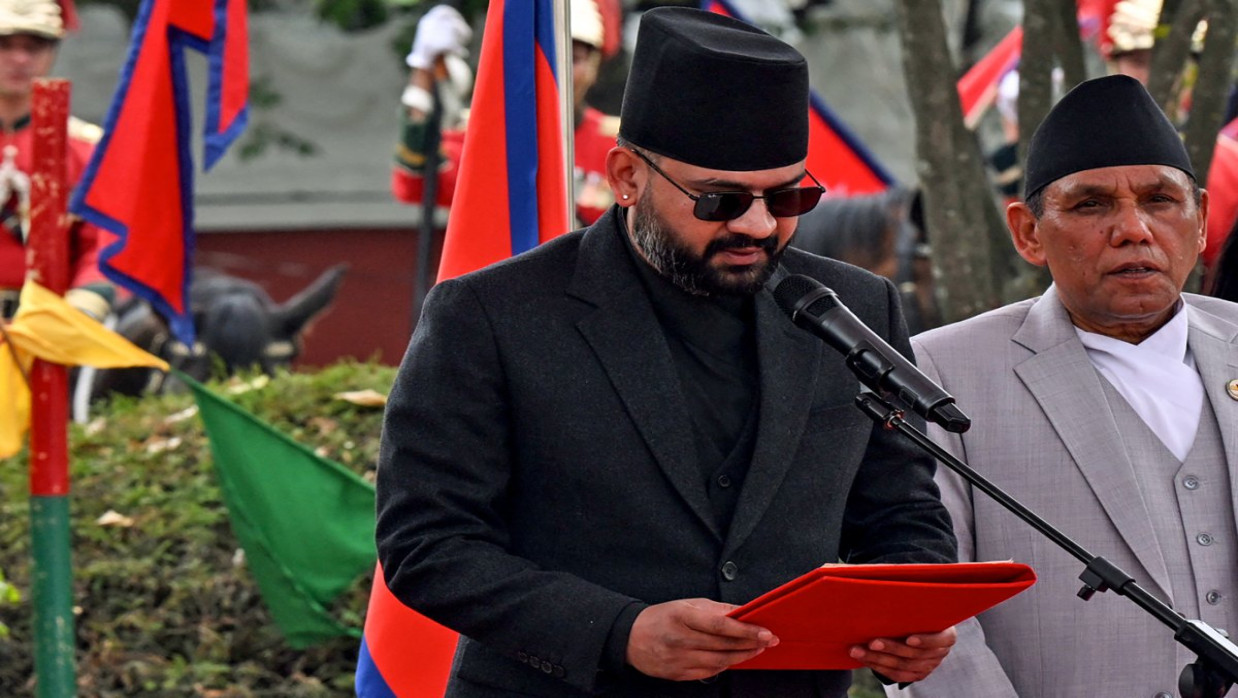
Prime Minister Balendra Shah was sworn into office on March 27, and Nepal's transition into a new political era is now underway. The head of the anti-establishment party that rose to power through mass student-led protests last September and won last month's election by a landslide, Shah is bringing swift changes to the government. Eliminating corruption, promoting accountability, and driving administrative change have become priorities in Nepal's capital.
Within days of assuming office, the Shah administration initiated legal proceedings against several prominent political figures, including former Prime Minister K.P. Sharma Oli and former Home Minister Ramesh Lekhak. Their arrests, linked to a report documenting the previous government's crackdown on protesters, mark a rare and dramatic departure from Nepal's long-standing tradition of elite impunity. Soon afterward, former Kathmandu Chief District Officer Chhabilal Rijal was also detained. In contrast, investigations into alleged financial irregularities involving other former prime ministers, Sher Bahadur Deuba and Pushpa Kamal Dahal, were intensified.
The decisions mark a departure from political tradition. Political leaders in Nepal have for years been considered above reproach, even as corruption scandals have dogged their administrations. Nepal's anti-corruption bodies had only begun filing charges against top officials in recent years. Shah's actions were both expeditious then and meant to set a new standard for accountability in the country.
Yet the government's rapid offensive carries inherent risks. Nepal's post-monarchical political system, established after 2008 and rooted in the democratic transition of the early 1990s, has long depended on fragile alliances among competing elite factions. By targeting senior figures across party lines, the Shah administration risks provoking resistance from networks that still wield influence within political parties, security institutions, and the bureaucracy.
Signs of institutional pushback have already appeared. Nepal's Supreme Court requested written clarification regarding the arrests of Oli and Lekhak, signaling judicial scrutiny of the government's actions. Meanwhile, small but noticeable protests by supporters of detained leaders suggest that political polarization could deepen if investigations continue to expand. The Home Ministry, now led by Sudan Gurung, a former protest organizer critical of Nepal's security establishment, may become a particularly sensitive arena as reform efforts intersect with institutional interests.
Still, the government wants to press forward. One of the pillars of its recently launched 100-point plan to strengthen governance is the probe into the assets of all those who have been in power since 1991. This could be a strong step toward accountability for years of misrule. It will also likely play well with young voters, who came out in droves for Shah and are hungry for change.
The new government also has time and a mandate on its side. Unlike many of its transitional counterparts in South Asia, helmed by weak coalitions that either lack a full mandate or are restrained by upcoming elections, Shah's administration has the political space to right the wrongs that its predecessors were reluctant to address.
Nepal's past should temper expectations. Fewer than three dozen governments have been formed in Nepal since the country reinstated parliamentary democracy in 1990. Reformist administrations have often fallen short of high public expectations amidst Nepal’s fractured coalition politics and institutional pressures. Push too hard, too fast, and Nepal’s well-funded opposition parties could coalesce to block investigations.
So, for Shah, the question may not be whether he will move forward with reform, but rather at what pace. Move too slowly, and momentum for change will lose the strong public support that’s been buoyed by years of impunity. Move too quickly and special interests within Nepal’s political infrastructure could kill his reform efforts.
A balanced approach that is both pragmatic and grounded in principle may be Shah’s best bet: carefully sequencing reforms, bolstering institutional autonomy, and securing buy-in from opposition parties could embolden Kathmandu to take on wrongdoers and help Nepal avoid slipping back into political chaos. Nepal’s young democracy has a chance to prove itself. There’s an opportunity for the Shah administration to take positive first steps that place Nepal on a path of transparent governance and long-overdue reforms. But chances of remaining favorable forever are unlikely, and Nepal could quickly find itself mired in the same brand of political retribution it hopes to leave behind. Only time will tell if there is a happy medium.


0 Comments
LEAVE A COMMENT
Your email address will not be published