

John Dayal
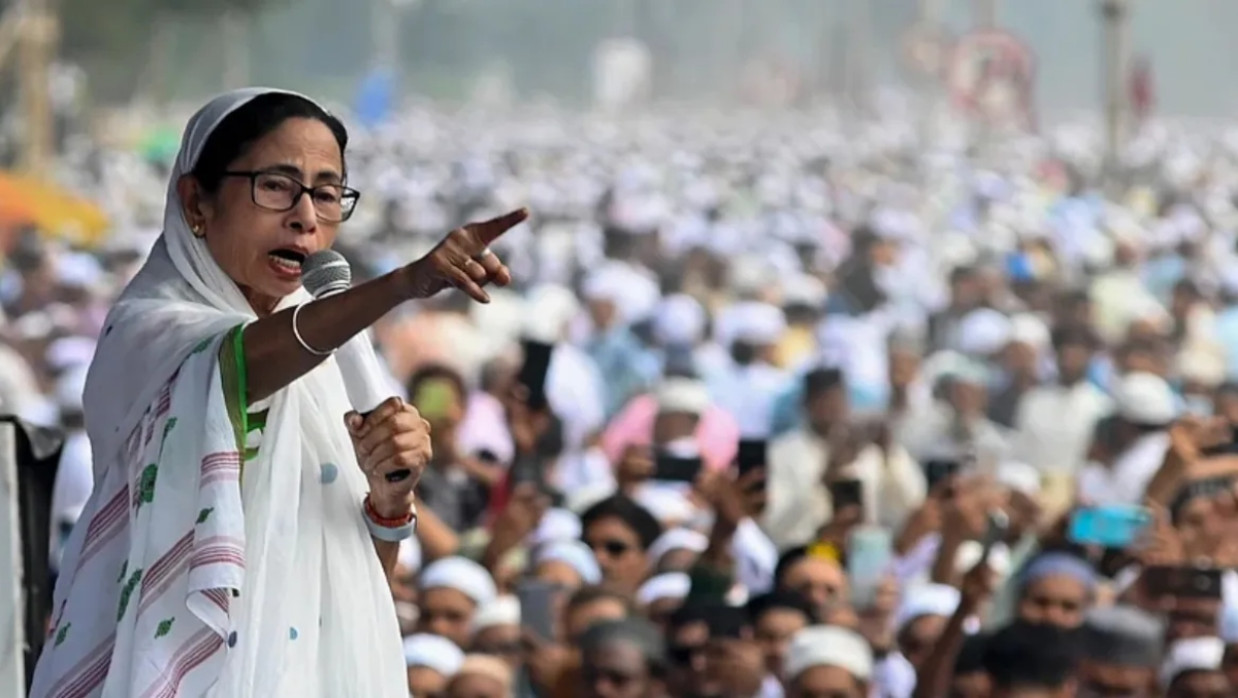
There is something almost heroic in Mamata Banerjee’s lonesome stand as she pitches for a fourth term as chief minister of West Bengal in the state assembly elections, scheduled in two phases on April 23 and 29, with results due on May 4.
With the Bharatiya Janata Party (BJP) nipping at her heels, and the Marxists and Congress baying for her blood a little distant behind, Banerjee has forged the contest into an unprecedented institutional and constitutional crisis.
Mid-April opinion polls project her Trinamool Congress (TMC) party retaining power with a reduced majority — estimates range from 155–194 seats — while the BJP could pass 100 seats and establish itself as a permanent pole without securing a majority. The Left and Congress may scrape 10–20 seats combined.
The closeness of the political challenge has seen Banerjee advocate her own cause in a path-breaking personal pleading in the Supreme Court, and return invective and abuse back to Prime Minister Narendra Modi and Union Home Minister Amit Shah in rallies and road shows.
But most of all, she bravely struggles to shake off Chief Election Commissioner Gyanesh Kumar, who seems to have his teeth in her jugular.
At its center lies the Election Commission of India’s Special Intensive Revision (SIR) of electoral rolls, which has removed nearly 9.1 million names — approximately 12 percent of the state’s original 76.6 million electorate.
An additional six million voters faced adjudication, resulting in roughly 2.7 million further exclusions after scrutiny. The rolls were frozen on April 9, preventing any readmission of deleted names of voters for these polls.
This number of votes may mean victory or defeat for the main contenders, and Banerjee has therefore portrayed the SIR as a calculated “voter-purge conspiracy” orchestrated to disenfranchise minority and TMC-leaning voters.
There is no let-up in the party’s unrelenting legal campaign, including Banerjee’s rare personal appearance in the Supreme Court, while mobilizing its grassroots network to frame the election as a defense of West Bengal’s democratic identity against central overreach.
The BJP, supported by the Modi government, defends the revision as an essential cleansing of “bogus votes,” “infiltrators,” and duplicates.
Together with the anti-Muslim dog-whistle, the BJP also campaigns under the emotive “Sonar Bangla” (Golden Bangla) banner, promising enhanced welfare, development, and governance reform.
The Supreme Court has allegedly been a bad referee, imposing procedural safeguards without curtailing the Election Commission’s core powers.
With polling days now imminent, the old parties which held sway since Independence, the Left Front and Congress, remain marginalized. Both have lost their cadres to the TMC, and recently also to the BJP.
The stakes reach well beyond the 294 Assembly seats. A TMC victory despite the deletions would reaffirm Bengali exceptionalism and strengthen the opposition INDIA bloc nationally.
A significant BJP advance could accelerate saffron consolidation in eastern India and reshape 2029 Lok Sabha calculations.
For independent political observers, the election tests the balance between electoral integrity, federal autonomy, and the constitutional right to vote, and how freely marginalized communities, mainly Muslims, can participate in a deeply polarized democracy.
The SIR was launched in late 2025 to purify electoral rolls by identifying over 15 million entries with “logical discrepancies” or unmapped status, and has allegedly morphed into a hint for Muslim voters of the TMC.
Voters were required to submit fresh proof of citizenship, age, and residency — often repeatedly — causing widespread confusion, long queues, and genuine hardship.
Hindus account for about 63 percent and Muslims 34 percent of deletions, but proportionally, however, the impact is heavier in Muslim-concentrated areas. In Nandigram, where Muslims form roughly 25 percent of the electorate, they represent 95 percent of deletions in supplementary lists.
Highest adjudicated exclusions occurred in Muslim-dominant Murshidabad, followed by North 24 Parganas and Malda.
The Supreme Court has upheld the Election Commission’s “widest discretion” under Article 324 for intensive revisions, including deviation from standard documents when justified.
Banerjee and her nephew and political heir, Abhishek Banerjee, have depicted the SIR as an existential assault.
The Trinamool Congress will contest 291 seats, ceding three in the Darjeeling Hills. She is fielding 52 women and 95 Scheduled Caste or Dalit and Scheduled Tribe or tribal candidates.
In TMC’s reckoning, Bannerjee’s personal charisma gives her a definite edge in 226 seats. She has the benefit of unmatched organizational depth and a narrative of Bengali pride against central interference, standing up to imperial New Delhi.
Bannerjee has had a pragmatic yet fiercely independent political career. A former Congress leader and a street fighter of the Youth Congress in her student days, she founded the TMC in 1998.
In 1999, she joined the BJP-led federal government under Prime Minister Atal Bihari Vajpayee, serving as Union Railway Minister (1999–2001) and briefly as Coal and Mines Minister (2004).
She maintained a cordial personal rapport with Vajpayee, who valued allies and once supported her politically. She has never entered a formal, sustained coalition with Congress in West Bengal, consistently prioritising TMC autonomy.
Even within the INDIA bloc, relations remain fraught; Mamata has rebuffed seat-sharing proposals in the state while participating selectively at the national level.
A recent pre-poll trip through West Bengal shows her solid hold over Muslim voters, disillusioned or opportunistic former Marxist cadres, and a broad appeal to Bengali identity that transcends traditional divides.
This independence bolsters her current “lone warrior” image: fighting institutional pressures without reliance on national partners.
The BJP’s 15-point manifesto promises 3,000 rupees (US$32.08) monthly women’s assistance, doubling TMC’s offering. The party is also voicing its pro-Hindu rhetoric with the promise of a Uniform Civil Code to contain the growth of the Muslim population, and new national institutes of medical sciences and technology.
Party leaders pin hopes on winning as many as 170 seats.
The Left Front and Congress’ combined vote share has collapsed in recent cycles; they are likely limited to single-digit seats at best, their marginalization underscoring Bengal’s bipolar consolidation.
Campaign violence continues, alongside civil society campaigns and regional divides: North Bengal shows development aspirations favoring the BJP, while South Bengal’s minority belts remain TMC strongholds despite deletions.
In 44 constituencies, deleted voters outnumber 2021 winning margins, heightening stakes.
Observers fear that deletions risk suppressing turnout or shifting outcomes in vulnerable seats, compounded by anti-incumbency factors. Yet TMC advantages persist. Recent events have galvanized the victimhood narrative and may trigger a backlash turnout.
A TMC victory would mean far more than retaining office. For Banerjee, it would cement her legacy as Bengal’s indomitable defender of federalism and democratic exceptionalism, validating her strategy of defiant independence.
Nationally, it would energize the INDIA bloc, demonstrating regional resilience against central dominance and reinforcing that strong state parties need not subordinate themselves in alliances.
Defeat, even without an outright BJP majority, would prove costly.
For Banerjee, after more than 15 years in power, it might accelerate personal marginalization amid health concerns and internal fissures.
For West Bengal, this election transcends mere seat counts. It probes whether democratic exceptionalism can withstand institutional headwinds.
The article appeared in the ucanews

0 Comments
LEAVE A COMMENT
Your email address will not be published