

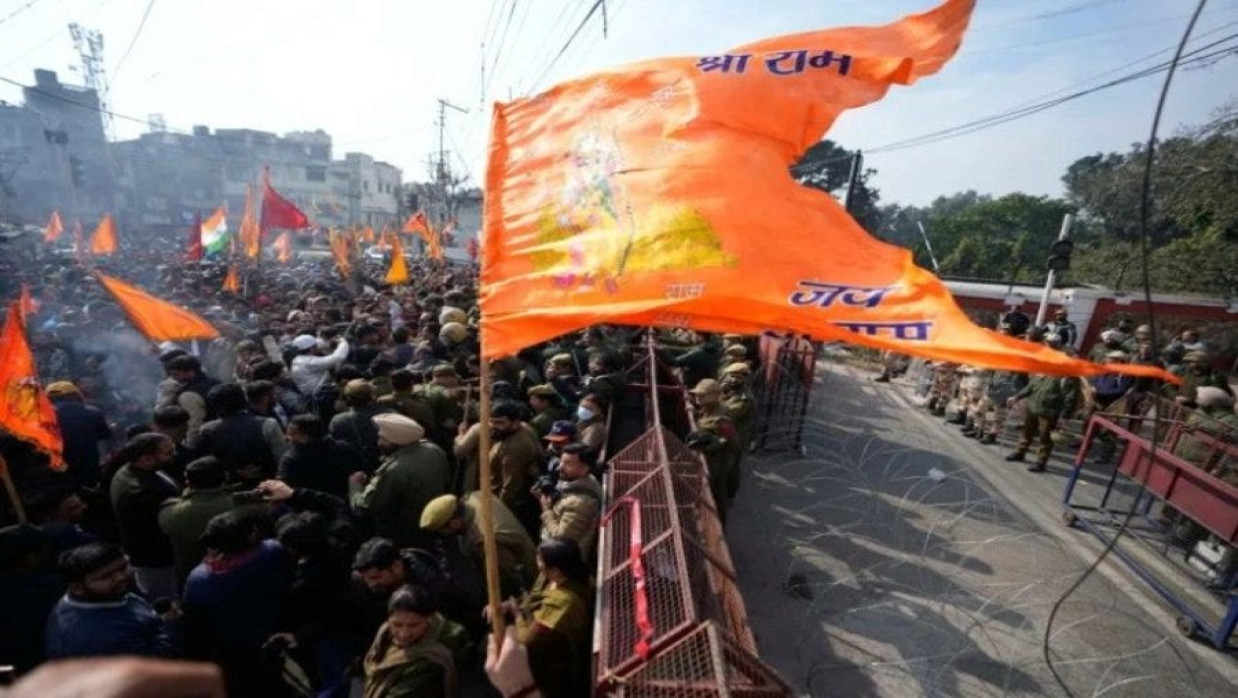
Hindutva politics is not an Indian ideology but a project of crony capitalism that derives its totalitarian ideological inspiration from European fascism and Nazism, which later manifested in America in the form of planned capitalism. The Hindutva political project in India emerged to weaken the anti-colonial struggle, with patronage from British colonialism, which followed a policy of divide and rule. This British colonial policy was politically supported by Hindutva fundamentalists, Muslim fundamentalists, and feudal landed ruling elites, which ultimately led to the partition of India and the creation of Pakistan. The enduring wounds of communal partition of Indian subcontinent contributed significantly to the growth of Hindutva politics in postcolonial India.
Hindutva politics and its ideological narratives were popularised by the unregistered organisation called the Rashtriya Swayamsevak Sangh (RSS; 'National Volunteer Organisation'), which defined itself as a patriotic, nationalist, and cultural organisation but in reality did not participate in the Indian freedom struggle. It betrayed the idea of an independent and united India by siding with the British to create a Hindu nation and opposed India’s cultural and linguistic diversity by promoting the ideology of Hindu, Hindi, and Hindustan.
Such a monolithic Hindutva project gained momentum with the rise of neoliberal globalisation, which marginalised the masses. Hindutva mobilised popular discontent against neoliberal globalisation by promising nationalist economic policies. However, when Hindutva came to power during the Prime Minister Mr Vajpayee era and in the current era under Prime Minister Mr. Modi, Indians witnessed overt forms of crony capitalism in the name of development and economic modernisation. Today, the Modi government functions as a single-window system for both national and international capitalist forces by creating conditions and policies that promote economic totalitarianism at the expense of people and the planet in India.
The national capitalist classes have consolidated their economic base, while international capitalist classes from the United States, the European Union, and the United Kingdom have entered India through various trade agreements. This process is once again poised to drain Indian wealth, skills, knowledge, and human and natural resources in order to further consolidate and deepen their economic base in the country.
Therefore, Hindutva politics and its economic project are not merely an ugly, monolithic and Eurocentric form ethnic politics of the colonial divide-and-rule policy invoked in the name of Hindus, Muslims, other minority communities, and castes, but also an economic project of corporate totalitarianism. The last two decades of Hindutva politics and the economic rise and consolidation of corporations such as Reliance and Adani demonstrate Hindutva’s allegiance to crony capitalism. This system is led by such corporations and supported by the Hindutva government under Mr. Modi, who admires minimal government and the economic ethos of European and American models of various forms of planned capitalism—models that have been discredited and have failed despite centuries of dominance.
Just as historic figures such as the racist British Prime Minister Winston Churchill, the American ambassador to Italy Richard Washburn Child, U.S. Congressman Sol Bloom (Chairman of the House Foreign Relations Committee), and British intellectuals like George Bernard Shaw defended Mussolini, many illiberal American, British, and European intellectuals and ruling elites today portray Hindutva politics and its economic project as a modernising force in India. This narrative aligns with the economic interests are concommitant with global corporations, which are now closely intertwined with Hindutva politics.
Such a project is neither in the interests of India nor in the interests of Indians. The Hindutva political project weakens both the nation and its people by prioritising the interests of capitalist classes at the expense of working people. Hindutva politics seeks to establish an absolute majoritarian state in order to dismantle the Indian Constitution, weaken democracy, and undermine citizenship, thereby building a corporate state in the name of Indian nationalism and patriotism—values that Hindutva continues to undermine in practice.
Hindutva politics is a corporate project rooted in a hierarchical Brahminical social and economic order that has widened wealth inequalities and continues to marginalise the working masses. It has little to do with India, the Indian people, or their interests and well-being. Hindutva politics and its government operate in close harmony with corporate forces, functioning as coordinators of capitalism and its forms of economic totalitarianism. Like many governments, Hindutva government are structured to facilitate and protect the interests of capital by criminalising mass dissent as a law-and-order issue, thereby framing resistance to authoritarian Hindutva politics and economic governance as anti-national in the name of public safety and national unity.
Hindutva is not a modernising force in politics, society, culture, or the economy. The BJP, the organised political force behind Hindutva, uses Gandhian socialism in its party constitution, yet it undermined Gandhi, killed him and his politics by practicing violence against Muslims, religious minorities, rationalists, secularists, and socialists. While the BJP speaks of a nationalist economy, it pursues policies aligned with the imperatives of capitalism. Hindutva politics claims to champion cultural nationalism and national unity, yet it undermines both by practicing divisive politics of “othering” in India. It advocates nationalist education policies but weakens Indian universities and the broader educational system by inviting corporate British, American, and Australian universities to operate their outsourced certificate programs in India. These contradictions in Hindutva politics are not accidental; they are a deliberate implementation of planned capitalism in India, designed to divert attention away from the people and their needs.
Hindutva collaborators of British colonialism have become capitalist collaborators today. The Hindutva government acts as a “socialist” government for corporations such as Reliance and Adani, while remaining ruthlessly authoritarian toward the working people of India. Hindutva politics is fundamentally opposed to the secular, liberal, democratic, and scientific ethos of the Indian Constitution, and is therefore fundamentally against the people and their citizenship rights. In its historical patterns, Hindutva resembles Italian, German, British, and American fascism, but it is far more dynamic and systematic in its authoritarian praxis.
The Hindutva government, its organisational machineries led by the RSS, mass media, and illiberal or opportunist academic apologists are highly skilled at generating propaganda in defense of the Hindutva project, making many Indians believe it is a modernising force for a developed India. However, most people remain unaware of the threats that Hindutva politics poses to India and its citizens in both short run and long run. Therefore, defeating Hindutva is central to the survival of the idea of India and the protection of the interests of its people. Hindutva offers nothing constructive to Indian nationalism and is not a patriotic force working in the interest of India or its citizens. It is never too late to understand, analyse, and resist Hindutva fascism and its undemocratic social, cultural, political, and economic projects—for the sake of India and its people.


0 Comments
LEAVE A COMMENT
Your email address will not be published