

Anti-colonial, anti-imperialist, anti-apartheid, and anti-racist foundations of the Indian freedom struggle laid the foundations of the foreign policy and international relations of post-colonial India. Only fifteen months after Indian independence, on 25 November 1948, Article 40 of the Draft Constitution of India (1948) adopted the principle that “the State shall promote international peace and security by the prescription of open, just and honourable relations between nations, by the firm establishment of the understandings of international law as the actual rule of conduct among governments, and by the maintenance of justice and respect for treaty obligations in the dealings of organised peoples with one another.” This draft article was later incorporated and enacted on 26th of January 1950 as Article 51 in Part IV—Directive Principles of State Policy of the Constitution of India, which directs the Indian state to pursue foreign policy to achieve the ideals in which “the State shall endeavour to— (a) promote international peace and security; (b) maintain just and honourable relations between nations; (c) foster respect for international law and treaty obligations in the dealings of organised peoples with one another; and (d) encourage settlement of international disputes by arbitration.”. These constitutional provisions provide the moral foundation of Indian foreign policy.
Unlike the Westphalian colonial, imperialist, and racialised capitalist nation-states of Europe and the United States, Indian foreign policy is not governed by self-centered and ficticiaous national interests sans the interests of people but by the principles of international peace, security, law, and justice. These principles provided direction to many post-colonial states in Asia, Africa, and Latin America to incorporate similar ideals into the praxis of their foreign policies. The moral fabric of Indian foreign policy has thus influenced the principles governing international relations in many post-colonial countries. India provided moral leadership to the world when the first Prime Minister of India, Jawaharlal Nehru, articulated the Five Principles of Peaceful Coexistence, known as Panchsheel: (i) mutual respect for each other’s territorial integrity and sovereignty; (ii) mutual non-aggression; (iii) mutual non-interference in each other’s internal affairs; (iv) equality and mutual benefit; and (v) peaceful coexistence. These principles were first signed by India and China and were later adopted as core principles of the Non-Aligned Movement (NAM). They were further deepened in the Bandung Declaration adopted at the Afro-Asian Conference held in Indonesia in 1955. In this way, these values and principles not only guided the foreign policy of India but also influenced the foreign relations of more than 120 countries under India’s moral leadership.
The Non-Aligned Movement (NAM) was not merely about maintaining an independent foreign policy or refusing to take sides. It was about taking the side of justice, equality, and freedom at a time when a bipolar world order was imposed upon the world during the Cold War period. NAM emerged as a collective and internationaist force that sought to shape international politics in favour of world peace and actively opposed the war-mongering policies of colonial, racist, and imperialist powers in Western Europe and the United States.
India, under its first Prime Minister Jawaharlal Nehru, demonstrated this principled and moral position by condemning the USSR’s Operation Whirlwind, which led to the invasion of Hungary, without any hesitation, even while maintaining strong and friendly relations with the Soviet Union. Such clarity and independence in India’s position during 1956 gave the country an extraordinary stature as a moral leader of post-colonial states and an uncompromising advocate of world peace.
India stood with Africa during its struggle against European colonialism and racist apartheid regime. Indian stood with Latin America in its struggle against American imperialism. India also stood with the Jewish people during the Nazi persecution of Jews in Europe. It provided refuge to Jewish communities, including those known as the “Tehran Children,” in India during 1943. At the same time, India was among the first countries to recognise the State of Israel while opposing Zionist politics that led to the occupation of Palestinian land. India strongly supported the Palestinian struggle and their right to statehood, advocating a two-state solution to the Israeli–Palestinian conflict. India also stood with Arab countries in their fight against colonialism and feudalism. Indian, African, and Arab nationalist movements and states worked together to build the Non-Aligned Movement as a moral force for world peace.
These historical legacies of Indian foreign policy were first diluted by the Congress Party and its successive governments when they adopted neoliberal economic policies to pursue a free-market economy and formed economic and political alliances with Western European countries and the United States. American foreign policy, particularly through its Global War on Terror, gradually incorporated India into its strategic framework. The Indo–US nuclear deal, led by the Congress Party government, further strengthened Indo–US relations and softened earlier tensions and anti-India positions within American foreign policy. This growing Indo–US relationship, along with the War on Terror framework, also reinforced the existing ties between India and Israel and diluted India’s earlier position in strong support of Palestinian struggles for independence.
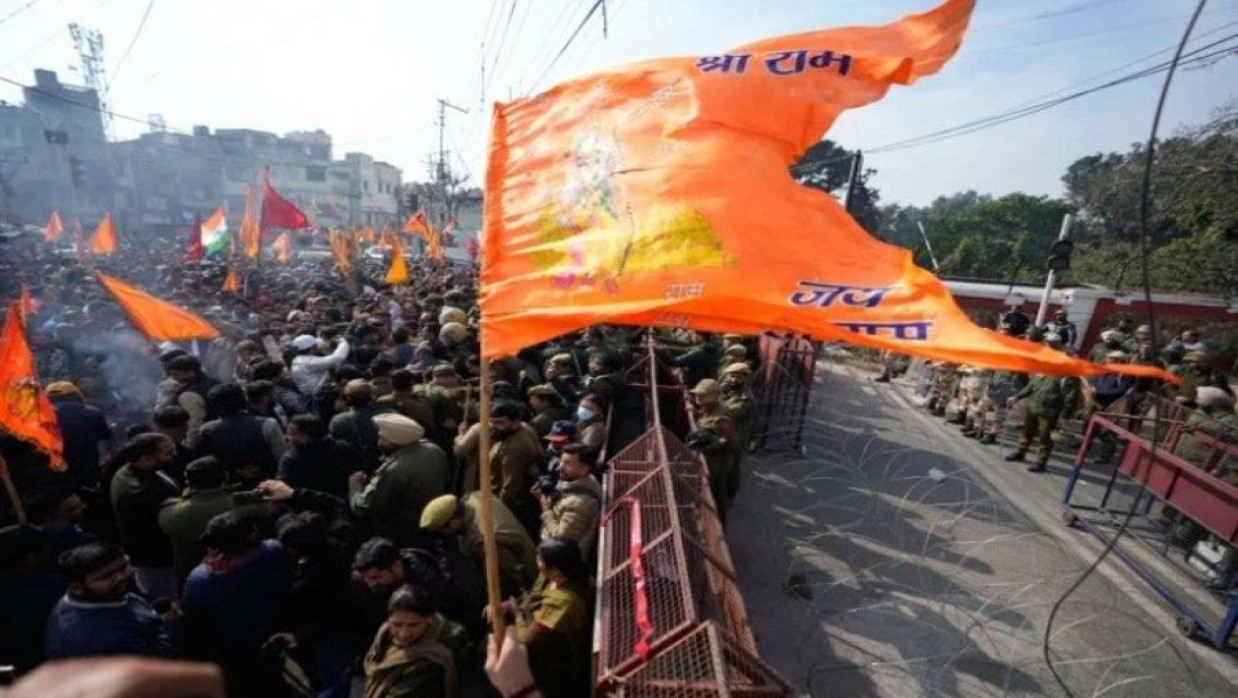
The ideological foundations and historical legacies of Indian foreign policy were further diluted by the first BJP government led by Prime Minister Atal Bihari Vajpayee and later by the BJP government of Prime Minister Narendra Modi, which has been steadily dismantling the foundations of Indian foreign policy brick by brick. Hindutva, Zionist, colonial racist, and imperialist ideologies share significant similarities in their orientations, particularly in their grounding in supremacist ideas of puritan ethno-nationalism in the service of crony capitalism. These ideological convergences bring leaders such as Narendra Modi, Donald Trump, and Benjamin Netanyahu into close alignment. These three leaders are undermining the historical and ideological foundations of multicultural societies in Israel, India, and the United States. Rather than working for the interests of the American, Jewish, Israeli, and Indian peoples and their countries, their political orientations advance projects of imperial domination in pursuit of unfettered capitalism.
India, under Hindutva politics and the government led by Prime Minister Narendra Modi, has weakened India’s political and economic independence, as well as the moral ethos and constitutional foundations of its foreign policy. This has adversely affected India’s foreign relations and diminished its position in world affairs as a moral force for world peace. Prime Minister Narendra Modi has shown little moral or political resolve in opposing the Israeli war that has devastated the Palestinian people, undermining peace and stability in the Middle East, the Arab world, and West Asia. He has also failed to condemn American and Israeli attacks on Iranian targets, including schools and civilian areas, which have reportedly resulted in the deaths of schoolchildren, women, and unarmed civilians in the streets of Tehran. Such silence risks isolating India and weakening its long-standing historic and uncompromised reputation as a resilient moral force for world peace on the international stage.
Hindutva politics and its alliances with Zionist and imperialist forces are primarily about upholding the interests of crony capitalism in the name of national interests. This reactionary alliance has harmed lives and livelihoods, damaged the environment, and undermined world peace. The hollowness of Hindutva foreign policy, and its reactionary propaganda hidden behind the rhetoric of Indian nationalism, is now increasingly evident. The Hindutva government under Narendra Modi has failed to uphold the interests of the Indian people, the nation, and world peace. By forming such alliances and abandoning the internationalist ethos that historically guided Indian foreign policy, it has pursued a directionless strategy of so-called “multi-alignment.” This approach threatens India’s historic relationships and friendships with Russia and with countries across Africa, Asia, the Middle East, the Arab world, and Latin America.
Indians must defeat Hindutva in order to oppose Zionist imperialism and its system of racial capitalism, while resetting India’s foreign policy, foreign relations, and international friendships based on peace and solidarity. This would help re-establish the moral, internationalist and constitutional ethos of Indian foreign policy and its independence in the pursuit of world peace and opposition to all wars.


0 Comments
LEAVE A COMMENT
Your email address will not be published