

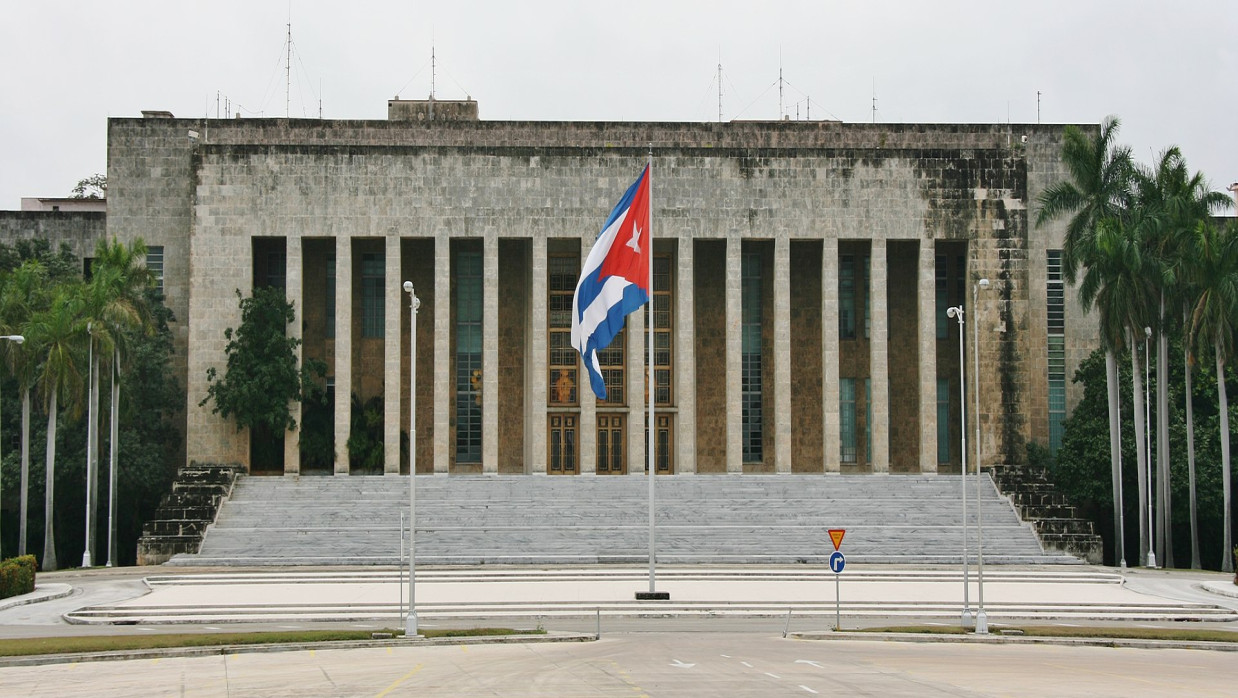
The morning of my departure from José Martí Airport, named after the father of the nation, I hugged everybody: the woman who checked me in, the man who stamped my passport, the ground staff. I had hugged all my friends tightly the previous day, my tears fighting for the right to stream down my face. It felt as though, through these hugs, I wanted to somehow transmit my trepidation about what could possibly happen to Cuba, the Cubans, the Cuban Revolution – all of it – because of the madness of Donald Trump.
**
What has the world become? It is as if billions of people have become bystanders of the atrocities imposed by the United States and Israel: the genocide of the Palestinian people, the kidnapping of the Venezuelan president, the pummeling of Iran without cause, and of course, the attempt to asphyxiate Cuba. The decadent brutality of the US government, sharpened by the foolhardiness of Trump, is unpredictable and dangerous. No one can accurately say what comes next. Trump seems trapped in Iran, where he did not anticipate the political wisdom of the Iranians in refusing a ceasefire now, only for the US and Israel to rearm and destroy their cities with greater ferocity in a week. Trump cannot seem to bring the war in Ukraine or the genocide against the Palestinians to a halt. Trump’s ally, Israel, has once again widened its war to Lebanon and thus threatens to shake up the streets of the Arab world, where there is already disquiet at their utterly pliant governments. Will he strike Cuba next, thinking it will be a quick victory?
It is hard for me to describe the impact of Trump’s cruel Oil Embargo to Cuba. There has been no shipment of refined oil to Cuba since early December 2025. This means that every part of modern life has been utterly disrupted. The roads of Havana are quiet because there is simply not enough fuel for cars and buses to take people around. Schools and hospitals—the temples of revolutionary Cuba—struggle to maintain basic services. Farmers struggle to bring food into the cities, and medicines are expensive, if they are available. Imagine being a patient who needs to have neurosurgery, with doctors simply unwilling to risk putting a probe into your brain amid electricity fluctuations and rolling blackouts. This was the starkest example of the dangers of the Trump Oil Blockade that I heard during my time in Havana. As I walked around the Malecon, I saw a few horse-drawn carts go by. It is almost as if the yanqui wants to punish the Cuban Revolution and thrust ten million Cuban citizens into the Iron Age.
**
I came to Cuba as part of a delegation of solidarity from the International Peoples Assembly, a platform of hundreds of organizations from around the world that are trying to reestablish movement-to-movement internationalism. Our delegation was led by João Pedro Stedile (national direction of the Brazilian Landless Workers Movement), and included Fred M’membe (President of the Socialist Party of Zambia and the opposition’s candidate for president this year), Brian Becker (one of the leaders of the Party for Socialism and Liberation in the United States), Manolo De Los Santos (director of The People’s Forum), Giuliano Granato (one of the leaders of Potere al Popolo from Italy) as well as Manuel Bertoldi and Laura Capote (coordinators of the ALBA Movements). We visited many places, including the Latin American School of Medicine, the Institute of Neurology, the Martin Luther King Centre and Casa De Las Americas. We met with the Central Committee of the Communist Party of Cuba and the President of Cuba, as well as countless ordinary Cubans. We went to the main cemetery in Havana to pay homage to the thirty-two Cubans who lost their life defending Venezuelan sovereignty, and we walked around the city of Havana to meet people who were going about their everyday lives.
During one of the conversations, a friend asked how I found Cuba, a place I have visited countless times over the past thirty years. I said that I found the situation difficult but that the people seemed irrepressible. My friend was clear: the prevailing sensibility in the country was that the Cubans would fight to the very end to defend their right to a future and their refusal to return to 1958, the year before the Revolution.
During the early years of the Revolution, Fidel Castro made it clear that the urgency was to solve the people’s immediate needs and problems. This meant that the Cuban Revolution placed its emphasis on ending hunger and poverty, illiteracy and ill health, as well as providing housing and cultural spaces. To see the deterioration of life because of the harsh, nearly seventy-year Embargo and the new Oil Blockade is heartbreaking. The priority remains to ensure that every Cuban can live a life of dignity. This was the message as well from the President of Cuba, Miguel Diaz Canel, a man of great humility: we will resist, he said, but we will not permit the Revolution to squander its gains and its emphasis on the well-being of our people.
Sitting on a rocking chair beside my friend Abel Prieto, a former Minister of Culture, in Casa De Las Americas, was a tonic. As usual, Abel, my fellow Marxist-Lennonist (!), made me laugh aloud and at the same time feel sorrow. His comments ranged from an assessment of Trump (with “madness” being the word most often used) to his sense of the vitality of Cuban reality (the remarkable crowds that stood in pouring rain to pay homage to the remains of the Cubans killed by the US forces in Venezuela on 3 January). I felt comforted by his balance between humor and clarity, Abel’s literary sensibility in control of the fast-moving situation.
I accepted Abel’s view that perhaps the United States in its current form is a gigantic mistake– the arrogance of Trump a reflection of something inherent in the extreme idealism that the United States and its administrations know better than anyone else. They believe they know better what should be done to the Palestinians, the Venezuelans, the Iranians, and the Cubans. In the name of “democracy,” the democratic rights and existential rights of the people in these darker nations are utterly absorbed by the US President—the holder of preponderant power. It is an ugly vision but a real one, a reality that rips sensitive people around the world away from their own desire to shape a reality that is not so hideous. A third of the people killed in Iran by the United States and Israel are children, and the children of Palestine, whose names we honor, will never become adults.
**
On my last day, I saw a group of Cuban schoolchildren playing in a park, dressed in their school uniforms, their revolutionary scarves around their necks. They were chirping with laughter and chatter. I watched them from across the road playing a game, supervised by two smiling teachers, with some cones on the ground– a game that required them to weave between them. These children must have been about five or six, boys and girls who played in a cocoon of great happiness. I sent them a virtual hug. Be safe children. Aways. Hug Cuba for me every day.


0 Comments
LEAVE A COMMENT
Your email address will not be published