

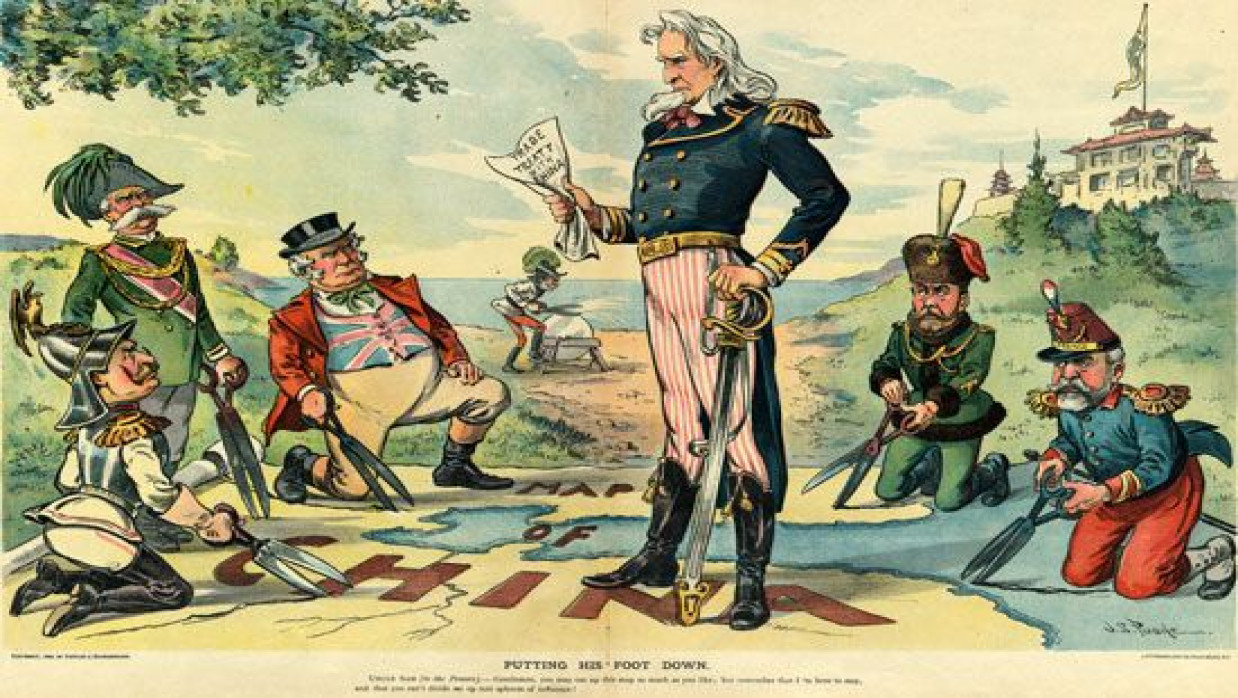
The international order is transforming as consequential as the collapse of the European colonial empires or the end of the Cold War. The political, military, and financial institutions created under Western leadership after the Second World War remain powerful, but the economic foundations of Western primacy are weakening. China has become an industrial and technological giant, India is expanding its global influence, and countries across the Global South are demanding a greater voice in determining the rules of international affairs.
These changes cannot be understood solely through the conventional language of rivalry among nation-states. They must also be examined through the evolution of capitalism, the influence of multinational corporations, the persistence of military power and the retreat of welfare-oriented politics. The concept of "hyperimperialism," advanced by Marxist historian and journalist Vijay Prashad and his colleagues, offers one framework for interpreting this increasingly unequal and militarized global system.
At the same time, the rise of right-wing populism demonstrates that the crisis is not merely international. It is also a domestic crisis of economic insecurity, democratic legitimacy and social dignity. Unless progressive political forces return to the fundamental questions of employment, housing, food, healthcare and human security, the political right will continue to exploit the anxieties created by neoliberal capitalism.
From Imperialism to Hyperimperialism
Russian revolutionary Vladimir Lenin wrote one of the first theories of imperialism in the early twentieth century. Lenin saw imperialism as competition between capitalist nations for control of the world. European powers controlled colonies, protected their own national businesses from competition, and used military force to gain territory and resources for markets. Imperial rivalry contributed to the First World War.
Capitalism has since undergone a profound transformation. Production, finance and ownership now extend across national frontiers. Giant investment companies, banks, technology conglomerates and multinational manufacturers possess assets larger than the economies of many sovereign countries. Their decisions can determine where factories are built, which communities obtain employment and which governments gain access to capital.
Hyperimperialism describes the fusion of this transnational corporate power with the military, diplomatic and financial architecture of the United States and its principal allies. It does not suggest that governments have disappeared. Rather, powerful states protect and facilitate an international system in which capital moves freely while workers, migrants and poorer nations remain constrained.
The Bretton Woods institutions of the postwar era the I.M.F. and the World Bank were couched as institutions of monetary stability and reconstruction. NATO served as the military baseline for the Western alliance. Later on, the WTO would help establish rules-based trade internationally. Each of these institutions served necessary global functions. But they also mirrored global power dynamics at the time of their inception. The I.M.F. still operates with voting power weighted heavily by financial allotments, as opposed to one nation per vote. Reform has led to a small shift of representation towards developing nations, but even the I.M.F. recognizes that this structure will need to continue evolving with the global economy. And there's the long-standing tradition of a European managing director of the I.M.F. and an American running the World Bank, which some argue reinforces Western privilege while masquerading as international institutions. On its website, the I.M.F. describes how national quotas dictate voting power.
The Neoliberal Consolidation
The dissolution of the Soviet Union in 1991 removed the most powerful geopolitical counterweight to Western capitalism. Many Western intellectuals interpreted the moment as the final triumph of liberal democracy and market economics—the celebrated “end of history.” Instead of viewing the Soviet collapse as the beginning of a new and uncertain international era, Western policymakers often assumed that all societies would eventually embrace their preferred political and economic model.
This involved privatization, deregulation, austerity, and free capital movement. Conditions from international lenders frequently included subsidy reductions, privatizations of public services, cutting social spending, and opening up markets to foreign corporations. Efficiency and investment increased as public goods were stripped away. Growing inequality was common as the poorest became more vulnerable.
Nor did this Western-led brand of globalization bring about a new age of peace. NATO bombed Yugoslavia in 1999, the United States invaded Iraq in 2003, and Western countries intervened in Libya in 2011. Each campaign had different rationales, but they had several consequences in common: political fracturing, years of instability, civilian casualties, millions displaced from their homes, refugee crises, and rising anti-Western sentiment.
Military interventions also took a heavy toll on the concept of humanitarian intervention itself. The war in Iraq undermined the doctrine more than any other episode because it was launched without a second UN Security Council resolution clearly authorizing the use of force. Libya demonstrated another pitfall: the removal of a government without a viable plan for political stabilization can turn an intervention meant to protect human rights into a generator of perpetual disorder. Episodes like these made a mockery of Western assertions that they always stood on the right side of sovereignty, international law, democracy, and human rights.
Today, we see something similar playing out with Iran. The United States has attacked Iranian forces in the hopes that military action will intimidate the Iranian government into conforming to an order more agreeable to Washington and Tel Aviv. Iran, however, surges as a regional power that undermines both American hegemony and Israel’s qualitative military edge in the region. Furthermore, Israel’s occupation of Palestinian lands and refusal to allow for Palestinian self-determination highlight the hypocrisy of the West’s professed principles.
The United States and its allies have become so accustomed to using military and economic power to force other nations into submission that power has increasingly displaced conscience. The standards governing the so-called rules-based international order are repeatedly altered to preserve Western advantage. Developing countries may attempt to follow international expectations, liberalize their economies, or cooperate with Western institutions, yet the conditions continue to shift.
We interpret even such concepts as terrorism, resistance, nationalism, and legitimate self-defense in accordance with our political interests. When your enemy slaughters civilians, it’s terrorism. When your ally does it, it’s a regrettable necessity of keeping us safe. Sovereignty is absolute when it’s our turn to hold sway over a country, but conditional when others do it. We champion human rights when it serves us against geopolitical foes, and turn a blind eye to abuse when our friends do it.
The fundamental issue is thus not the existence of rules, but the consistency of their enforcement. There can be no rules without consequences. The international order will not be believable if it is based on picking and choosing what rules to follow, applying different standards to different countries, and holding that might makes right. When power trumps law, justice is a distant dream and with it the moral authority of the international order.
Deindustrialization and the Crisis of Western Societies
Globalization affected the industrial economies of North America and Europe as well. Companies outsourced labor to places with lower wages, longer supply chains, and favorable investment incentives from governments. Cheap goods for consumers and higher profits for corporations were positive effects. However, many industrial towns suffered as their economies were eliminated.
Factories did more than provide wages. They supported local businesses, trade unions, apprenticeships, social networks and a sense of collective identity. When factories closed, entire communities experienced unemployment, declining tax revenues, addiction, family breakdown and political alienation.
Jobs-creating promises thus have strong affective appeal. Donald Trump's message of "Make America Great Again" resonated in communities where voters felt globalization had victimized them. Similar resentments have delivered voters to far-right parties in Europe.
Yet rebuilding an industrial economy cannot be accomplished through slogans or tariffs alone. Multinational capital is rarely patriotic: it generally moves toward the greatest expected return. Advanced manufacturing also requires skilled workers, modern infrastructure, research investment, and long-term industrial planning. Western manufacturing has not disappeared, but its relative place in national economies has declined. World Bank data illustrate how sharply national economic structures now differ, although claims that manufacturing represents 40 percent of China's GDP are exaggerated; the actual manufacturing share is considerably lower, even while China remains the world's dominant manufacturing center. World Bank manufacturing data provide the appropriate basis for such comparisons.
China and the End of Western Exclusivity
The most important challenge to Western economic primacy is China's rise. Its transformation cannot be separated from the country's experience of foreign intervention, internal fragmentation, feudal relations and mass poverty. Following the 1949 revolution, the Communist Party eliminated landlordism, expanded literacy and public health, and established the institutional foundations for industrial development.
Market reforms beginning in the late 1970s introduced private enterprise, foreign investment and commercial competition. China consequently developed a mixed system in which markets play a major role, but the state retains control over strategic industries, finance, infrastructure and national planning.
It also means that facile labels do not work. China has large capitalist corporations and severe inequalities. But China is not run like a standard-issue Western-style capitalist nation. Nor is it automatically imperialist just because it invests overseas. You have to look at how Chinese power operates in practice: on what terms loans are given, how workers are treated, environmental impacts, political alliances, and whether infrastructure increases or decreases sovereignty and self-determination.
Under neoliberalism, China's greatest success has been the dramatic reduction in extreme poverty. According to UN figures, over 770 million people have been lifted from poverty by whatever metric you use, though relative inequality and inequality between rural and urban populations continue to grow. China's own national definitions are even more impressive: the UN's China Cooperation Framework congratulates Beijing on having eliminated absolute rural poverty in 2020, but notes that developmental challenges remain.
Perhaps most prominently, the Belt and Road Initiative has expanded China's economic reach by constructing railways, ports, energy infrastructure and internet infrastructure. Some see this as a tool for South-South cooperation; others point to risks of debt, political coercion, and environmental damage. The reality is surely some combination of both. China should be criticized where it is merited, but without resorting to Cold War-style rhetoric.
The Rise of the Right and the Failure of Liberalism
The contemporary right wing did not rise simply because the left became culturally unpopular. It grew within the vacuum created by the retreat of liberalism and social democracy from economic justice.
Since the 1980s, center-left parties embraced privatization, financial deregulation, unions with less power, and cuts to social protection. They came to differ mainly with conservatives on cultural and administrative issues, rather than economic views. People were told that globalization was not optional when their salaries stalled, and their towns suffered.
Right-wing populists moved into this deserted political ground. They understood there was economic fury but blamed Indigenous peoples, minorities, other religions, or foreign nations instead. Rather than confronting wealth oligarchs, they promote nationalism and cultural angst. Solidarity is swapped out for fear, and billionaires can claim to be warriors for the working person.
To say this isn't to diminish issues of race, gender, religion or cultural identity. Prejudice exists and needs to be challenged. However, if politics is divorced from material concerns, it cannot forge durable mass movements. The worker who can't find a job, the peasant denied a decent livelihood, and the family threatened with eviction encounter oppression first and foremost as insecurity. Economic dignity is the precondition that allows greater democracy to take root.
This basic principle is embodied by the iconic South Asian demand for roti, kapra aur makaan: bread, clothing and shelter. Welfareism starts with the ethical promise that nobody deserves to go hungry or uncared for. Welfareism isn't charity. It's the acknowledgment that our citizenship affords us social rights as well as political ones.
From the Realm of Necessity to the Realm of Freedom
At its deepest level, socialism aspires to deliver humanity from the "realm of necessity" and into the "realm of freedom." So long as people labor under material obligation, they remain in the former: they work to eat, suffer insecure jobs, and worry about getting sick, losing their jobs, or growing old. Political rights are no substitute for freedom if people struggle for survival from sun-up to sun-down.
Freedom therefore entails something more than the opportunity to sell your labor contract. Freedom is access to education, healthcare, leisure time, participation in cultural life, time with family, time to create, time to engage civically. Yes, yes, work can be good and can give you pride. But slavery and dangerous work and Marx's infamous "week-long day" aren't exactly liberatory ideals.
The left must make good on that feeling with action. The left won't do away with the welfare state; it must fight for it. It must revitalize labor unions and advocate for universal employment at a livable wage, expand public spending, and fight monopoly power. The left must embrace internationalism worthy of our multi-civilizational world; one that opposes Western militarism and advocates against dictatorships and oppression in the Global South.
The decline of Western hegemony does not guarantee a fairer world order. Just as multipolarity can enable greater cooperation, it can also give rise to new great-power competitions. Nor is the key question whether global power transitions from West to East. What matters is whether working people have greater agency in shaping their economic and political destinies.
Authoritarians will continue to prey on people's fears so long as the right peddles economic insecurity. Reform is needed if the Global South will ever look to international institutions rather than rebelling against them. The challenge for would-be hegemons thus goes beyond superseding the old dominator. It is to establish a world where sovereignty, dignity, and freedom are afforded to everyone, not just powerful states and corporations.


0 Comments
LEAVE A COMMENT
Your email address will not be published