

Amy Chew
Malaysian Prime Minister Anwar Ibrahim shocked the refugee community when he said on 16 September that he would invite(Opens in new window) Myanmar’s Min Aung Hlaing for an official visit in return for Yangon taking back thousands of Rohingya Muslim refugees.
That Anwar – known in the West as a “reformist” – extended an invitation to Min Aung Hlaing – a retired general who seized power in a 2021 coup and plunged Myanmar into a civil war costing more than 100,000(Opens in new window) lives – stunned civil society organisations.
Min Aung Hlaing was also the former commander-in-chief of Myanmar’s military that launched the genocidal campaign against the Rohingyas in 2017 which caused more than 700,000 to flee the country. He concocted elections this year to declare himself(Opens in new window) president.
Anwar’s comments came following a surge in hostilities and hate speech against Rohingyas in recent months which saw hundreds of thousands signing Change.org petitions calling for them to be expelled from Malaysia.
In July, more than 100 Rohingyas claimed they were evicted(Opens in new window) from their homes on the northern island of Penang by local residents. Authorities later relocated the group to different parts of the country.
A letter from prominent Myanmar human rights activist Khin Omar posted on Facebook last week urging Anwar to halt the deportation of Rohingyas(Opens in new window) were met with angry responses, with calls to “just send them back” and other invective.
Amid a backdrop of rising cost of living, unemployment and misinformation, segments of society view Rohingyas as “stealing” their jobs and “taking over Malaysian businesses” when Rohingyas in fact often take on manual work shunned by locals. This includes as construction labourers, loading and unloading heavy goods in markets, or tiling the land in farms and plantations.
Anwar’s decision to deport Rohingyas comes as his ruling Pakatan Harapan (PH) coalition has taken a beating– it recently lost(Opens in new window) three state elections in Negeri Sembilan, Johor and Sabah.
Embattled and fighting for his political survival ahead of the next general elections that must be called by early 2028, Anwar’s current stance on Rohingyas smacks of politics in the face of strong public resentment as opposed to a long-term solution to Malaysia’s refugee problem.
Despite Anwar’s commendable efforts in keeping inflation down with his fuel subsidies that cost the government billions of ringgit, he still struggles to win over Malay voters(Opens in new window) who comprise(Opens in new window) almost 70% of the country’s population of 34 million.
And Malay voters are amongst the most vocal in calling for the deportation of Rohingyas.
In a Merdeka Center survey(Opens in new window) carried out between 12 March and 9 April this year, Anwar’s overall popular rating stood at 52%. It was seven points lower among Malay voters.
Anwar stood before the UN General Assembly in 2023 and said: “The barbarism and depravity inflicted upon the people of Myanmar is indefensible” (Cia Pak/UN Photo)
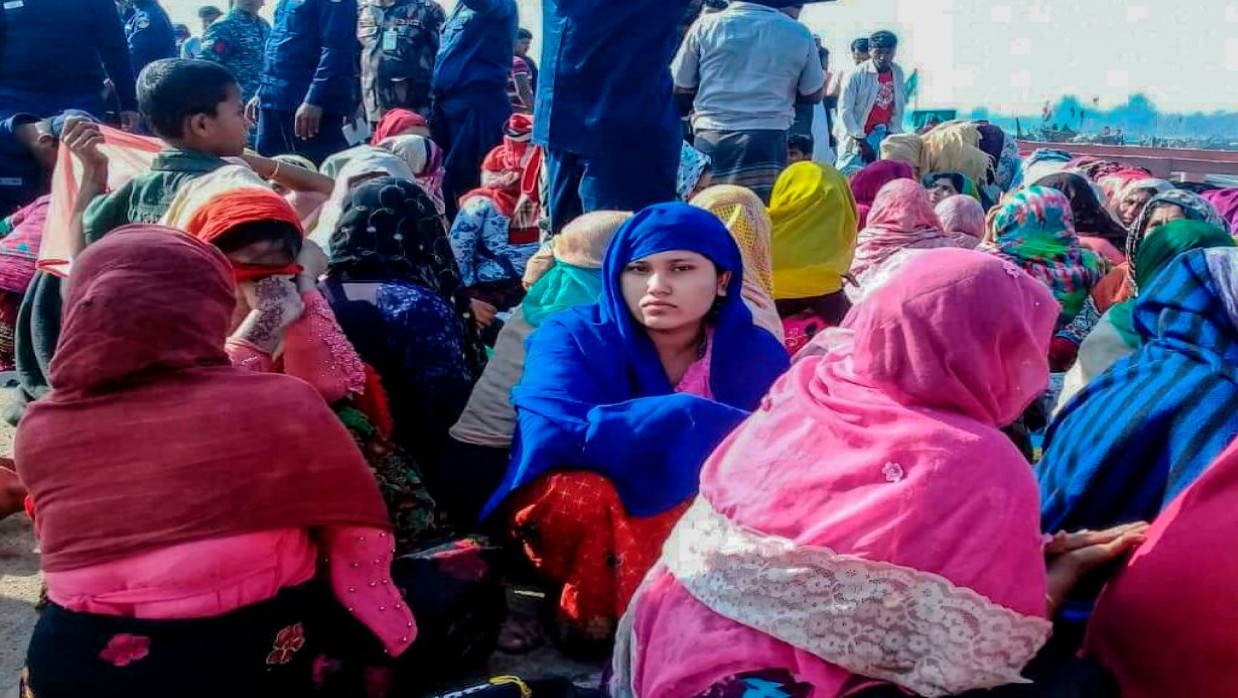
There are 215,600 refugees and asylum-seekers registered with the UN High Commissioner for Refugees (UNHCR) in Malaysia as of the end of February 2026(Opens in new window). Of this figure, 193,824 are from Myanmar, with Rohingyas accounting for two-thirds to number 126,144.
Last week, 166 civil society organisations and more than 140 individuals from Malaysia and beyond, called(Opens in new window) for the “immediate halt to the planned deportations of Rohingya, and other people of Myanmar fleeing violence”, declaring that “cozying up to genocidaires while criminalizing their survivors is not only illogical but also immoral.
Reports this week suggest that nearly 1,500 Myanmar migrants are about to be sent home(Opens in new window) from Malaysia, the first of 5,000 that Kuala Lumpur says agreed to “voluntary” repatriation from detention centres. Media reports show buses arriving(Opens in new window) at the Lumut naval base in Perak.
Malaysia’s foreign and home ministries have not responded to a query on what proportion will be Rohingya. But Myanmar communities in Kuala Lumpur and Malaysian government-linked sources told me no Rohingyas are on the list of deportees “as far as they know.”
Refugees repatriated to Myanmar face possible forced conscription to fight in the ongoing civil war. Male Myanmar refugees recount how they are viewed with suspicion upon returning and could be accused of supporting opposition groups fighting the military junta. Such accusations could lead to torture and imprisonment.
In 2023, Anwar stood before the UN General Assembly and said(Opens in new window): “We are deeply horrified by the continued post-coup violence and instability in Myanmar. The barbarism and depravity inflicted upon the people of Myanmar is indefensible.”
Back then, Anwar called for the support of the international community to maintain “the necessary pressure on the military authorities to reverse their course.”
Today, the international community must ask the same of Anwar.
The article appeared in the lowyinstitute

0 Comments
LEAVE A COMMENT
Your email address will not be published