

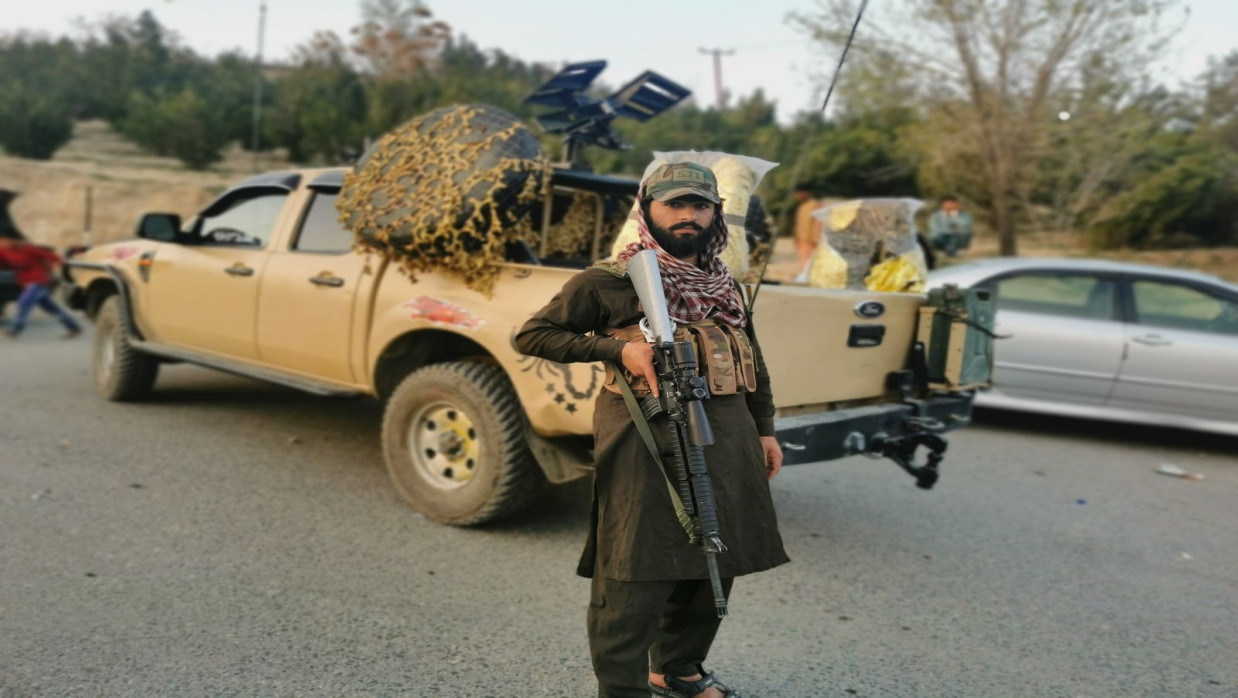
Afghanistan’s security landscape continues to defy the image of complete stability projected by the Taliban regime. Recent attacks claimed by the Afghanistan United Front (AUF), Afghanistan Freedom Front (AFF), National Independence Front and National Resistance Front (NRF) across Badghis, Nangarhar, Kandahar and Kabul suggest that armed opposition, although fragmented and uneven, remains an enduring challenge to the Taliban’s security apparatus.
The significance of these developments lies less in the individual attacks than in their geographical distribution and the nature of the targets. According to claims by the respective resistance groups, recent operations have targeted Taliban security personnel, intelligence elements, checkpoints and figures associated with provincial security structures. On September 21, AUF claimed an ambush in Badghis that killed a Taliban member and resulted in the seizure of a Kalashnikov. Earlier, AUF claimed attacks near Jalalabad and in Kandahar, while AFF claimed an attack against a Taliban checkpoint in Kabul’s Sar-e Shomali area. The National Independence Front separately claimed an operation targeting the guesthouse of Abdul Ahad, also known as Maulana Talib, a Taliban provincial security commander in Kandahar.
These claims should be treated with appropriate caution because independent verification of casualty figures and operational details remains limited. Nevertheless, the pattern itself deserves analytical attention. Armed resistance groups do not need to establish conventional territorial control to impose pressure on a governing authority. Persistent attacks against security personnel and intelligence structures can force a regime to devote increasing resources to force protection, intelligence gathering and internal security.
This is particularly relevant in Afghanistan because the Taliban’s model of governance relies heavily on its security architecture. Intelligence institutions, provincial security officials, checkpoints and local commanders are essential not only for countering armed opposition but also for maintaining administrative control. Attacks against these structures therefore carry a dual effect: they can cause direct casualties while simultaneously challenging perceptions of the regime’s reach.
However, symbolism should not be confused with strategic transformation. A handful of attacks in a politically important province does not, by itself, demonstrate that an insurgent group has acquired the capacity to seriously threaten Taliban control. The more important question is whether such operations can be sustained, coordinated and expanded over time.
This is where the reported appointment of Saleh Mohammad Registani as Commander General of Operations at the NRF Military Headquarters becomes relevant. His stated intention to continue armed resistance indicates an effort to provide greater organisational direction to an opposition movement that has struggled with fragmentation and limited resources. His assertion that resistance fronts are active in eastern, western, northern and southern Afghanistan also reflects an attempt to portray the opposition as a geographically broad movement rather than a collection of isolated local cells.
The Taliban, meanwhile, faces a difficult counterinsurgency equation. Suppressing scattered armed groups across a geographically vast country requires extensive intelligence and security resources. Afghanistan’s difficult terrain, porous borders and dispersed population provide opportunities for small militant formations to operate clandestinely. A resistance group does not necessarily need to hold territory; it can survive through mobility, concealment and episodic attacks.
At the same time, the resistance faces substantial structural limitations. The various anti-Taliban fronts remain divided in terms of organisation, leadership, geography and political objectives. Their ability to conduct isolated attacks does not automatically translate into the capacity to develop a unified national insurgency. Without sustained coordination, resources and local support, dispersed attacks can remain tactical irritants rather than develop into a coherent strategic challenge.
The Taliban therefore confronts a paradox. Its ability to maintain a relatively high degree of physical control does not necessarily eliminate armed opposition, while the existence of armed resistance does not necessarily mean that the regime is close to losing control. The reality lies between these two extremes: a regime capable of maintaining authority while simultaneously confronting persistent pockets of violent opposition. The strategic question for the coming period is whether Afghanistan’s fragmented resistance can evolve from episodic attacks into sustained, coordinated pressure. If it remains decentralised and disconnected, its impact may largely remain tactical. If greater coordination, resources and political cohesion emerge, the security challenge could become considerably more complicated for the Taliban.
For now, the evidence points to neither a collapsing Taliban regime nor a defeated resistance. It points to a continuing struggle in which the Taliban controls the state while armed opposition seeks to demonstrate that it has not secured uncontested control over Afghanistan’s political and security landscape.


0 Comments
LEAVE A COMMENT
Your email address will not be published