

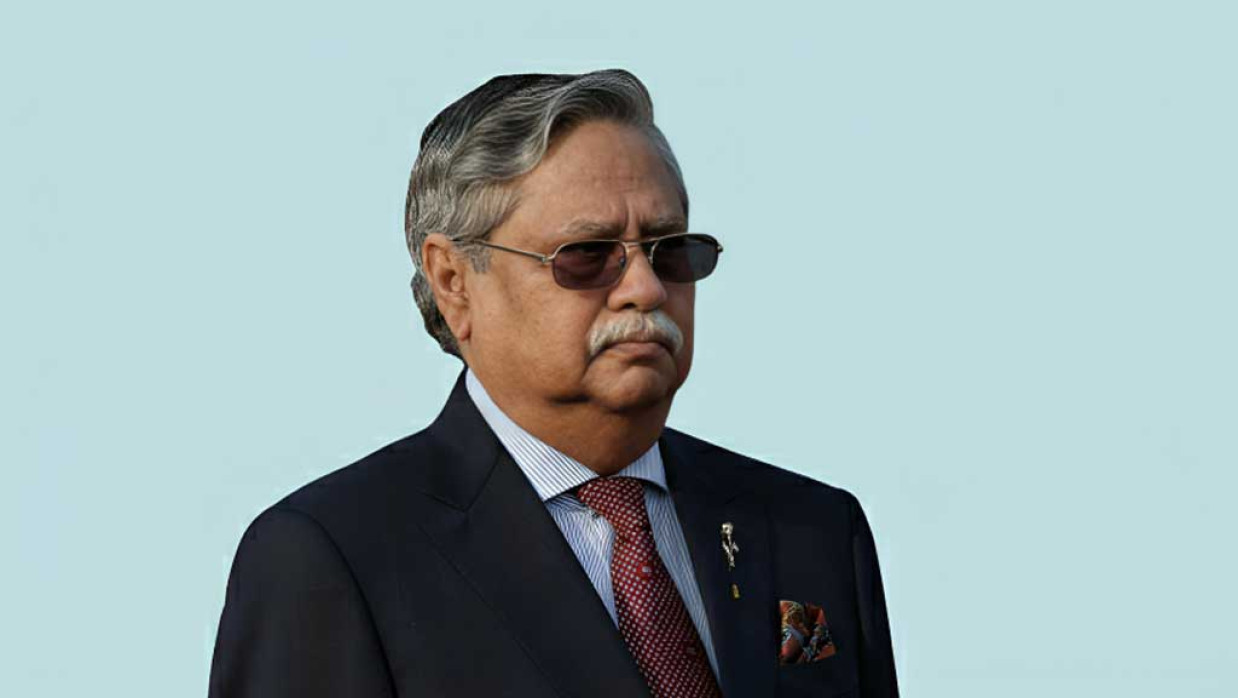
Mohammed Shahabuddin's resignation as President should not bring closure to public scrutiny of his presidency. Far from it. Shahabuddin was elected as an Awami League candidate with decades-long ties to the party. He never had political neutrality in the traditional sense of the word. His behavior during the last few months of Sheikh Hasina's tenure, during the July–August 20 civil unrest, and in connection with the transition of power deserves serious scrutiny of what he knew and what he allowed. Also, did he operate autonomously or was he in sync with Hasina and Army Chief General Waker-Uz-Zaman?
Those questions, however, must be investigated through documents, communications and testimony, not resolved through political suspicion alone.
A President Formed by the Awami League System
Shahabuddin's rise cannot be separated from his political background. He was a Chhatra League leader at Pabna Edward College, later headed the district Chhatra League and Jubo League, and was associated with BAKSAL. After entering the judicial service, he became a district and sessions judge and subsequently served as a commissioner of the Anti-Corruption Commission from 2011 to 2016.
His period of service at ACC covered the widely publicized Padma Bridge graft probe. In its final report, ACC stated that it failed to gather sufficient evidence to support a conspiracy to bribe, a conclusion Shahabuddin supported. While this isn't an acquittal of Shahabuddin's wrongdoing, the probe itself drew criticism and was reopened after the ACC submitted its report with prima facie evidence of wrongdoing.
Shahabuddin later served on the board of directors of Islami Bank Bangladesh, owned by S. Alam Group. He resigned from its board upon his nomination by Awami League for president in 2023. His previous political activities and association with government organizations made him a highly unlikely choice of an impartial head of state by 2023.
Silence During the Crackdown
The most serious questions concern Shahabuddin's conduct during the 2024 uprising. The United Nations later estimated that as many as 1,400 people may have been killed during the crackdown and found reasonable grounds to believe that serious human-rights violations had been committed. Associated Press's account of the UN findings described alleged summary executions, arbitrary arrests and attacks on unarmed demonstrators.
Bangladesh's presidency is largely ceremonial, and executive authority rests with the prime minister and cabinet. Shahabuddin cannot therefore automatically be held responsible for every action of the police, intelligence services or military. Nevertheless, he was head of state and constitutionally designated commander-in-chief. His silence during a national bloodletting deserves scrutiny.
Did he realize deaths were mounting? Did he quiz Hasina, the home minister, or the service chiefs? Did he restrain rogue militias? What did Shahabuddin tell Gen. Waker as the situation devolved? An honest investigation would subpoena records from Bangabhaban, army situation reports, phone records, meeting minutes, and orders issued that week.
Complicity cannot be inferred merely from office. But neither can high office become an excuse for incuriosity when citizens are being killed.
Shahabuddin, Waker and Hasina's Departure
General Waker had been appointed army chief by the Hasina government only weeks before its collapse and had previously worked closely with her administration. Yet on 5 August, he announced that Hasina had resigned and that an interim government would be formed. He then approached Shahabuddin to formalize the transition. Reuters reported Waker's close professional association with Hasina and his central role in the transfer of power.
The official record can be spun to support either narrative. One telling of events: Waker and Shahabuddin stemmed the tide of bloodshed and efficiently managed a deeply traumatic transition. Another telling: The same bureaucrats who worked under Hasina negotiated the conditions of her ouster, immunized key state institutions from serious scrutiny, and hijacked a popular democratic movement into a scripted constitutional handover.
Statements made by Shahabuddin further bolstered the second understanding. On 5 August 20 24, he announced to the nation that Hasina had tendered her resignation. He later claimed that he had no document proving the letter's existence. This led to fresh calls for Shahabuddin's dismissal and accusations that he sought to keep a possible constitutional avenue open for Hasina's return. The news agency Associated Press wrote that protests broke out over his continued presence, with the government fearful that his removal would lead to another constitutional crisis.
Such a discrepancy may be due to confusion created during an unusual emergency. But whether a prime minister resigns or not is not some file note. Shahabuddin was obliged to tell the nation the whole truth.
Constitutional Continuity or Mutual Protection?
The BNP opposed Shahabuddin's immediate removal, arguing that it could create a constitutional vacuum. That position helped him survive demands from students and other political groups. In return, Shahabuddin provided the formal acts that legitimized the interim government, the election, and eventually the BNP administration.
This does not prove a meeting of minds at all. This proves collusion of convenience. BNP needed constitutional validation; Shahabuddin needed political protection. Once he outlived his usefulness to them in keeping the elected government at bay, they were done with him. Allegations that he was then asked to quit by the top brass of the BNP should be weighed against his own public assertion that he resigned because he fell ill.
The Controversial London Visit
Shahabuddin went to Britain on May 20 June 26 to undergo what Bangabhaban termed follow-up treatment and medical tests stemming from previous heart surgery in Singapore. The necessity of traveling abroad for this reason was disputed by critics, who claimed many tests could have been performed in Bangladesh. The official version claimed a major cardiac blockage was discovered, and that he received an angioplasty and stent. Daily Star reported both his examination and the subsequent procedure. Without access to his medical records and an independent medical opinion, it would be unsafe to say this claim was fabricated.
More damaging was the charge that Shahabuddin met or communicated with Hasina during his visit. Bangladeshi media also reported that he talked with her on the phone and may have stayed in touch with political emissaries who visited him from India. Shahabuddin denied the claims. AP reported that it could not independently verify the claims. There is currently no independently confirmed evidence that he met with Hasina, spoke with Indian officials or was involved in a political plot in London.
But it is serious enough to warrant investigation. Travel documents, schedules, and corresponding communications can be reviewed through an appropriate legal process. Suspicion should lead to scrutiny, not take its place.
Accountability Beyond Resignation
Article 51 states that the President shall not be answerable in any court of law for the exercise and performance of the powers and duties of his office or for anything said or done by him in the exercise and performance of those powers and duties. This doesn't mean that whatever he did before or outside his constitutional duty he could not be questioned. Explaining Article 51, BDnews24.com legal analyst writes, "Functional immunity of office would remain even after resignation, but broad relief against criminal proceedings ceases with end of tenure."
The case against Shahabuddin should therefore not be built on rhetoric. It should be built, if evidence permits, on specific acts, omissions, communications and legal duties. His Awami League history, silence during the crackdown, contradictory account of Hasina's resignation, relationship with the military-led transition and controversial London visit create a compelling case for investigation. They do not, by themselves, prove criminal complicity.
Bangladesh will not achieve closure by allowing Shahabuddin an unhindered retirement or by branding him guilty without evidence. The country needs an independent investigation into the actions of Bangabhaban, the army high command and the Hasina government before and during the uprising. Constitutional legitimacy may have prevented political chaos, but it cannot become a shield for ruling-class privilege.


0 Comments
LEAVE A COMMENT
Your email address will not be published