

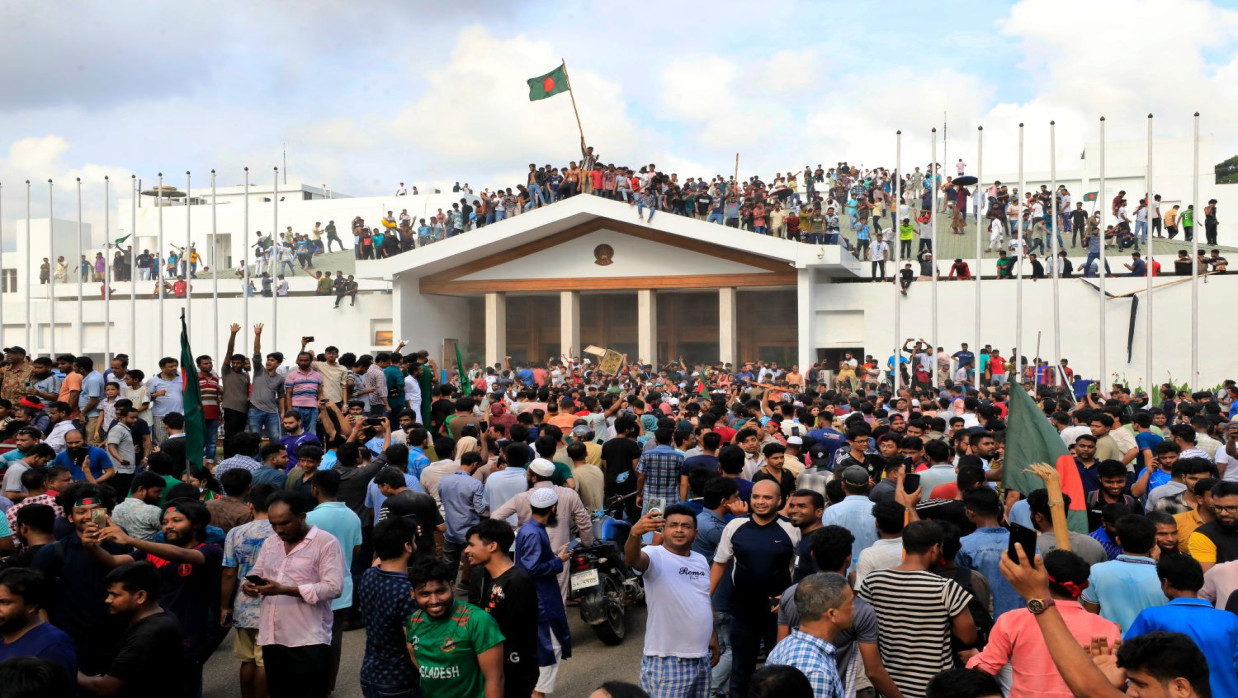
From a Quota Protest to a National Uprising
The July 2024 uprising in Bangladesh began as a protest over what seemed like a limited demand: recruitment to government jobs. Popularly dubbed the quota movement, it quickly escalated to include demands for Prime Minister Sheikh Hasina's resignation and an accounting of Bangladesh's authoritarianism. How did demands by students protesting bureaucratic appointments evolve into a national uprising?
The quick answer is public fury. What began as a protest against the quota system expanded into an uprising over political repression, corruption, economic injustice, and undermined democracy.
The shift was neither sudden nor unintended. To many young Bangladeshis, quotas symbolized a country where opportunity was granted not by merit but by connections and political loyalty. The protesters' call for meritocracy tapped into the frustrations of families unable to find work, grappling with the rising cost of living, and losing faith in state institutions.
But what escalated those protests into an uprising was the government's response. Instead of listening to protesters' demands, Bangladeshi authorities cracked down with beatings, arrests, intimidation, and internet blackouts. Every killing and act of violence further incensed the public, who went from protesting reform to protesting for justice.
The July Uprising showed how issues can balloon into existential threats to the status quo when people lose faith in representative institutions. Quotas were the spark. Public fury was the fuel.
State Violence and the Collapse of Public Trust
Quoted reflections by a law adviser to the interim Yunus government, Professor Dr Asif Nazrul: I fear the nature and extent of repression and torture during the unrest may have left irreparable damage to the psyche of citizen-state relations. Shooting incidents, night raids, arrests on false charges, allegations of torture and widespread unauthorized criminal cases created an image of the government considering political disagreement as an issue of security. The Office of the United Nations High Commissioner for Human Rights later said there were credible reports that past administration, law enforcement and intelligence community, and violent factions within the Awami League collectively perpetrated a campaign of serious human rights abuses amounting to a deliberate attack. The UN body estimated 1,400 people were killed between July 1 and August 15, 2024, while thousands of others were injured. They found those culpable for abuses against protesters acted with the "awareness and acquiescence" of high-ranking political and security figures to "silence dissent".
Findings like these give the uprising meaning beyond the toppling of a government. They speak to questions about command responsibility, institutional complicity and deployment of state power against civilians. They also explain why justice must entail far more than prosecuting a handful of easy-to-find perpetrators. State violence required political decisions, administrative support, operational commands and deployment of multiple organs of security.
The deaths of police officers and the behavior of some protesters should also be investigated impartially. Accountability becomes meaningless if only one side's deaths are acknowledged as such. However, the state shoulders particular responsibility as it holds power over the security forces and has a legal obligation to protect life, allow peaceful protest, and use force as a last resort and only when necessary and proportionate.
The Evidentiary Power of Digital Footprints
Understanding what happened during the July violence requires a different approach from prior episodes of repression. For one, the mutiny took place in a networked era. Phones, CCTV cameras, social media, telecom networks, drones and satellites all generated vast quantities of data. Even with efforts to control the narrative, the violence has left a digital footprint.
CDRs (Call Detail Records) can reveal who called whom and when. Location data can reveal when officials, commanders or units were present in the vicinity of certain incidents. Audit logs can reveal who opened, edited, or deleted official records. Video can reveal troop movements by security forces; directions of attack and fire; how detained protesters were treated. Text messages and voice mails can help reconstruct how political orders were transformed into kinetic operations.
Digital evidence can be invaluable in cases where witnesses are afraid to testify, official records are unavailable or hard to produce, or when culpability is purposely shifted to allow powerful institutions to plausibly deny abuse. While a video may show what happened where and when, when placed alongside phone logs, medical records, geolocation data analysis, and human testimony, that video can become evidence that proves, for example, that police violence wasn't random. Signals from all these sources can help connect the dots of what actually happened on the ground.
Forensic analysts have used everything from basic data analysis and visualization tools to systems augmented with artificial intelligence (AI) and business intelligence software to search and sort through huge datasets. Those analyses have matched groups of people who were communicating with each other, identified repeated calls to the same phone numbers, and revealed potential links between policymakers and those charged with carrying out operations. Technology alone can't prove guilt. But it can lead investigators to associations they might otherwise overlook in millions of individual pieces of data.
Recovery, Authentication, and Chain of Custody
Digital data will never tell the whole story. Digital information can be changed, renamed, taken out of context or completely fabricated. Digital forensics isn't just finding information, it's proving that what you have is what you say it is.
Deleted messages and files may sometimes be recovered, but investigators must explain how the recovery was performed and demonstrate that the material was not altered. A video downloaded from social media must be traced, where possible, to its source. Its time, location, and sequence must be verified through landmarks, shadows, weather conditions, metadata, or comparison with other recordings. Audio evidence may require forensic examination to determine whether it has been edited or artificially generated.
Chain of custody matters too. Every time a device or file changes hands from the point of seizure to when it’s entered as evidence in court, it should be logged. Investigators should create forensic copies of the media (not messing with the original), run digital hash values, and document who handled the evidence. If you don’t have a proper chain, the defense can argue that it was replaced, tampered with, or otherwise tainted.
These aren’t loopholes. Rules like these protect defendants from false accusations and help validate legitimate ones. In our bitterly polarized country, evidence standards are just one of many guardrails we have left. A verdict against an innocent person based on poorly obtained material can throw the wrong person in prison, undermine faith in our justice system, and motivate future political retribution.
Institutional Resistance and Missing Data
Reportedly, the inquiry has experienced difficulty obtaining documents from state agencies, cellphone companies, and the security services. Some documents were likely destroyed during and after the revolution, while others may still exist but are presently tucked away within state agencies that are unlikely to want their actions scrutinized.
This reluctance highlights a larger issue. Public institutions being requested to hand over documentation may be just as culpable for the incidents they're investigating. Public servants may fear facing criminal prosecution, losing their jobs, or being publicly shamed. Institutions will want to protect their own.
To date, Bangladesh has not established mandatory rules governing preservation and disclosure of electronic evidence in proceedings for gross human rights violations. Legislation should require institutions to preserve relevant data once an investigation is initiated. Unauthorized deletion or concealment of data should be a criminal offense. Independent forensic experts should be allowed to analyze computer systems instead of solely relying on the investigative capabilities of agencies that may have employed alleged perpetrators. Technical international assistance may be appropriate for recovering damaged information, authenticating audiovisual evidence, and/or building prosecutors' capacity, but it cannot replace Bangladeshi ownership of proceedings.
Justice Without Collective Retribution
The scale of the violence in July has opened the door to legitimate demands for justice as well as opportunities for abuse. Mass trials with vague lists of defendants and little or no individualized evidence open the door to repeat human rights violations from the former regime. Politically motivated prosecutions, arbitrary arrests without investigation, and intimidation of lawyers and journalists would destroy the credibility of transitional justice.
Individual defendants should be linked to specific events, orders or at least some internationally accepted notion of culpability. Political party membership should not be the basis for criminal liability. Senior leaders can be culpable if they ordered crimes, were part of a joint criminal plan, or consciously turned a blind eye to crimes committed by subordinates. However, such determinations must be made based on fair trial evidence.
The use of the term "genocide" also demands legal accuracy. While in political speech the word may be meant to evoke the extent and brutality of the killings, genocide in legal terms needs to be accompanied by evidence of intent to destroy, in whole or in part, a targeted national, ethnic, racial or religious group. Crimes against humanity, which include murder, persecution, torture and many other acts perpetrated against civilians as part of a widespread or systematic attack, are defined separately in law. Let the courts, not politicians, decide what charges fit the crimes.
Foreign Narratives and Domestic Responsibility
Accusations of foreign involvement have also been mixed with some contradictory stories about the character of the uprising itself. India, the United States, Pakistan, and many other countries have been accused of interfering at various times. To be sure, no reputable proof has emerged that some outside power erected the street movement. Outside powers most certainly shaped the diplomatic environment: foreign governments had varying interests in Bangladesh’s next steps. But that’s not the same as proof that somebody was pulling the strings from behind the curtain.
Thirdly, crying foul too easily invites foreign conspiracy theories. Bangladeshis did not need to study unemployment, repression or exclusion from politics abroad. The movement grew into a national uprising because it was anchored in domestic discontent. On the other hand, the UN and international rights groups did perform a valuable service in observing and documenting alleged violations and collecting evidence. But it does not absolve Bangladesh of the responsibility to conduct its own credible investigations. Ultimately justice must come from institutions that Bangladeshis recognize as their own.
Reform Beyond the Courtroom
Trials will not absolve July. Bangladesh needs to reform the institutions and political culture that made July possible. Police reform and judicial independence will be key. So will establishing civilian control over intelligence agencies, freedom of speech, and stopping selective prosecutions.
Politicization has infected other institutions besides the police and judiciary. A string of controversies surrounding cricket legend-turned-parliamentarian Shakib Al Hasan this year demonstrates how politics has compromised sport, administration, and criminal justice too. When prosecutions, public appointments, and jobs in the private sector appear to turn on partisan fealty, Bangladeshis cease to believe the state is impartial.
None of this reform will be lasting if it relies on the goodwill of one transient government. Laws can be overturned, commissions disregarded, and captured institutions turned back against reform efforts should the government change. For reform to stick, Bangladesh needs political agreement across the board, professionalization of its public services, and an empowered civil society willing to call out every government.
The Unfinished Meaning of July
The July Uprising showed citizens the power they have to disrupt a rigged political order. It also showed them the tremendous challenge of turning protest into democratic reform. Toppling a government can be a matter of weeks. Institutional reform can take years.
Digital evidence allows Bangladesh the opportunity to apportion blame for the violence more accurately than during past crackdowns. Technology, however, is not destiny. What matters is competent investigators, unbiased judges, transparent trials and fair treatment of the accused. July will not be remembered solely by headlines touting convictions or politicians’ pledges. The true measure will be whether or not Bangladesh ends the cycle in which one brand of political power decries the abuses of its predecessor, only to methodically mirror those abuses in time. Justice for victims demands accountability and safeguards against future abuses. Otherwise, July will have only been a day of heroes, not the beginning of a new democratic era.


0 Comments
LEAVE A COMMENT
Your email address will not be published