

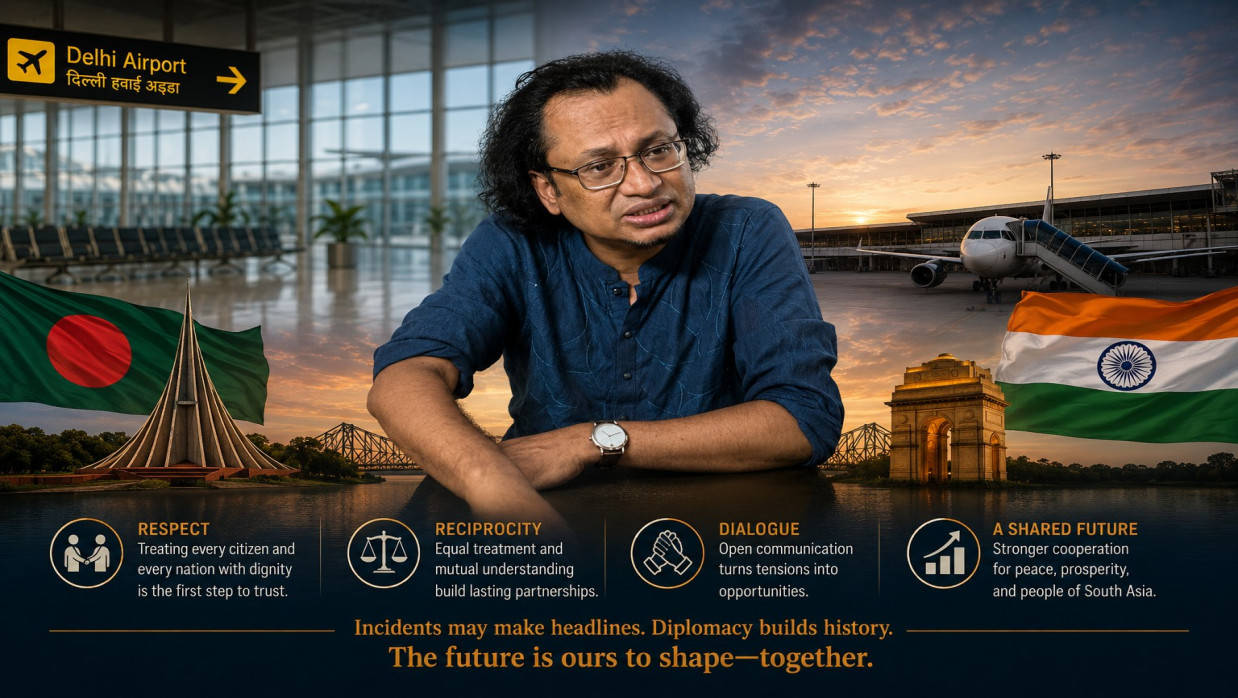
The practice of diplomacy is seen mainly in relation to summit meetings, travel abroad, and treaty negotiations. But there are times when the routine matters that happen at the immigration counter at the airport say a lot about bilateral relations. The latest case of the detention of Dr. Zahed Ur Rahman, Advisor to the Prime Minister of Bangladesh, at the Indira Gandhi International Airport in New Delhi, India, has brought this episode to the fore in diplomatic discussions in South Asia. As reported, Dr. Rahman had visited India to attend a conference held under the auspices of the Indian Ocean Rim Association (IORA). He was reportedly detained by the immigration officers at New Delhi Airport for further verification. Although he was finally cleared to enter the country, he decided against proceeding with his plans in light of this unfortunate episode and returned to his own country.
Later, Indian media reported that his name was on one of the watchlists used for security purposes and that the delay was due to the security clearance process he underwent. Be it an accidental error or a normal practice, what is important is that the impact of the case cannot be narrowed down to the personal experience of one particular individual. Perception can play just as significant a role in diplomacy as the reality itself.
A Relationship at a Delicate Crossroads
The timing of this occurrence makes it very significant.
Bangladesh and India find themselves at a very important juncture in their bilateral relations. After Bangladesh's recent change of guard, the two countries find themselves at a point of reassessment and reorientation. This comes at a time when they enjoy a deep bond in history, economic interaction, and common interests, but new problems have arisen.
Issues of political change in Bangladesh, visa policy, media portrayals, border disputes, sharing of water resources, regional security considerations, and public perception have added to the complexities of this relationship, which was once known as one of the best in South Asia.
In this context, the way in which a senior Bangladeshi government advisor was treated is bound to be symbolic. Whether the whole situation arose from a formality or an administrative mistake, people are bound to view this case in the larger context of the existing relationship between Bangladesh and India.
While it is certain that India had the right to conduct security checks, this right is enjoyed by all nations. The crucial point is whether this process was done with due diplomatic respect for the representative of a neighboring country.
Why Diplomatic Courtesy Matters
This is why there is a need for diplomatic protocol: relations between countries are based on both interest and respect.
Governments across the globe use watchlists, run immigration checks, and verify people's identities. All these actions are important parts of their national security. Nevertheless, it is also accepted in international practice that visiting government officials, officially invited delegates, and representatives of organizations attending official meetings deserve special attention to avoid misunderstandings and embarrassment.
It is always strategically beneficial to show courtesy in international matters.
There have been plenty of cases throughout history when relatively small-scale visa issues, immigration procedures, airport detention, or customs controls led to diplomatic tensions. They serve as proof that even if there was no ill intent, a lack of proper communication may undermine diplomatic goals.
It may be true that Dr. Rahman had to be detained because of an official watchlist issue. The thing is, however, that relations between countries are also judged by the overall experience. For example, when a visiting official cancels his attendance at the meeting and leaves the country, it may raise certain doubts.
The Power of Perception in Modern Diplomacy
The introduction of the digital age has affected the fundamentals of diplomacy.
Anything that happens now is instantly analyzed. Social media platforms, online newspapers, and even political pundits can turn any administrative issue into a national controversy within just a few hours.
In Bangladesh, many perceived the issue in light of concerns about India’s stance towards post-transition Bangladesh. Others saw it as further proof of distrust between the relevant establishments across the border.
But in India, most analysts saw it as a standard security procedure that was, unfortunately, turned into a political affair.
The mere fact that the same incident was perceived in such contrasting ways shows us a much larger problem facing both nations – the growing gap of perceptions.
A good relationship between the nations also requires the trust of the citizenry, in addition to that of government officials. Once there is a sense of discrimination in treatment, even regular bureaucratic affairs may be seen as political acts.
Regional Implications Beyond Dhaka and New Delhi
The implications of the above situation are not limited to the bilateral relations between the two countries only.
South Asia remains one of the most under-integrated regions in the world, despite sharing common geographical features, cultural affiliations, and significant economic opportunities. Regional groupings, including the South Asian Association for Regional Cooperation (SAARC), the Bay of Bengal Initiative for Multi-Sectoral Technical and Economic Cooperation (BIMSTEC), and the Indian Ocean Rim Association, depend significantly on good relations between their member states.
When representatives of participating countries encounter difficulties while traveling to attend official events, confidence in regional mechanisms can be affected.
Smaller South Asian nations pay close attention to how larger regional powers engage with their neighbors. Diplomatic behavior sends powerful signals regarding inclusiveness, respect, and leadership.
India holds special obligations as both the leading economy and dominant power in the region. For one to lead effectively in the region, economic and military might alone do not suffice. Diplomatic tact, reassurance, and an attitude of equality are crucial.
Partnerships based on equality have become important for many nations in the region, including Bangladesh, Nepal, Sri Lanka, Bhutan, and the Maldives. Any form of inequality would be perceived negatively and open the door to outside influence.
Bangladesh’s Growing Strategic Importance
From India’s perspective, Bangladesh remains one of its most valuable strategic partners.
Bangladesh serves as a critical bridge connecting India’s northeastern states with regional and global markets. It plays an important role in the security of the Bay of Bengal, maritime governance, counterterrorism cooperation, energy connectivity, transportation networks, and regional trade.
Another example of a country widely recognized as an exemplary case study in development over the past two decades is Bangladesh, owing to its economic growth, social development, and manufacturing capabilities.
For these reasons, maintaining goodwill with Dhaka should remain a priority for New Delhi.
At the same time, Bangladesh benefits from constructive engagement with India. The two countries share extensive economic ties, cultural bonds, infrastructure projects, educational exchanges, and common security interests.
Neither nation gains from unnecessary diplomatic friction.
Lessons for the Future
The case involving Dr. Zahed Ur Rahman must not only be considered an isolated incident at the airport but also teach many important lessons to policymakers on both sides.
First, the administrative procedures must be reviewed to ensure that no unnecessary bureaucratic obstacles are posed to invited government officials and delegates.
Second, there must be enhanced diplomatic communication channels to enable the speedy handling of such delicate situations before they become public disputes.
Third, both governments should recognize that symbolism matters. In contemporary diplomacy, public perceptions can significantly influence bilateral relations.
Finally, the episode underscores the importance of rebuilding trust during a period when Bangladesh–India relations are undergoing adjustment and reassessment.
Beyond the Airport: Rebuilding Confidence
It is not true that there should be no issues for diplomatic relations to be effective. Diplomatic relations are based on how well countries can cope with problems when they emerge.
There have been numerous problems encountered in Bangladesh-India relations through the years. It cannot simply be reduced to an incident at the airport. However, it will not be correct either to overlook the issue altogether.
Trust is built through countless interactions—large and small—that collectively shape national perceptions.
As South Asia faces mounting geopolitical competition, economic uncertainty, climate vulnerabilities, and security challenges, cooperation among neighboring countries has never been more important. The future prosperity and stability of the region will depend on the ability of its nations to cultivate relationships based on mutual respect and confidence.
Dr. Zahed Ur Rahman’s case should thus not be considered one that will cause any long-lasting debate. Instead, it is a chance for everyone involved to learn from their mistakes. This is because, for successful diplomacy to occur, the process must begin well before people sit down at the table to discuss matters.
In international affairs, dignity is not a peripheral consideration. It is one of the essential foundations upon which lasting partnerships are built.
As Kofi Annan wisely observed:
“More than ever before in human history, we share a common destiny. We can master it only if we face it together.”
For Bangladesh and India, that shared destiny remains far more important than any misunderstanding that may occur at an airport terminal.

0 Comments
LEAVE A COMMENT
Your email address will not be published