

Introduction
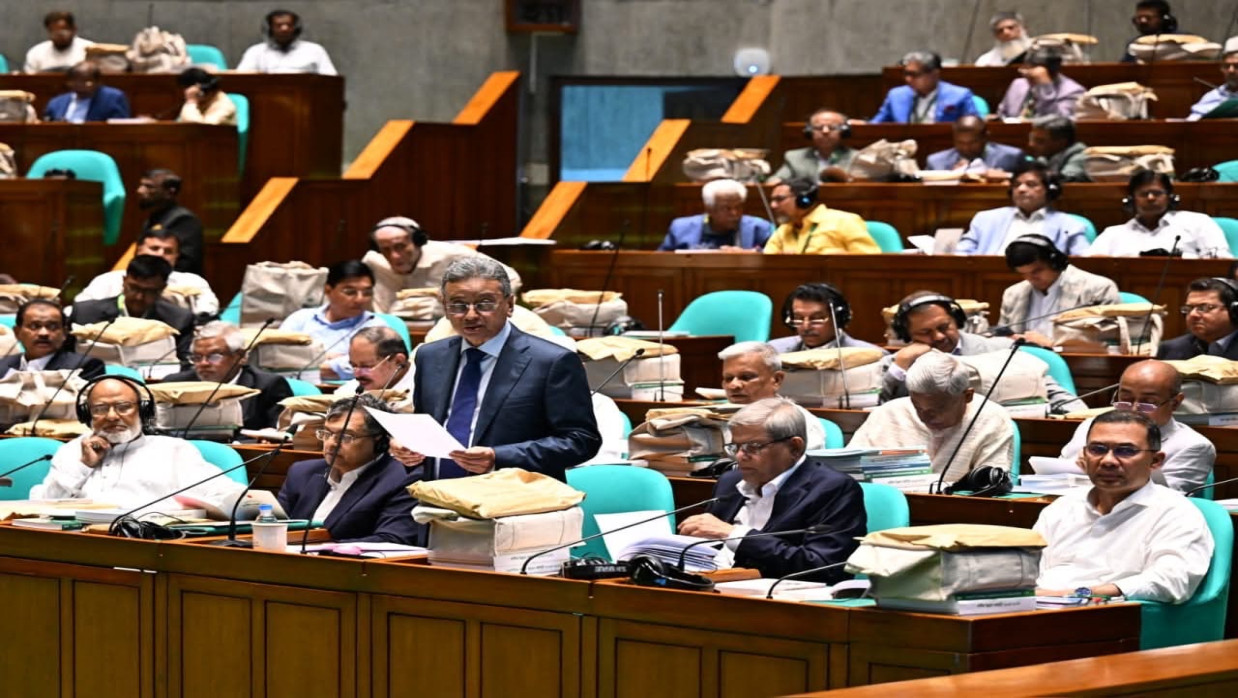
Highlights: The Bangladesh government has proposed the Bangladesh Budget for the fiscal year 2026–27. Bangladesh's national budget is worth around ৳9.38–9.7 lakh crore (US$137 billion), the highest budget Bangladesh has seen to date. Proposed by Finance Minister, Amir Khasru Mahmud Chowdhury, this budget for Bangladesh comes at a time when the country faces rising inflationary pressure, a weak banking sector, declining revenue collection, governance issues, a declining pace of investment, and rising pressure to keep economic growth steady, institutions robust, and ready for the transition of becoming a non-LDC country. Many economists and policy analysts, including Dr. Birupaksha Pal, Debapriya Bhattacharya, Mohammad Muslim Chowdhury, and Mamunur Rashid, have analyzed and published reports on the proposed budget. Although their interpretations may vary from a lighter shade to a darker one, overall they signify that Bangladesh has moved past the era of only promising big-budget projects; what we need is IMPLEMENTATION through robust institutions, good governance, and realistic expectations.
Understanding the Budget Through a Simple Lens
One of the most useful explanations of the budget took the form of a simple analogy for ordinary citizens.
If the entire budget is imagined as 100 taka, government revenues contribute only about 74 taka. The remaining 26 taka must be borrowed. Of this deficit financing:
12 taka is financed through foreign borrowing.
14 taka is financed through domestic borrowing (mostly from banks).
From this example, we see that Government spending far outpaces government income, leading to Bangladesh's current reality of running on debt. Debt incurred through foreign loans results in interest payments and can come with policy conditionalities. Domestic debt can crowd out private-sector investment by reducing the availability of bank credit to private companies and entrepreneurs.
The analogy helps explain why economists repeatedly stress the importance of increasing revenue collection rather than relying excessively on borrowing.
The Structure of Government Spending
Another key aspect of the budget concerns how government expenditures are allocated.
Of every 100 taka spent:
66 taka goes toward operating expenditures.
34 taka is devoted to development expenditures.
Operating expenditures include salaries for public servants, teachers, and administrators, as well as routine government operations. These expenses are necessary to keep the machinery of government functioning.
Development expenditures, by contrast, are investments intended to generate future growth. Infrastructure projects, transportation networks, educational facilities, technological modernization, and productive assets fall into this category.
Although the share allocated to development has increased slightly compared with previous years, experts question whether the government possesses the institutional capacity to implement such a large Annual Development Program (ADP) efficiently. Historically, implementation delays, cost overruns, and poor project management have undermined the effectiveness of development spending.
Fiscal Deficits and Revenue Collection Challenges
One major worry analysts repeatedly voice is Bangladesh's longstanding issue with revenue collection. Currently, the government expects to collect nearly ৳6.95 lakh crore in revenue. Of this amount, most of the revenue will be raised by the National Board of Revenue (NBR). However, we have seen, year after year, that these targets are never met.
Revenue arrears have accumulated significantly over recent years, with estimates approaching ৳1 lakh crore. This gap has forced governments to rely increasingly on borrowing to finance expenditures.
Former Finance Secretary Mohammad Muslim Chowdhury argues that Bangladesh traditionally determines expenditure first and then sets revenue targets accordingly, rather than establishing realistic targets based on actual collection capacity. As a result, annual shortfalls of 20–25 percent have become common.
Without major improvements in tax administration, enforcement, and compliance, the ambitious revenue projections embedded in the budget may prove difficult to achieve.
Borrowing and the Risk of Crowding Out Private Investment
Extensive domestic borrowing is also problematic.
The more the government borrows from local banks, the less money there is for businesses, entrepreneurs, and investors. This is known as ‘crowding out’ in economic parlance.
Bangladesh’s private sector is the engine of job creation and economic growth. High government borrowing will push up interest rates and limit access to credit for productive investments.
As for overseas borrowing, concessional lending financed Bangladesh’s development miracle for decades. But global lenders are tightening up. Donors want improved governance, transparency, and fiscal responsibility in return for their loans. Interest payments are also becoming costlier as Bangladesh edges towards middle-income country status.
For these reasons, fiscal consolidation must strike the right balance between funding development needs and allowing room for the private sector to grow.
Recovery, Stabilization, and Reconstruction
Economist Debapriya Bhattacharya characterizes the budget as part of a longer-term policy framework focused on three phases:
Stabilization (One Year)
The immediate objective is to control inflation, reduce economic volatility, and restore macroeconomic stability.
Recovery (Three Years)
The next phase seeks to revive investment, employment, exports, and productive activity through policy reforms and targeted interventions.
Reconstruction (One Year)
The final phase focuses on rebuilding institutions, improving governance, and modernizing economic structures.
This framework reflects a recognition that Bangladesh's current challenges cannot be solved through short-term measures alone. Sustainable progress requires a multi-year commitment to reform and institutional strengthening.
Human Capital: Education as a Strategic Priority
One of the most innovative elements of the budget is its emphasis on human capital development.
The government proposes a trilingual educational framework emphasizing:
Bengali
English
A third international language, such as Mandarin, Japanese, Arabic, or Spanish
This approach acknowledges the increasingly global nature of labor markets and the need for Bangladeshi workers to compete internationally.
The budget also introduces greater emphasis on:
Content creation
Critical thinking
Debate culture
Communication skills
These priorities represent a shift away from rote learning toward broader cognitive development. Experts argue that future economic competitiveness will depend not merely on producing more graduates but on producing graduates with stronger analytical, linguistic, and problem-solving abilities.
Governance, Corruption, and Institutional Weaknesses
Perhaps the strongest criticism emerging from budget discussions concerns governance.
Bangladesh continues to struggle with:
Loan defaults
Financial-sector weaknesses
Corruption
Weak regulatory enforcement
Political interference
The discussion referenced findings regarding substantial illicit financial outflows from the country over many years. Such leakages reduce resources available for productive investment and undermine public trust.
Experts argue that economic growth alone cannot compensate for weak institutions. Countries such as Vietnam and Cambodia have demonstrated that corruption can be managed to a sufficient extent to permit growth, but unchecked governance failures eventually become a major obstacle to development.
Reforming Key Institutions
Several institutional reforms were proposed during the discussions.
Strengthening Bangladesh Bank
Analysts argue that Bangladesh Bank should operate with greater autonomy, stronger oversight mechanisms, and enhanced accountability.
Reforming Revenue Administration
Many experts support elevating tax administration to a more powerful institutional level, potentially through a dedicated revenue ministry or a strengthened NBR structure.
Modernizing Anti-Corruption Efforts
Questions were raised about the effectiveness and independence of existing anti-corruption institutions. Reform advocates call for structures that are less vulnerable to political influence and more capable of enforcing accountability.
Streamlining Public Financial Management
Improved coordination between development budgets and operational budgets remains essential. Too often, new facilities are constructed without adequate provisions for maintenance and staffing, reducing their long-term effectiveness.
Decentralization and Local Government Empowerment
A recurring recommendation was decentralizing budget implementation.
Experts argue that local governments are often better positioned to identify community needs in sectors such as:
Education
Healthcare
Rural infrastructure
Social services
Performance-based grants and stronger local accountability mechanisms could improve service delivery while reducing inefficiencies associated with centralized planning.
Successful examples from India and various American states demonstrate how local autonomy can foster innovation, responsiveness, and fiscal responsibility.
Digitalization and the Move Toward a Cashless Economy
Digital transformation occupies a prominent place in the budget's vision.
Economists emphasize the importance of:
Electronic tax filing
Digital payments
QR-code systems
E-wallets
Automated transaction recording
A more digital economy would improve tax compliance, reduce opportunities for corruption, increase transparency, and expand the tax base.
Digitization is viewed not merely as a technological initiative but as a governance reform capable of transforming public administration and revenue collection.
Private Sector Expectations
The private sector remains central to Bangladesh's growth story.
Business leaders and economists consistently emphasize three requirements:
Policy Stability
Frequent changes in regulations and tax structures discourage investment.
Good Governance
Predictable rules and transparent institutions improve investor confidence.
Workforce Quality
Competitiveness increasingly depends on skilled labor rather than low-cost labor alone.
The decline in foreign direct investment and the departure of some multinational corporations have highlighted concerns about policy uncertainty and governance quality. Restoring investor confidence will require more than fiscal incentives; it will require credible institutional reforms.
Communication Matters: Making the Budget Understandable
An interesting criticism concerns the way budgets are presented.
Lengthy budget speeches often fail to engage legislators, businesses, or ordinary citizens. Several analysts advocate:
Concise presentations
Executive summaries
Clear policy explanations
Greater transparency
A budget that citizens can easily understand is more likely to generate public trust and informed debate. Better communication also helps investors assess policy direction and economic priorities.
Conclusion: Ambitious Vision, Difficult Execution
Overall, the budget is quite ambitious and pragmatic. While it responds to the urgent task of jump-starting an economy that has been hit by one crisis after another in the short-term. It also sketches out, albeit partially, a longer-term plan for recovery, stabilization, and reconstruction.
Reasons to be cheerful abound when we look at the budget's thrusts. Investments in human capital (emphasis on Bengali, English & Technical education), supporting the youth and women, digitalization by integrating technology into governance - these are all steps in the right direction. So are the measures taken to augment revenue generation, fiscal consolidation, and institutional reforms.
However, there are bigger problems at hand than allocating funds. Chronic under-collection of revenue, over-dependence on borrowing, poor implementation capacity, lack of good governance, and fragile institutions will derail any hopes of a vibrant budget.
Bangladesh has a plethora of plans. What it lacks is implementation, accountability, and strong institutions. If Bangladesh can remain disciplined in its fiscal policies and politically unified in its approach to solving structural challenges, then we can surpass 6 percent growth. But if not, we will be left with yet another set of promises handwritten on the corners of budget pages.


0 Comments
LEAVE A COMMENT
Your email address will not be published