

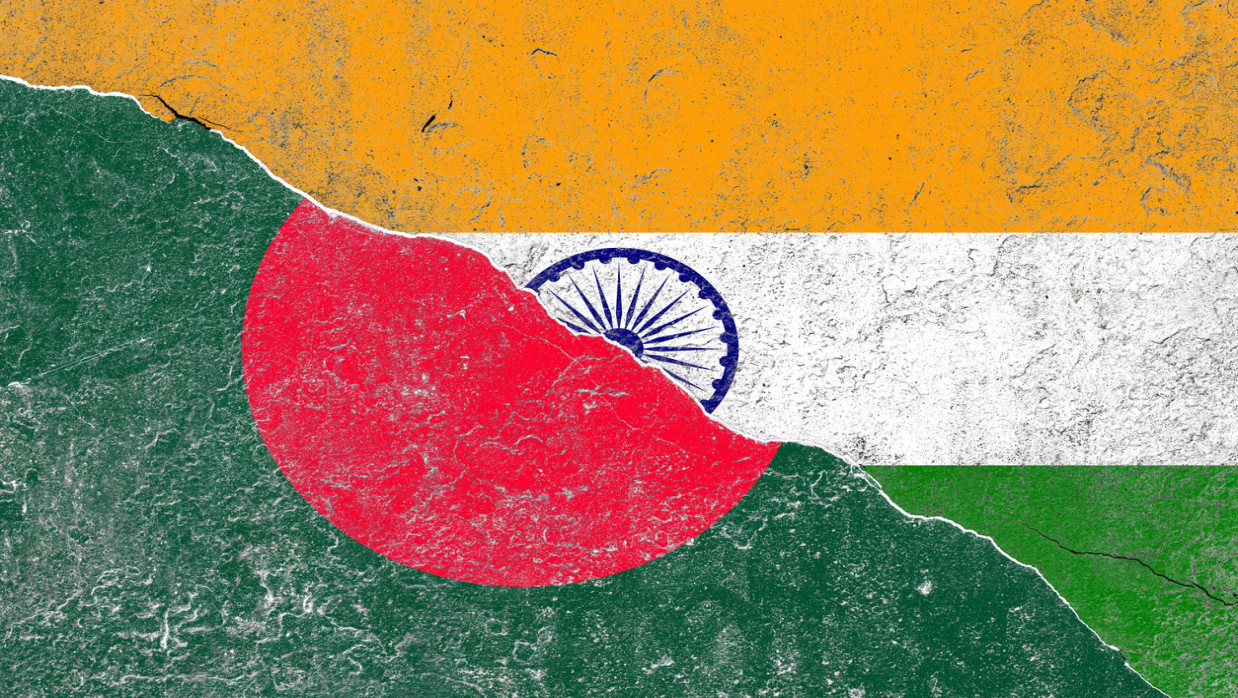
It was one of those periodic debates that have kept observers guessing over the decades. Had Bangladesh become strategically aligned with India and over-dependent on India during Sheikh Hasina's tenure? Or was it truly a partnership between equals? Events since the 2014 overthrow of Sheikh Hasina's government have certainly reopened this debate. No longer the subject of partisan political attacks in Dhaka, questions about Bangladesh's growing subservience to India are now being raised publicly in interviews by officials of the interim government led by Nobel laureate Dr. Muhammad Yunus and privately among sections of the Bangladeshi intelligentsia.
From Sheikh Hasina's flight to India as millions rose against her government, to reports that India provided refuge to many of her government ministers, and to accusations that Bangladesh's political system had become calibrated to New Delhi's designs–all this has revived talk of another Asian country drifting into India's sphere of influence: Sikkim. Even before its annexation by India in 1975, Sikkim's leader, Lendup Dorji, had made famous a declaration that Bangladeshis are now asking themselves: Is my country becoming another Sikkim?
Hyperbole. Emotional. Fair comment. Whichever way one looks at it, the parallels with Sikkim are hotly debated. Bangladesh is a populous country of nearly 180 million people forged in war and bloodletting in 1971. It has an ego and nationalism proportional to its population, not to mention a military. Sikkim was tiny by comparison. But mention the "S" word in polite company in Dhaka, and you will see why the comparison has become center stage once again.
Many Bangladeshis who opposed Sheikh Hasina's increasingly authoritarian style of governance also accuse her of treating Bangladesh not as an independent country with options but as India's client state whose geopolitical direction was mapped out in New Delhi.
Was Bangladesh becoming a second Sikkim? Of course not. But was Bangladesh's democracy at risk by becoming too cozy with India? That is the question that many are now asking.
The Historical Foundations of India–Bangladesh Relations
No discussion of Bangladesh's relations with India can ignore the events of 1971. India played a decisive role in Bangladesh's liberation war against Pakistan. Millions of Bengali refugees crossed into India, Indian military intervention changed the course of the war, and New Delhi emerged as a principal supporter of the new state.
For years, this interpretation of history influenced the Awami League's outlook. Sheikh Mujibur Rahman had friendly relations with India. Relations became much warmer after Sheikh Hasina returned to power in 2009. The Awami League collaborated with India on security operations, transit, intelligence sharing, and crackdowns on northeastern insurgents who found sanctuary along the India-Bangladesh border.
To New Delhi, Bangladesh was the perfect neighbor. Hasina curbed anti-India militant hideouts, helped improve connectivity, and brought Dhaka into New Delhi's security fold.
Domestically, critics began accusing Bangladesh of taking a one-sided approach to the relationship. Water sharing remained a contentious issue, border killings continued, and Bangladeshis complained of unequal trade balances. They felt Bangladesh conceded too much, without reciprocal gestures.
Opposition parties such as the Bangladesh Nationalist Party (BNP) and Islamists alleged Sheikh Hasina was compromising Bangladesh's interests in favor of India. Opposition-led protests erupted after the controversial 2014 elections, and every subsequent election that critics say was rigged: 2018 and 2024.
Fall of the Hasina Government
Public uprisings in 2024 forever altered the political landscape. Although organized to express demands regarding governance and democratic mandate, this soon morphed into nationwide protests against authoritarianism, corruption, and governmental oppression. One controversy that heavily damaged Sheikh Hasina involved the deaths of protesters amid the civil unrest. During her subsequent interview with the Indian Express, she acknowledged having "leadership responsibility" for the deaths of "thousands of citizens", but claimed she did not personally sanction state oppression of protestors.
This admission was extraordinary because it represented the first time she publicly accepted political responsibility for the bloodshed.
Yet perhaps even more politically explosive was the manner of her exit from Bangladesh. According to reports and subsequent commentary, her extraction to India was carried out with coordination among Bangladeshi military figures and Indian authorities.
The symbolism mattered enormously.
To many Bangladeshis, the image of a deposed leader fleeing to India reinforced long-standing suspicions that her regime's survival had depended heavily on New Delhi's political and strategic support.
The subsequent reports that former intelligence chiefs, generals, and key officials associated with her government also took refuge in India deepened these suspicions.
The Scroll Interview and the Language of Dependency
The interview given by Shafiqul Alam, press secretary to Chief Advisor Dr. Muhammad Yunus, to Scroll India was particularly significant because it openly challenged the geopolitical assumptions of the Hasina era.
Maybe the most memorable quote from the entire interview was when he said:
"We treated Bangladesh's foreign policy as if it were leased out to another country for years."
Even though he refused to say it outright, everyone knew he was talking about India.
That one sentence summed up how many Bangladeshis had been feeling for years. National policymaking had become too India-centric, especially in foreign policy and security.
Shafiqul Alam further remarked:
"Maybe she thought the only thing that mattered in South Asia was India."
This was not merely a criticism of bilateral diplomacy. It was an accusation that Bangladesh under Hasina abandoned the strategic balance and reduced its diplomatic space by overcommitting to a single regional power.
The interim administration sought to frame its foreign policy as a return to sovereign equilibrium, improving ties with all SAARC countries, including Pakistan, rather than relying overwhelmingly on India.
This marked a dramatic shift in tone.
India's Strategic Interests in Bangladesh
From India's perspective, Bangladesh occupies immense strategic importance.
Geographically, Bangladesh surrounds India's vulnerable northeastern corridor. Stability in Bangladesh is therefore directly linked to Indian national security. New Delhi has long feared that hostile or unstable governments in Dhaka could provide sanctuary to insurgents, facilitate Chinese influence, or encourage Islamist militancy.
Under Sheikh Hasina's leadership, India checkmated China on various fronts. Border infiltration was effectively plugged, while connectivity between Dhaka and New Delhi grew through roads, railways, ports, and power lines. Dhaka-New Delhi security cooperation and intelligence sharing have taken significant strides with growing military interactions. Chinese strategic incursions into Bangladesh were effectively contained by India's deepening economic footprint. Indo-Bangladesh naval interactions in the Bay of Bengal also gathered pace.
These developments strengthened India's regional position considerably.
However, this strategic intimacy also produced backlash inside Bangladesh. Many citizens came to believe that India supported Hasina not because she represented democracy, but because she protected Indian strategic interests.
That perception became particularly damaging after controversial elections widely viewed as lacking legitimacy.
The Sikkim Analogy
Drawing parallels between Sheikh Hasina and Lendup Dorji may be sensationalist and political fodder, but it is analytically flawed.
Lendup Dorji was the last chief minister of Sikkim and oversaw policies that eventually led to Sikkim acceding to India in 1975. He was accused of being too submissive toward India and of weakening Sikkim's autonomy.
Drawing on the above example, Sheikh Hasina is accused of overseeing a period in which India expanded its influence over Dhaka's internal politics, the security establishment, and the survival of political elites.
However, there are key differences.
Sikkim was a small Himalayan state with little military power or political strength. Bangladesh is a significant South Asian nation with a long history of nationalism and militarized independence.
India has shown no indications that it wants to annex Bangladesh or reclaim its territory.
Hence, the comparison might allude to New Delhi's alleged political influence over Dhaka rather than to actual territorial ambitions.
Metaphors aside, the very mention of such alarming parallels speaks volumes about the nationalist angst within Bangladesh.
The Role of Indian Media
Another recurring theme in the Scroll interview was hostility toward Indian media narratives about Bangladesh.
Shafiqul Alam had leveled the charge that India's leading news outlets peddle "fake news" and blow the issue of minority persecution out of proportion in Bangladesh. Bangladeshi resentment stemmed from a feeling that India's press tends to frame Bangladesh as a communal or security problem.
The interim government argued that Indian media narratives contributed to diplomatic tensions by presenting Bangladesh as unstable, extremist, or hostile to minorities.
At the same time, Indian commentators frequently portrayed the Yunus administration as sympathetic to Islamist forces or insufficiently protective of minorities.
The resulting information war deepened mistrust between the two countries.
Democracy, Legitimacy, and Geopolitics
One of the central tragedies of Bangladesh's recent history is that democracy became entangled with geopolitical rivalry.
Many Bangladeshis began to believe that external powers cared more about stability and strategic convergence than democratic accountability. This hurt India's image with parts of the Bangladeshi public. Although India rhetorically backed democratic values, critics said New Delhi turned a blind eye to Bangladesh's slide towards authoritarianism under Hasina because Dhaka allowed New Delhi what it wanted.
The Yunus administration has attempted to reverse this narrative by presenting itself as a product of popular revolution rather than geopolitical engineering.
However, it, too, faces criticism, particularly over the ban on the Awami League from elections.
In the Scroll interview, Shafiqul Alam defended the ban by comparing the Awami League to post-war fascist movements, arguing that the party had embraced "the politics of murders."
Yet critics contend that excluding one of Bangladesh's largest political forces risks undermining democratic legitimacy once again.
Bangladesh Between India and China
Another important dimension often overlooked is China.
During Hasina's tenure, Bangladesh also developed extensive economic relations with China through infrastructure projects, loans, and investment. India watched these developments carefully. Thus, Bangladesh became part of a larger regional contest between India and China for influence in the Bay of Bengal and the broader Indo-Pacific.
For New Delhi, maintaining influence in Dhaka was therefore not merely bilateral diplomacy — it was part of a larger strategic struggle.This geopolitical competition increased the stakes of Bangladeshi domestic politics.
Toward a More Balanced Relationship
The future of India–Bangladesh relations will depend on whether both countries can move beyond dependency narratives and build a relationship rooted in mutual respect. Bangladesh cannot ignore India. Geography alone makes close cooperation inevitable. At the same time, Bangladesh's political class must avoid allowing domestic legitimacy to become dependent on external backing.
For India, the lesson may be equally important. Supporting one political faction too closely can generate long-term resentment among ordinary citizens. A durable relationship requires engagement with Bangladesh as a sovereign democratic partner, not merely as a strategic buffer.
Conclusion
The fall of Sheikh Hasina's government has fundamentally reshaped the debate about sovereignty and foreign influence in Bangladesh. The accusations emerging from the Yunus administration that Bangladesh's foreign policy had effectively been "leased out" to another country represent one of the sharpest public critiques of India's regional role in decades.
You can argue that not all those charges were deserved. India certainly was at the heart of security and development under Hasina. Bangladeshis supported that relationship too. But the specter of over-dependence turned toxic politically. Comparisons to Sikkim and Lendup Dorji might be exaggerated. But they reflect a fear that sovereignty can be compromised through politics and policy, strategic influence, and the convergence of domestic and international goals.
Bangladesh now stands at a crossroads. Its future stability will depend on rebuilding democratic legitimacy at home while maintaining balanced and respectful relations abroad.
For both India and Bangladesh, the challenge ahead is to replace suspicion with partnership and dependency with dignity.

0 Comments
LEAVE A COMMENT
Your email address will not be published