

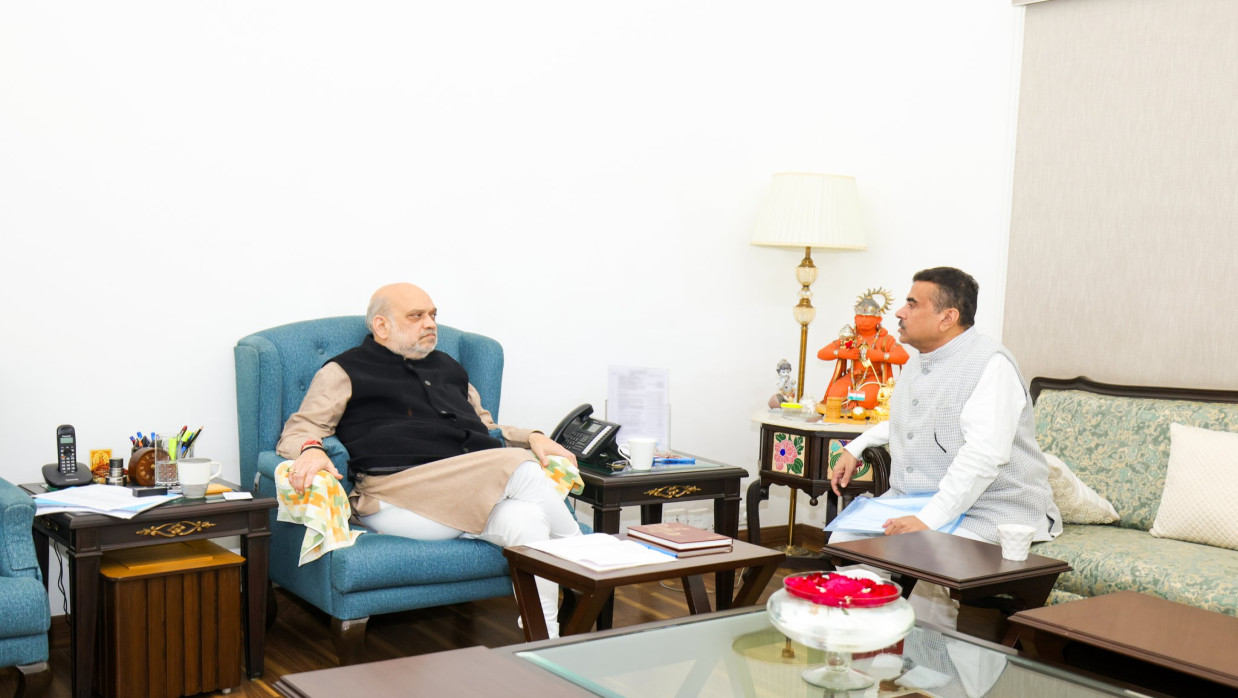
The swearing‑in of Suvendu Adhikari as the new Chief Minister of West Bengal marks a dramatic and unsettling turn in the political history of a state that, for decades, resisted the communal polarization sweeping across much of India. His rise is not merely a regional development; it carries profound implications for India’s Muslims, for Bangladesh, and for the fragile peace of an entire subcontinent already strained by majoritarian politics.
Not too long, on May 4, Adhikari reportedly declared, “The Hindu people of Nandigram made me win again. There, the entire Muslim vote went to TMC... I will work for the Hindus of Nandigram. TMC will be finished. Within 24 hours, it will be destroyed, it will be finished. This corrupt, family-oriented party has no ideology... We will do the work that Home Minister Amit Shah had declared in the manifesto, and Prime Minister Modi has guaranteed again and again. We will complete it..." For many observers, such remarks signaled not reconciliation after a contentious election, but a sharpening of communal lines.
Adhikari is widely regarded as a highly polarizing figure whose political ascent has been intertwined with rhetoric that critics describe as deeply hostile toward Muslims. Within days of taking office, his administration oversaw the demolition of homes and small businesses using bulldozers – an approach that has become emblematic of the governance style of Uttar Pradesh’s former Chief Minister, Yogi Adityanath. On Thursday, May 14, 2026, bulldozers also razed a Trinamool Congress party office and a clock tower in West Bengal. This comes a day after an allegedly illegal tannery was brought down in Kolkata’s Tiljala area after a fire broke out in the building, killing two and injuring three persons.
Critics argue that such actions disproportionately affect Muslim communities and are often justified under the pretext of “illegal encroachment,” even when due process is questionable. For many, the speed and symbolism of these demolitions suggest not administrative necessity but a political message—one that deepens fear among minorities and signals a new, harsher era in West Bengal’s governance.
This shift in West Bengal is not occurring in isolation. It is part of a broader transformation of India under the Bharatiya Janata Party (BJP), whose ideological project – rooted in Hindutva—has increasingly reshaped political, social, and administrative life across the country. From Assam to Gujarat, from Karnataka to Uttar Pradesh, the pattern is unmistakable: a narrowing of civic space for minorities and a normalization of exclusionary politics.
West Bengal, long governed by parties that resisted communal polarization, was once considered a buffer against this tide. That buffer has now collapsed.
One of the most troubling aspects of this year’s West Bengal election was the widespread allegation that many Muslim voters were prevented from voting on “technical grounds.” Reports from civil society groups, journalists, and political observers suggest that the disenfranchisement was not accidental but systematic – an outcome of bureaucratic maneuvers that disproportionately affected Muslim-majority constituencies.
While the full extent of the irregularities is still being documented, the pattern aligns with concerns raised in previous elections in other BJP‑ruled states, where voter list manipulation, document requirements, and targeted exclusions have been used to reshape electoral outcomes. Many analysts attribute these tactics to strategic planning at the national level, particularly under the influence of Home Minister Amit Shah.
For a hybrid-democracy like India that prides itself on electoral legitimacy, such practices strike at the heart of public trust.
The rhetoric emerging from some BJP leaders about “pushing illegal Bangladeshis back” has resurfaced with renewed vigor after Adhikari’s victory. While India has the sovereign right to enforce immigration laws, the political framing of this issue often blurs the line between undocumented migrants and Indian Muslims, creating a climate of fear and suspicion.
This narrative is not new. It has been used repeatedly to justify policies such as the National Register of Citizens (NRC) in Assam, which left nearly two million people – many of them Muslims – at risk of statelessness. The danger now is that West Bengal may become the next laboratory for such policies.
For Bangladesh, this rhetoric is deeply destabilizing. It revives old anxieties about demographic engineering and raises the specter of forced population transfers – an act prohibited under international law. Even when such outcomes do not materialize, the political signaling alone can strain bilateral relations.
Bangladesh‑India relations were already at a low ebb during the Interim Government of Dr. Muhammad Yunus. Contrary to some narratives in India, the tension did not stem from Dhaka’s actions but from longstanding grievances about New Delhi’s perceived interference in Bangladesh’s internal affairs. Many Bangladeshis viewed the previous government of Sheikh Hasina as excessively aligned with Indian interests, to the point of compromising national sovereignty.
Hasina’s nearly sixteen‑year mis-rule left behind a legacy of serious allegations – extrajudicial killings, enforced disappearances, rampant corruption, and the near‑bankruptcy of state institutions. She now faces legal proceedings in Bangladesh, yet continues to reside in India, a fact that fuels public resentment and complicates diplomatic engagement.
The return of the BNP to power in Dhaka initially raised hopes for a reset in bilateral relations. But Adhikari’s rise in Kolkata threatens to widen the rift once again. West Bengal is not just another Indian state; it is Bangladesh’s immediate neighbor, sharing deep cultural, linguistic, and economic ties. A hostile political climate in Kolkata inevitably reverberates across the border.
The Risk of Cross‑Border Communal Contagion
Communal tensions do not respect borders. If targeted attacks on Muslims escalate in West Bengal, the ripple effects could be felt in Bangladesh, where minority communities – particularly Hindus – have historically faced retaliatory violence, although on a much small scale, during moments of regional crisis. This is not a hypothetical scenario; it has happened before.
The danger is twofold:
- Indian Muslims may face intensified discrimination, violence, or displacement, especially if bulldozer‑style governance becomes normalized in West Bengal.
- Bangladeshi minorities may become collateral victims, as extremist elements exploit regional tensions to justify attacks – potentially prompting well‑off Hindu families to consider relocating to India for safety.
This cycle of reciprocal insecurity benefits no one. It undermines social cohesion, destabilizes border regions, and erodes the moral foundations of both democracies.
Genocide is not a sudden eruption; it is a slow, deliberate process. Scholars of mass violence have long warned that the earliest stages are marked by dehumanizing rhetoric, discriminatory laws, targeted disenfranchisement, and the normalization of state‑sanctioned violence. According to Genocide Watch—an organization dedicated to preventing mass atrocities—many of these warning signs are now plainly visible in India’s political landscape. Ignoring them would be an act of willful blindness.
Raising this alarm is not an accusation that genocide has already occurred. It is a recognition that India is moving along a trajectory that experts in atrocity prevention find deeply troubling. When a majoritarian ideology embeds itself in state institutions, when entire communities are cast as outsiders or enemies, the risk of mass violence does not merely rise—it becomes structurally enabled. The danger grows not through dramatic ruptures, but through the steady normalization of exclusion and coercion.
The ongoing transformation of India under the banner of Hindutva is therefore not just a domestic political shift; it is a regional security threat. For India’s 200 million Muslims, the implications are existential. For South Asia as a whole, the destabilizing potential is immense. A country of India’s size and influence sliding toward systematic persecution is not merely “concerning”—it is a crisis in the making.
A Call for Leadership, Not Bigotry
Suvendu Adhikari now governs a state that has historically prided itself on pluralism, intellectualism, and resistance to communal hatred. The responsibility on his shoulders is immense. He can choose to govern as a statesman—protecting all citizens, upholding the rule of law, and preserving West Bengal’s legacy of inclusivity. Or he can continue down a path of polarization that endangers millions and destabilizes an entire region.
The choice he makes will shape not only West Bengal’s future but the future of India‑Bangladesh relations and the safety of vulnerable communities on both sides of the border.
It is time for leadership, not bigotry. Time for governance, not intimidation. Time for healing, not division.

0 Comments
LEAVE A COMMENT
Your email address will not be published