

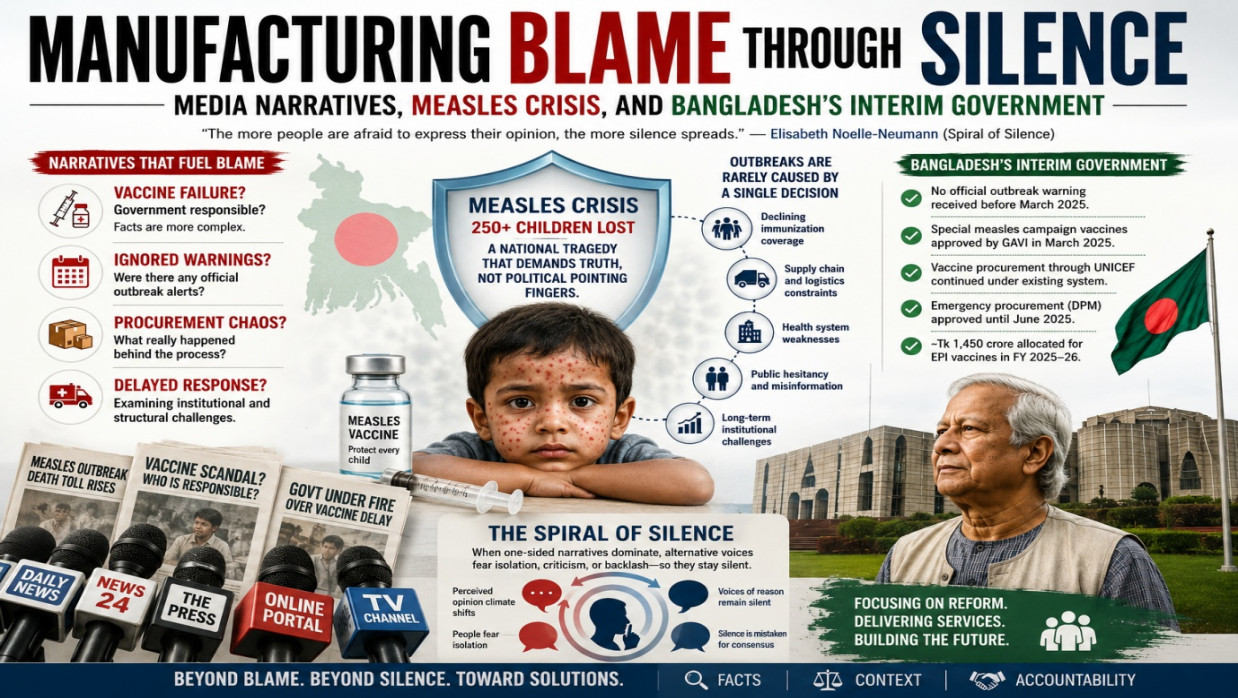
During national disasters or other unfortunate incidents in any country's history, it is common for people to seek explanations and accountability for them. Unfortunately, in many cases, people found not the reality but the politics behind the incident. One example is the recent measles vaccination issues faced by Bangladesh. In this case, what started as a public health crisis turned into a political blame game against the interim government of Professor Dr. Muhammad Yunus, a Nobel Laureate. Alongside this, various misleading narratives came from some media outlets in India. While this is the story of a public health crisis, many people in the world do not realize the deep politics of the situation. It became apparent that several media organizations in Bangladesh were not ready to tell the whole truth of the situation in a critical manner.
The public outrage is understandable. The death of children is heart-wrenching beyond imagination. However, taking such an emotional situation and simplifying it into a matter of blame against one administration, without exploring institutional realities, long-term structural weaknesses, and all the events that took place, is problematic. Even more problematic is the reluctance of media organizations in Bangladesh to publish the background of the procurement process. This needs to be understood in light of communication theory.
Elisabeth Noelle-Neumann first introduced the communication phenomenon known as the "Spiral of Silence". According to her theory, individuals and institutions avoid expressing their thoughts in certain situations for various reasons. Such avoidance stems from feelings of isolation, fear, and a lack of courage. Elisabeth Noelle-Neumann's "Spiral of Silence" seems highly applicable in Bangladesh today.
The Narrative versus Facts
Some articles and social media discussions suggest that this measles crisis occurred solely due to the interim government's negligence. According to them, the interim government ignored warnings from international agencies, changed the procurement system irresponsibly, and delayed the procurement of the vaccine.
However, Professor Dr. Md. Sayedur Rahman, a former special assistant to the chief adviser for the Ministry of Health and Family Welfare, offered a different explanation.Professor Dr. Md. Sayedur Rahman clarified that the interim government never received any epidemiological warning or instruction from any international organization requiring an immediate emergency measles campaign.
According to him, a nationwide special measles campaign was organized twice: the first in 2014 and the second in 2020, with roughly a six-year gap between the two. As per the plan, the third measles campaign was scheduled for 2024. However, Bangladesh faced exceptional political turmoil in 2024 after the July uprising, which made it difficult to organize the campaign. Health authorities had to deal with emergencies related to hospitals, the management of casualties, injuries, and dead bodies. Also, GAVI's formal approval letter for the procurement of measles and rubella vaccines was received in March 2025. Also, according to him, there was "no alert, warning, or red flag from any national or international agency" at that time requiring an immediate special measles campaign.This clearly contradicts the popular perception about authorities ignoring an outbreak warning.
Likewise, regarding the vaccine procurement process, he also denied the allegation. In his clarification, he mentioned that during the tenure of the interim government, no EPI vaccines were procured through open tender, and procurement through UNICEF under the direct procurement method continued as usual. He also added that discussions about the procurement reform process were only exploratory, aimed at improving the procurement process for EPI vaccines, as the process depends heavily on the emergency procurement method. Also, during its tenure, the interim government significantly increased vaccine allocations; around Tk. 1,450 crore was allocated for procuring EPI vaccines using combined government and ADB funding. These facts may or may not justify the interim government, but they certainly provide a different perspective on understanding the whole thing.
"Spiral of Silence" and the Silence in Media Organizations in Bangladesh
Then, why did many people not get these facts about the incident?Perhaps the reason lies in the very "Spiral of Silence" theory mentioned above. According to Elisabeth Noelle-Neumann, people constantly monitor public opinion to avoid social isolation or future retaliation. According to Noelle-Neumann's theory, the mass media is the primary agent that shapes the so-called "opinion climate". Once a certain opinion becomes the majority, the minority tends to stay silent to avoid being targeted for holding an opposing view.
It looks like in today's Bangladesh, people who express opinions against the previous political structure may face backlash. Similarly, people who defend the interim government of Bangladesh are likely to face backlash. Hence, many journalists choose silence and selective framing over telling the truth in the form of a full story.The effects of such practice could be devastating for democratic societies.
Once people are fed politically motivated stories without being presented with the full background information, their public opinion gets skewed. Citizens will not be able to think critically about the situation because only one side of the story has been told to them."Spiral of Silence" may lead to nothing but the silencing of the truth.
Measles Outbreaks Are Rarely Triggered by Any One Government
As public health experts understand, measles is a highly contagious disease that occurs in outbreaks. Various factors,, such as declining immunization coverage, logistical failures, vaccine hesitancy, population mobility, weak health infrastructure, and other institutional problems, contribute to triggering measles outbreaks.However, Professor Dr. Md. Sayedur Rahman also acknowledged bureaucratic inertia, broken institutional memory, delays in project approvals, and other coordination problems in this case.But even then, all public health experts know that measles outbreaks rarely occur during the tenure of a single government. If any measles vaccine problem occurs, it cannot be pinned down to a single administration.
Politicizing the deaths of children would not help in building future vaccination trust.Once public trust in the immunization system fails, the repercussions become more serious.For developing nations, such an eventuality can be dangerous.
Media's Responsibility in a Fragile Democracy
While a responsible journalism system needs to investigate power critically, it should not let its work descend into sensationalism. Journalists are supposed to present a balanced view of the situation, not feed the public with politically-motivated narratives. Once journalism forgets its responsibility, a country's democracy is compromised.Currently, Bangladeshi media institutions are facing a huge dilemma whether to continue serving politics or reclaim their responsibility as the media.
The issue of vaccine procurement and the measles outbreak should not be politicized. Instead of considering ways to weaponize the tragedy against political opponents, people in Bangladesh should think of these vital questions:How can we strengthen institutional continuity during the government's transition period? How can we make vaccine supply chains secure and insulated from bureaucratic problems?
How can we improve our health communication during crises? And lastly, how can we protect the truth amidst a polarized society where silence replaces journalism? No democratic society can flourish without truth.As Elisabeth Noelle-Neumann warned decades ago, once the spiral of silence dominates discourse, the perception of consensus becomes stronger than reality itself. And once the truth becomes inconvenient, the biggest casualty is not a single government or leader but the public's right to know.

0 Comments
LEAVE A COMMENT
Your email address will not be published