

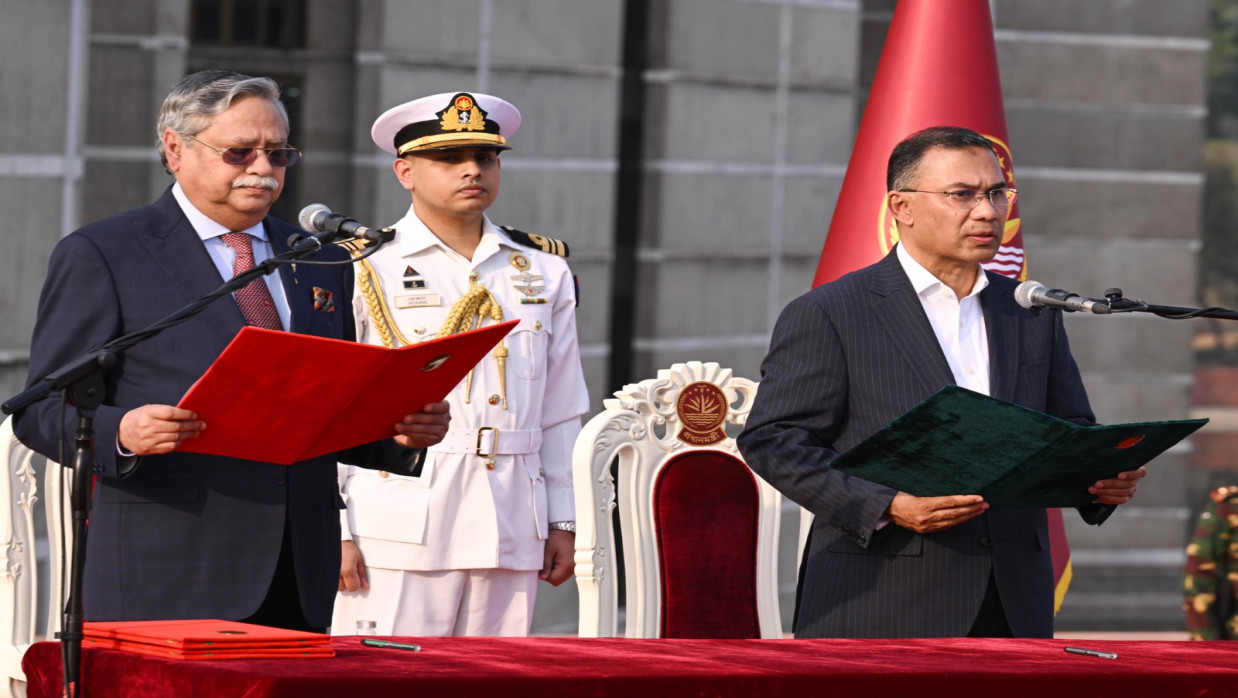
The Bangladesh Nationalist party (BNP) has won a landslide majority in the country’s first election held on February 12, 2026. The election transited Bangladesh from a non-political technocratic Interim Government which was formed in the aftermath of a mass uprising that ended the 15-year rule (2009-July 2024) of Sheikh Hasina in Bangladesh. One commendable aspect of the election is that the Interim Government kept its commitment and held the election in free and fair conditions.
The election commission has confirmed that the BNP alliance had secured 212 of the 297 parliamentary seats announced so far. Jamaat-e-Islami, which was banned by Hasina’s government, came second with 77 seats along with its coalition partners members and left oriented parties were decimated. Only seven women will sit in the parliament. BNP, the winning party has since formed the government.
The election and the evolving political dynamics
Unlike the 2001-2006 era, when BNP and Jamaat collaborated with each other, this election has seen the opposite.
BNP and Jamat have contested the election as bitter rivals. Jamat now occupies the position of the principal opposition party in the parliament, a position it never held in Bangladesh’s history.
The voting marked a significant political shift in Bangladesh, a country of more than 170 million people. Polls offer Bangladesh a rare window to democratic transformation. The 2026 vote marked a qualitative improvement over Bangladesh’s previous elections. According to the Bangladesh Election Commission, the BNP Alliance received 49.97% and the Jamaat Alliance received 34.08% of total votes cast. But the BNP won 71% of parliamentary seats despite receiving 50% of votes. While Jamaat recorded historic gains, but first – past - the -post electoral system returned the BNP to power. The National Citizen Party (NCP) which is comprised of student protest leaders, won 6 seats out of 30 seats contested (20%) will play a robust role in the opposition. Given a highly polarised political environment in the country, which is a significant achievement for the NCP
It is also evident from the results of this year’s election that the Jamaat, which until recently has been a party in the fringe, seems to have spread its influence, wide and deep such that the party as a dominant body in the parliament, as a formidable opposition, has assumed the position of unprecedented institutional recognition and an important vehicle for change at the legislative level. ,
The BNP, a party which is firmly rooted in Bangladesh’s political architecture won the election not because it inspired the nation, but it knew how to use the arithmetic of first past-the post system and at the same time, the party used the intricate patronage networks to its advantage.
For rural voters in Bangladesh the patronage networks offer safety net, jobs, stability, and avenues for dispute resolution. The system on its own does not guarantee justice, familiarity does and the interplay of patron/client relationship in Bangladesh’s politics is starkly if not painfully evident from the fact that when people were given the choice to elect representatives they opted for existing elites at the expense of the generation – the Gen Z - that spearheaded the July’s bloodied revolution and rescued Bangladesh from the grip of a repressive, autocratic and kleptocratic government – from the centre stage, they are now at the fringe of Bangladesh’s political atlas.
The Awami League Question
A defining feature of the election was that the interim administration which banned Awami League, Hasina’s party because of its most recent horrific human rights abuses, the party was unable to participate and contest in the election.
Regardless, as the AL remains one of the largest political forces and with significant followings, many thus argue that the 2026 election was anything but pluralistic, not entirely.
However, banning political parties that were involved in terrible human right violations from engaging in normal political processes is not new.
For example, in Germany, the National Socialist German Workers' Party commonly known as the Nazi Party, a far-right political party in Germany that operated between 1920 and 1945 under the leadership of Adolf Hitler that engaged in terrible human right violations in Germany during its rule was banned and declared a criminal organization, after Germany's defeat by the Allied forces in 1945 and the fall of the Nazi government. Today, the use of Nazi symbols is prohibited in Germany and Austria.
The created by Benito Mussolini the National Fascist Party of Italy is another example, a political party that ruled Italy from 1922 to 1943 by following Nazism in its ideological orientation was officially dissolved and banned for life by the post-War Italian government with a constitutional provision that states, "It (National Fascist Party) shall be forbidden to reorganize, under any form whatsoever, the dissolved Fascist party."
Whether similarities exist between the AL and these two European fascist parties need further discussion, but it is undeniable that the AL under Hasina was fundamentally a reincarnation of the BAKSAL, a one-party dictatorial system introduced by her father in 1975.
During Awami League’s her 15-year rule (2009-24) under Sheikh Hasina she exercised significant power which led to high levels of white-collar crimes and extensive financial corruption. She also ran a brutal repressive regime marked by unlawful killings, enforced disappearances, and brutal repression of dissent. Her regime was run like a criminal syndicate, and yet recent surveys suggest that 5-7% of voters remain staunchly loyal to the AL, who will never defect.
While public anger and resentments against the AL and their abuses persist, given Bangladesh’s wavering political history, it would be premature to write-off the AL forever.
For decades, politics in Bangladesh has centred around rivalry between the Awami League and the BNP, both centre-right parties. A third party, Bangladesh Jamaat-i-Islam (BJI), an Islamist right-wing party has had many devoted followers but has never done well, electorally.
Removal of the Awami League from the ballot, has fundamentally altered the competitive landscape of Bangladesh – BJI has emerged as the second largest political parties in Bangladesh in this year’s election.
Whether the Awami League’s absence is temporary and for how long, is difficult to say, but its absence has promoted a rather unique political dynamic in the country that has ramifications for the future political tapestry and stability of the country.
For the moment, the BNP holds a powerful parliamentary mandate – “the BNP-led alliance has won 212 seats, followed by 77 for the Jamaat-led alliance, out of the 297 parliamentary seats.” However, the scale of its victory should not be mistaken for unconditional endorsement.
The Referendum and BNP’s feet-dragging
Held alongside Bangladesh’s parliamentary election was a referendum that included among other proposals, sweeping constitutional reforms for proportional representation through creation of an upper chamber, introduction of improved checks and balances in governance and stricter anti-corruption and pro-democracy measures, reflecting the aspirations of student-led July bloodied uprising that toppled the autocratic and kleptocratic Hasina regime.
The main argument behind the July Declaration is that the current constitution, the Bangladesh Constitution, 1972, is full of loopholes that enables the winning party with two/third majority - as was the case during Sheikh Hasina’s rule - to transform democracy into autocracy and dent accountability and normalise corruption.
Sadly, the BNP which has got two/third majority in the Parliament is now dragging its feet on these constitutional reforms, known as “The July National Charter”, which most political parties signed last year, which has received 60.26 percent the ‘Yes’ votes. BNP argues that the Referendum and the proposed reforms have no constitutional backing.
Recently, Michael Kugelman, a Senir Fellow at the Atlantic Council has said in an interview, “If the party (BNP) is truly ready to break with the past, and show that it’s no longer a reflection of the old politics that so many Bangladeshis deplore and want expunged, then it will implement the reforms. This is especially the case since the public gave the reforms such a ringing endorsement in the referendum vote.”
Current leader of the opposition in the parliament and the head of the Bangladesh Jamaat-i-Islam, Dr. Shafiqur Rahman has said on Feb 17, 2026 that BNP’s refusal/feet-dragging to oath as a member of the State Reform Council tantamount to dishonouring ‘July 2024’. He further added it was because of the July Uprising that this election was held, and Tarique Rahman became the Prime Minister, and “I have become the Opposition Leader.”
Re-surfacing of dynastic politics/cronyism
Bangladesh has long been characterised by dynastic power politics and cronyism. The concentration of power in a few hands has been a recurring theme in Bangladeshi politics. For decades, Bangladesh had few political alternatives. Besides periods of military rule, the country has been dominated by two political dynasties: one led by late Begum Khaleda Zia, wife of former president Ziaur Rahman and mother of the current prime minister, and the other by her rival, Sheikh Hasina, daughter of Sheikh Mujibur Rahman, the founding president of the country. She is now a death row convict.
Tarique Rahman, the BNP leader who has spent 17 years in self-exile living in London, has assumed the leadership of the government on 17 February. Rahman is the son of the former president and BNP leader, Ziaur Rahman, and his wife Khaleda Zia, who previously served two terms as the country’s prime minister.
It is good that under Tarique Rahman’s leadership, the BNP has won the 2026 election and with two/third majority, an election which by all accounts was free and free.
However, this is not enough to guarantee good governance rather an overwhelming majority in the parliament has all the ingredients to promote cronyism, abuse and corruption that Bangladesh’s politics has been known for and witnessed in recent times.
Moving forward
Indeed, if world political history is any guide, an overwhelming majority in the parliament and strong mandate from the people do not automatically contribute to transparency and accountability in governance nor generate stability. In fact, the opposite may happen and it did, here in Bangladesh itself.
Therefore, the central political question now is whether the BNP could reinvent itself after years of its past rule that was mired by corruption allegations and confrontational politics. Also, failure to break with old patronage networks could rapidly erode public trust.
The new policy direction is important now because political stability based on a well-functioning democratic process is the most essential prerequisite for the government to attain political stability and the capacity to reform and revive the economy.
Notwithstanding transition to democracy through a free and fair election Bangladesh continues to face major risks, political and economic and these include but not limited to rising import and living costs, unemployment and inflation, climate vulnerability and debt, and a weakened governance framework.
While it is true that the 2026 February election has paved the way for Bangladesh to transit to democracy, the election has not quite enabled democratic governance, in the real sense of the term.
Adoption of the July National Charter which the people of Bangladesh has endorsed through the recently held referendum has the potential to transform Bangladesh from a flawed and corruptible governance framework to a framework which is truly representational, transparent and accountable that would have the potential to guarantee maximum transparency and accountability in the decision-making processes of the state and combat corruption.
Soon BNP comes to its senses and embraces the Referendum verdict, in letter and in spirit, better it is for the BNP, and indeed, for the country.


0 Comments
LEAVE A COMMENT
Your email address will not be published