

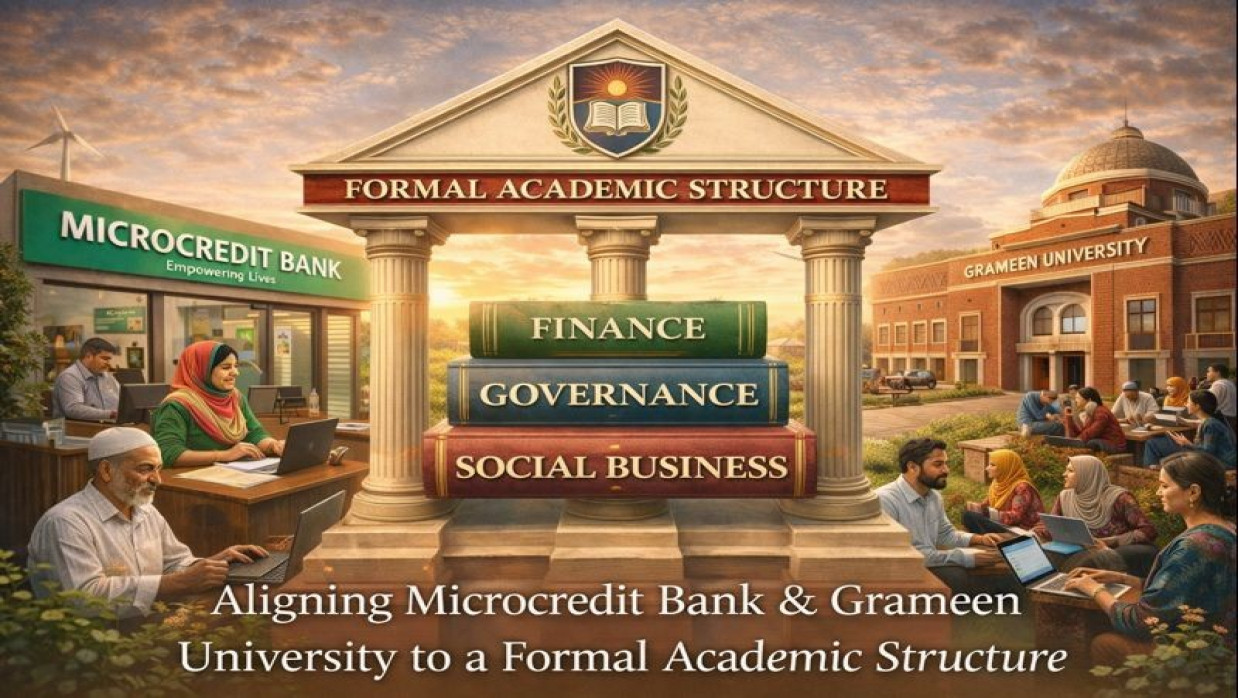
Institutional Architecture for Social Business Education, Research, and Deployment
This academic framework represents a pragmatic and visionary approach to a strategic collaboration between the Microcredit Bank, Grameen University, and the Social Business philosophy introduced by Professor Muhammad Yunus. Rather than following a rigid, one-size-fits-all model, the framework is purposefully designed to evolve. Its modular and scalable structure ensures it can adapt to a variety of global contexts and disciplines, while remaining deeply rooted in Bangladesh’s practical experience with poverty alleviation, grassroots entrepreneurship, and institutional innovation.
At its core, this model rejects the traditional separation of education, finance, and development as disconnected fields. Instead, it integrates them into a cohesive and interdependent ecosystem where learning, action, and policy continually inform and strengthen one another. The Microcredit Bank shall serve as a real-world laboratory for inclusive finance and Social Business practices, while Grameen University will act as the intellectual hub, transforming on-the-ground experience into academic knowledge, conducting research, and shaping leadership development and policy insights.
What sets this model apart is its capacity to show, not just tell. By embedding Social Business into a university structure that’s linked to a regulated financial institution, Grameen University demonstrates how academia can go beyond theory to become a driver of real-world change. The integrated curriculum is designed not just to educate students, but to spark inspiration, encouraging other universities, both public and private, in Bangladesh and across the world, to adapt and expand similar frameworks within their own systems.
In doing so, this model redefines the role of higher education not merely as a place of learning, but as a powerful force for ethical finance, inclusive development, and lasting social transformation.
Academic Programs & Degree Pathways
Undergraduate Programs (BA / BSc)
Function: Purpose: Building Ethical Foundations, Systems Thinking, and Social Consciousness
At the undergraduate level, Grameen University is intended to instill an early ethical foundation, systems thinking, and awareness in students. These courses are intended to produce socially conscious individuals and leaders who understand poverty, inequality, and exclusion not as discrete events, but as consequences of poorly designed institutional structures.
The BA in Social Business and Development Studies is centered on the concept of poverty as the failure of systems, not people. The curriculum includes the ethics of markets, the history of development paradigms, and the role of community-based institutions in rebuilding dignity. There is an integration of development studies and philosophical/political economy approaches.
The BSc in Inclusive Finance & Cooperative Economics exposes students to micro-credit schemes, savings instruments, insurance products, and payment channels designed specifically for low-income groups. The course focuses on the cooperative principles of ownership, financial literacy, cooperative governance structures, and cooperative operating models. The course equips students with a solid analytical knowledge of finance but also exposes them to the radically different nature of inclusive financial systems vis-à-vis banking for profit.
The BA in Social Entrepreneurship & Innovation aims to produce graduates who will serve as problem solvers and enterprise builders. The program combines design thinking, grassroots innovation, and mission-driven business models to empower students to identify social problems that can be turned into feasible mission-driven enterprises.
Throughout all of their undergraduate programs, students take a unified set of core courses: Foundations of Social Business, History and Political Economy of Microfinance, Inclusive Finance and Poverty Dynamics, and Ethics, Governance, and Democratic Ownership, culminating in a Community Immersion Practicum that has a direct tie to Microcredit Bank field units. In this manner, students are introduced to Microcredit Bank as a real-world entity rather than a theoretical one.
- Graduate Programs (Master’s Level)
Purpose: Raising System Designers, Policy Thinkers, and Mission-Oriented Leaders
The graduate programs offered at Grameen University focus on developing leaders who can create institutions, develop policies, and scale a social mission without compromising their integrity. These programs cater to mid-career professionals, development professionals, and rising leaders seeking advanced knowledge.
The Master of Science in Social Business Management (MS-SBM) equips students with skills to run social enterprises, inclusive banks, and mission-driven institutions. The curriculum combines strategy, governance, financial sustainability, and impact accountability to enable students to successfully run a social institution.
The MA in Development Policy & Inclusive Institutions focuses on the design of development policy, public administration, and institutional change. The program involves analyzing the impact of legislation, regulation, and governance on development outcomes, using the Microcredit Bank Ordinance as a case study.
The MS in Social Finance & Impact Measurement equips students with the skills to measure social outcomes, develop social impact metrics, and integrate finance and development objectives. This program prepares students to work in impact funds, development banks, research institutions, or regulatory agencies.
Each master’s degree has built-in residency components in which research projects or policy labs are conducted in collaboration with Microcredit Bank. This means that learning seamlessly transitions into implementation in real-world settings, where theory and practice inform each other.
- Doctoral Program (PhD in Social Business & Inclusive Development)
Objective: Creating Grameen University as an International Knowledge Hub
The Ph.D. program makes Grameen University a global hub for cutting-edge research in Social Business, Inclusive Finance, and Institutional Transformation. The Ph.D. researchers conduct in-depth, multidisciplinary research across various tracks, including Social Business Theory and Institutional Economics, Inclusive Finance, Banking Laws and Regulation, Poverty and Inequality, Systems Transformation, Governance, Ethics, and Mission Protection.
The PhD scholars conduct longitudinal and comparative studies using Microcredit Bank data, in accordance with rigorous ethical and privacy norms, to produce world-relevant knowledge informed by Bangladeshi experiences. This initiative ensures that Bangladesh not only leads in development practices but also in theory development and global knowledge creation.
Signature Labs and Experiential Learning Platforms
The signature labs developed as part of the Grameen University model aim to bridge the divide between theory and practice by transforming classrooms into spaces for experimentation, learning, and social impact. Each of these labs is closely integrated with the operational realities of the Microcredit Bank and serves as a platform for students and faculty to tackle real-world development challenges. These labs, taken together, are intended to institutionalize experiential learning, applied research, and ethical leadership as core elements of Social Business.
Social Business Innovation Lab (SBIL)
The Social Business Innovation Lab (SBIL) is conceptualized as a dynamic platform for co-creation, enterprise development, and problem-solving based on the realities of the social context. In the Social Business Innovation Lab, interdisciplinary teams of students and faculty will work with practitioners from the Microcredit Bank to conceptualize, design, and develop social enterprises aligned with the operational realities of the Microcredit Bank. Instead of focusing on innovation in the abstract, the Social Business Innovation Lab will focus on innovation within the financial, regulatory, and social realities of borrowers.
Pilot initiatives under development in the lab target critical sectors of inclusive development, including agriculture and agribusiness, primary healthcare delivery, education and skills training, renewable and clean energy solutions, and women-owned and women-led businesses. Each of these initiatives is created not only to be financially sustainable but also to have social impact, create employment, and build community resilience. Through the feedback loops that connect borrowers, Microcredit Bank officials, and academic researchers, the innovations remain grounded and responsive to the needs of people, the market, and the ethical imperatives of social business. In this manner, the SBIL cultivates a new generation of social entrepreneurs who are capable of designing businesses that are both socially driven and institutionally sustainable.
Inclusive Finance & Impact Measurement Lab (IFIML)
The Inclusive Finance & Impact Measurement Lab (IFIML) addresses one of the most pressing issues in inclusive finance: how to measure success beyond financial performance metrics. By going beyond traditional metrics such as repayment rates and portfolio size, the IFIML seeks to truly understand what inclusive finance achieves in borrowers' lives.
The research of IFIML scholars focuses on the multidimensional outcomes of inclusive finance, including household well-being, income stability, resilience to economic and climate-related shocks, gender empowerment, access to education and healthcare, and intergenerational mobility. By using both quantitative and qualitative approaches, the IFIML produces robust, evidence-based research on the impact of financial inclusion on social and economic outcomes. Its research products include policy briefs, peer-reviewed research articles, and the annual Social Impact Reports that are prepared for the Microcredit Bank. Through its research, the IFIML helps establish a new global standard for impact research in Social Business and inclusive banking.
Governance, Ethics, and Institutional Design Lab (GEIDL)
The Governance, Ethics, and Institutional Design Lab (GEIDL) focuses on a foundational yet often overlooked dimension of development institutions: how governance structures and legal architecture protect or undermine social missions. Through in-depth case studies of the Microcredit Bank’s ownership model, board structure, regulatory independence, and separation from NGOs and government influence, students gain practical insight into how institutions can scale without sacrificing integrity.
The lab emphasizes that ethical leadership cannot rely solely on personal values or informal norms; it must be embedded in laws, accountability mechanisms, and organizational design. Students learn how transparent governance, statutory obligations, and independent oversight prevent mission drift, mitigate conflicts of interest, and build long-term public trust. Graduates emerging from GEIDL are equipped with a sophisticated understanding of how to design, manage, and reform institutions that balance autonomy with accountability an essential skill set for future leaders in finance, public policy, and social enterprise.
Together, these signature labs transform Grameen University into a living ecosystem of Social Business education. They ensure that learning is not confined to classrooms, that research is rooted in real-world challenges, and that leadership is shaped through direct engagement with institutions committed to ethical, inclusive, and sustainable development.
Research Institutes and Centers of Excellence
Institute for Social Business & Inclusive Capitalism (ISBIC)
As the premier think tank of Grameen University, the ISBIC is the umbrella research institution for the study of Social Business theory and practice across various disciplines. The institute publishes journals, working papers, and international case studies, and organizes international conferences and executive meetings. The institute designates Grameen University as the global guardian of Social Business ideas.
Center for Microcredit, Banking, and Cooperative Governance (CMBG)
This is an applied research arm that examines the Microcredit Bank Ordinance and compares it with various global banking models. It provides guidance to policymakers and regulators and also offers executive training programs for professionals. This research directly influences policy reform and institutional design.
Rural Transformation & Entrepreneurship Institute (RTEI)
The RTEI is the university's deployment arm that serves the community. In partnership with Microcredit Bank branches, it assists in improving micro-enterprises, particularly emphasizing youth, women, and climate-affected groups. The aim is to help with loan services for scalable rural enterprise ecosystems.
Executive Education and Leadership Development
The target audience for the Social Business Leadership Certificate (SBLC) includes banking executives, NGO leaders, government officials, and development professionals working internationally. This training program is offered jointly by Grameen University faculty members and Microcredit Bank professionals. They focus on topics such as governance in social business, inclusive finance & risk ethics, scaling without mission drift, & leadership for systemic change.
Student Journey: From Enrollment to Outcomes
A typical student at Grameen University would go through a process of theoretical foundation in Social Business, immersion in Microcredit Bank communities, innovation work in the lab addressing real-world problems, and finally a capstone project jointly supervised by faculty and bank professionals. Social entrepreneurs, ethical bankers, policymakers, and institutional reformers would emerge from this educational process. Education would become a pipeline for transforming institutions rather than just a process of credentialing.
Strategic Outcome: A New Paradigm in Education with the Integrated Social Business University Model
This new paradigm in education is a quantum leap forward from the traditional university model, which is focused only on the classroom, theory, and outcome-based education disconnected from the university itself. In the context of the Integrated Social Business University Model, the Microcredit Bank is not only a partner and a place for internships but also a real-time living laboratory, where all decisions and outcomes of the financial institution and the university are observed and analyzed. Grameen University is no longer only a place for the awarding of degrees but also the epicenter of knowledge production, where evidence is turned into theory and into socially relevant scholarship of global importance. It is no longer only the place where research is conducted and published, but also where the outcome of the research is fed back into the system of institutional design and policy thinking and social innovation, where the faculty and the students are part of the process of creating the future of finance, governance, and development.
Most importantly, Social Business is no longer seen as an optional extra or an add-on to mainstream economics and management studies. Rather, it is integrated into the very fabric of finance, education, and governance. Ethics into law, ethics into accountability, and ethics into operations – sustainability beyond the individual or the program.
This model provides something that traditional universities cannot – a closed loop of learning, implementation, and informed policy. Ideas are implemented in real-world institutions; implementation provides insight and understanding; and understanding informs policy, regulation, and education. Policymaking is not taught as an abstraction; it is learned as an experience. Leadership is not taught as a theory; it is learned as a practice within an ethically-designed institution.
By providing this closed loop of learning and implementation, the Grameen University and the Microcredit Bank collectively provide the first fully integrated Social Business University – a model that transcends the traditional graduate employability skills and discipline-based boundaries to produce system builders, ethical leaders, and innovators of institutions. What is created is not merely educated graduates; it is a model of higher education sustainability.


0 Comments
LEAVE A COMMENT
Your email address will not be published