

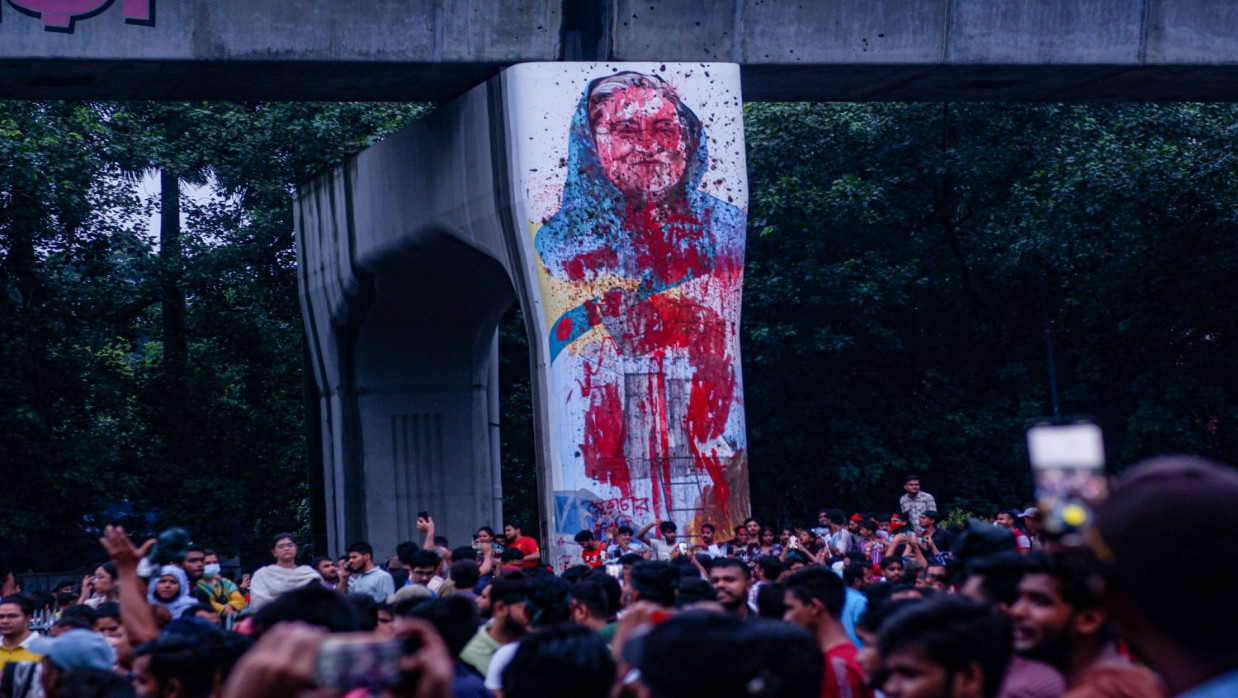
Bangladesh’s deposed Prime Minister Sheikh Hasina’s first speech since her removal, a virtual address to a jam-packed audience in New Delhi, was almost surgical in its objectives. Designed to demonstrate presence (“I am alive”), argue illegitimacy (“the caretaker order is illegal”), and insert herself into Bangladesh’s electoral politics from overseas, Dhaka’s volcanic reaction (calling India’s consent “beyond our imagination and shocking” and warning of “a dangerous precedent”) shows this fight is about to jump newState lines.
For starters, the obvious question is why now? Bangladesh heads to the polls on February 12 for the first general election since last year’s uprising. Hasina’s Awami League (AL) party is ineligible to compete after its registration was suspended, thereby leveling the electoral playing field against Bangladesh’s most formidable political force. Seen in that light, Sunday’s speech was about achieving multiple goals at once: keeping AL members motivated, undermining the election’s legitimacy, and implicating India, willingly or not, in Bangladesh’s democratic transition.
Intent Behind the Words
Details of Hasina’s Delhi speech indicate she leaned into rhetoric but sharpened the edges: labeling Muhammad Yunus and the caretaker government “fascist,” cautioning Bangladesh will not have a free and fair election under current circumstances, and implying that Bangladesh’s interim authority must go. Dhaka accuses Hasina of going even further, alleging incitement and “calling for things that will vitiate the election atmosphere.”
The intent, from Hasina’s vantage point, is obviously bigger than scoring points. It’s about reframing how the election will be viewed both domestically and internationally. If she can sow doubts within Bangladesh, empower diaspora influencers, and get external powers to question the validity of the outcome even before votes are cast, then Bangladesh’s next government begins its term wounded. That’s leverage worth its weight in bargaining chips if January’s vote produces a fractured parliament that needs coalition partners to survive.
Hasina’s address was also a message to AL supporters and functionaries. Institutions don’t fall, they adapt. A factionalized AL will bargain, lie low, and plan for opportunities to strike back or re-enter politics. Hasina is showing she can still rally domestic and diaspora audiences, even from exile, telling her supporters it’s not time to abandon the AL just yet.
Bangladesh calls foul
Bangladesh’s foreign ministry statement on the speech suggests this latest provocation was taken personally in Dhaka. Terms like “clear affront” and “dangerous precedent,” in addition to the incitement allegation, tell us New Delhi is suspected of doing more than offering political asylum to Bangladesh’s exiled leader. To many analysts in Dhaka, India was instead offering political oxygen.
Here’s Dhaka’s reasoning. Hasina is not a guy in a tennis shirt making anti-state speech from a student hostel. She is a former prime minister with legitimate criminal accusations against her and, reportedly, a conviction and death sentence awarded in absentia over mass killings in 2024. Allow that person to deliver a political speech to an audience of activists at a press club in Delhi’s capital and right before Bangladesh votes, and it registers as a signal of impunity, not private exile.
This is a relationship issue. Dhaka wants India to treat Hasina like a legal and diplomatic irritant who must be contained, not an exiled politician India is entitled to cozy up with. New Delhi, for its part, may believe that Hasina is a geopolitical fact on the ground that must be dealt with slowly, warily, and, above all, discreetly.
Is India Giving Hasina Political Shelter?
Here’s the brutal truth: “support” is relative. Delhi doesn’t have to give Hasina political endorsement to be accused of enabling her. Permitting the optics of a speech in Delhi can send signals that Hasina has political shelter with India’s blessing.
But India’s public messaging has also been more opaque than blanket condemnation. After Bangladesh submitted fresh extradition requests when Hasina reportedly received her death sentence, Indian authorities said the request was under review from a legal and judicial standpoint. When Bangladesh previously criticized Hasina’s access to Bangladeshi news outlets hosted on Indian servers, India pushed back with a classic diplomatic dodge: the Indian media is independent, and the government cannot muzzle it. This is a non-answer because it neither confirms nor denies that India is allowing a potentially disruptive politician to operate with implicit support.
So what does that make India? My read is India is hedging.
Wait, what? Hedging is not code for covert support. It’s a regional stability bias. Hasina was New Delhi’s partner for many years. Her government was focused on counterterrorism cooperation, border security, and countering insurgencies. A Bangladesh that doesn’t have Hasina at the helm, especially if it ends up with a coalition of political rivals who have to bargain with Islamists to hold onto power, threatens interests in Delhi, including India’s own Northeast and extremist havens along the Bangladesh border. This prospect isn’t made any easier by reports of American diplomats meeting Jamaat-e-Islami leaders with tactful curiosity before the election.
Against that backdrop, New Delhi may believe that allowing Hasina a megaphone keeps pressure on Dhaka by preserving “options” and conveys to Bangladesh’s soon-to-be-former ruling party that India won’t turn its back on friends and family members overnight.
Hold on to Your Seatbelts: The Extradition Question
Bangladesh and India have an extradition treaty that dates back to 2013. Bangladesh has invoked that treaty to request Hasina’s return on multiple occasions. However, extradition requests are a stress test of both law and domestic political optics.
Capital punishment matters here. Few in India’s political class would endorse sending a former PM back to face the death penalty. To my knowledge, experts on South Asia don’t believe India will extradite Hasina under current circumstances, for two reasons: what’s at stake legally, and the fact that Indian public opinion wouldn’t easily forgive the government for extraditing a friendly neighbor to face an adversarial process.
That isn’t the same as India needing to openly “support” Hasina to avoid extradition. India can and likely will delay, asking questions and waiting for responses while lawyers in South Block “examine” Bangladesh’s requests.
Delay = denial. Bangladesh’s interim leaders believe time is India’s tool to keep Hasina safe. India thinks time is its tool to hedge against a volatile outcome that may condemn Delhi’s decision if Bangladesh’s next government is unfriendly.
Will Hasina’s Speech Impact Bangladesh’s February Election?
Hasina’s Sunday meeting in Delhi accomplishes three objectives that don’t bode well for Bangladesh’s electoral stakes.
The first is simple: keep internationalizing the outcome. Hasina may not win a single vote in Bangladesh this month. But if she can keep her “election is not fair” claim alive from abroad, she can legitimize future challenges to the result on the streets, in boycott campaigns, or by questioning its authenticity, no matter who leads the next government.
The second is worsening Bangladesh’s tensions with its largest neighbor at the absolute worst time. Bangladesh’s foreign ministry concluded its statement by saying such activities will “seriously impair bilateral relations.” Avoiding external tensions is something every government desires before an election. Bangladesh just imported a bilateral spat onto a polarized political landscape.
The third: India just needled its own diplomats into a higher state of alert. Reuters is reporting Indian diplomats are pulling families out of Bangladesh over safety concerns ahead of the vote, which should scare everyone in Dhaka. Heightened fear in a mission leads to risk-averse decisions, which lead to misunderstandings.
The Long Game: Keeping the “Hasina Card” Alive
Let’s assume for a second that Hasina can’t actually “return” by giving a speech. The party she led is out of the election, and public sentiment in Bangladesh has turned a corner after 2024. So maybe the real goal is something else: keep AL intact as a political faction, and keep Mrs. Hasina relevant as a martyr figure. Bangladesh’s next government will think twice about provoking.
That’s not the same as betting on Hasina’s return. It’s keeping the “Hasina card” alive. Because if AL is out of power, needling the coalition partners who take its place can empower India’s leverage. Calling AL’s bluff about how it might react if India leans too hard post-election is useful pressure. And keeping Hasina’s image burned onto WhatsApp for now means India has better insurance if Bangladesh turns sharply against Delhi’s interests.
But this game is a gamble. If AL is out of politics for a long time, Bangladesh’s next elected leader will take office with a public record of Indian doublespeak. Nationalism will intensify, India’s diplomatic bandwidth will shrink, and fractures will appear where Bangladesh and India once had cooperative understanding on water, border killings, trade barriers, transit rights, and everything in between.
Lessons for India and Bangladesh
To avoid an escalatory spiral that could toxify Bangladesh’s transition, both sides need to remember a few lessons from this chapter.
Bangladesh must prove elections will be credible by deeds, not declarations. Hasina will never concede that the playing field is level. Bangladesh can do so by practicing restraint in security deployments, empowering independent investigation of claims, and accepting that transparency beats nationalist posturing every time. Claims of incitement are serious and should be investigated. But they shouldn’t be levied rhetorically as guilt until proven innocent.
India must decide what it values more: leverage or a relationship. Letting Hasina speak in Delhi might preserve Bangladesh-specific leverage, but it damages the bilateral relationship, something India says it wants to keep intact. At the very least, India needs to realize that merely saying “we don’t control the media” isn’t a satisfactory response when the charge is politically motivated activities allowed from Indian soil.
Bottom Line: When Hasina addressed the Audience in Delhi last Sunday, she wasn’t trying to make a comeback. Instead, she lit a signal flare at a precarious moment for Bangladesh-India relations. Bangladesh’s politics is reordering. India’s decades-old approach to Dhaka is showing stress fractures. And the region’s great powers are starting to position themselves for what comes next. The question is no longer if Hasina is receiving political support from India. The bigger question is if South Block believes the optics of that support are worth the political blowback that is sure to come should Bangladesh’s next government embrace nationalist retrenchment over partnership.

0 Comments
LEAVE A COMMENT
Your email address will not be published