

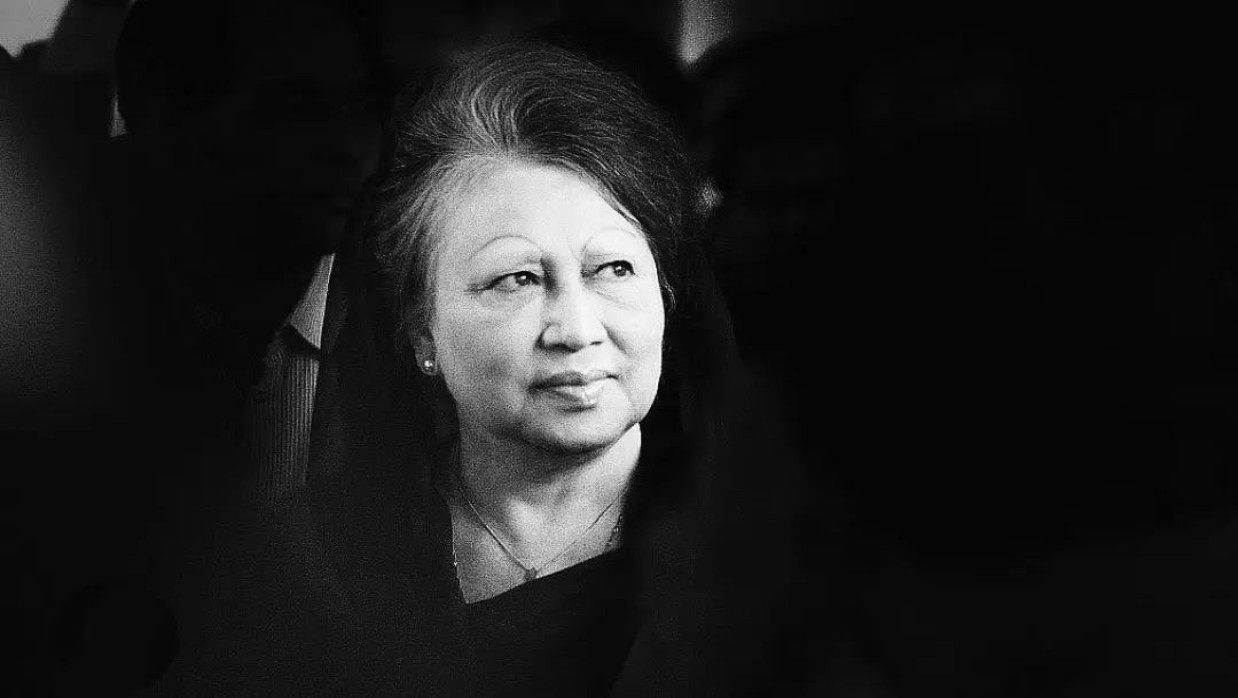
Bangladesh did not just lose a former prime minister this month. Bangladesh lost an incomplete chapter of its political history.
Khaleda Zia lived for neither drama nor ceremony. In death, however, she has been subjected to both. Days of relentless remembrance: encomiums and anecdotes; interviews, testimonials, and tawfiqs (“confessions”) by journalists, writers, and former bureaucrats who knew her.
One voice picks up where another leaves off. No one attempts to whitewash her legacy. Instead, they piece it together. Shards that contradict, complicate, and enrich our understanding of a political leader who defied easy labels.
What you will not find in these eulogies is mythmaking. You will find the story of a politician who prized sacrifice. Suspected everything. Held her dignity close. And who, above all, knew the power of silence.
Bangladesh’s Unwritten History of Khaleda Zia
In less than a week, Asif Nazrul, Mahfuz Anam, Nurul Kabir, Matiur Rahman, Tauquir Imrose Haider, and countless others contributed pieces to Bangladesh’s unwritten history of Khaleda Zia. Each vignette is unsolicited. None impartial. Together, they sketch the silhouette of Bangladesh’s second-longest-serving prime minister not through grand speeches or resounding defenses, but through what she chose not to say.
Khaleda Zia did not want to be politicized. She did not seek to be martyred.
Asif Nazrul, upon hearing charges of corruption against her, replied in exasperation: "I stole orphans’ money?" For context: Sheikh Hasina first accused Khaleda Zia of embezzling from an untouchable. Her response was not grandstanding. It was incredulity. Shock. A seasoned politician blinking at a conspiracy she simply did not recognize as politics.
This matters. In Bangladesh, allegations have become convictions. Persecutions are performed.
Khaleda Zia never believed that her prosecution was part of the act. She suffered it as injury, not art. She never reinterpreted her incarceration as courageous dissent. To Khaleda Zia, if only for a few painful years, it was injustice.
To be clear, that innocent has not seen the inside of a courtroom for some time. Nor is that admission an argument for selective prosecution or legal exoneration. It is an observation on how deeply Khaleda Zia valued power and what gave it legitimacy in her eyes.
She Said No to March 25
History celebrates saying yes. History rarely bothers with the things we say no to.
Journalist Nurul Kabir wrote of Bangladesh’s polarizing former leader's decline, one phrase that will forever remain undocumented: "to let March 25 be politicized." She said no.
In Bangladesh, “no” is a rare utterance. And Khaleda Zia’s refusal resonates so loudly because it marked a line in the sand. Between commemoration and commodification. Between history and headline-grabbing hyperbole.
Bangladeshi politics rarely takes nuance. It is bombast. Assertion. Often violence.
What we don’t hear about Khaleda Zia, however, is nuance articulated through ideological rhetoric. She wasn’t lyrical. Far from it. What she did have: instinct. Knowing where words devalue meaning.
Her greatest political gift may have been recognizing when not to speak at all.
She didn’t court the media. Matiur Rahman wrote that interviewing President Ziaur Rahman was among the most difficult tasks he had ever undertaken. Replace the names, and that sentence applies to Khaleda Zia as much as to her husband. Access was never her chosen currency.
Contrast that with today’s relentless politico-media culture of all-access passwords, salon interviews, whisper briefings, and curated ‘hellos.’ Zia was legitimized through symbolic and constitutional elections. Through accrued public goodwill. To her, power was not given solely on transactional terms.
If you had it, it was legitimate. Without it, it was nothing. She held power. And so dignified it by refusing spectacle.
Resilience Without Victimhood
In his moving tribute to Khaleda Zia, Mahfuz Anam wrote of her dignity: a resilience in the face of jail, illness, exile, and a decade of persecution without plaintive public soundbites or requests for absolution. She did not monetize her persecution into a public spectacle.
South Asian strongmen are loath to relinquish power. Far greedier still are leaders who rule through cycles of manufactured victimhood. Khaleda Zia didn’t. She paid the price for that.
“When it comes to leaders who make great sacrifices for their causes and communities,” wrote Fahham Abdus Salam, “I believe there is one trait above all that makes a great leader…”
Great sacrifice.
Khaleda Zia’s public life was strewn with it. Of freedom, of her health, of time with her children.
She wasn’t imprisoned for weeks. Years. When she was in jail, her children grew up without her. She turned down calls from them. Requests for lenience. Refused the congregate asylum of cellmates eager to smuggle out messages, to convert suffering into speeches and walkouts.
Khaleda Zia’s sacrifices were silent. Opaque, even.
Authoritarian revolutionaries use jail terms as victimhood-required-update Instagram reels. Khaleda Zia never did. Maybe that is why millions of Bangladeshis still believe…
… believe that she stood for something worth sacrificing four years of her life for.
Un definable.
Tauquir Imrose Haider wrote that Bangladesh will never see leaders like her, maybe once a century. Not because she was perfect. Far from. But because Khaleda Zia was impossible to define. She ruled without charisma. Commanded authority without terror. Won elections not through revolution-making personality cults but by being parliament’s remaining option. The office was never her entitlement. To Khaleda Zia, it was a trusteeship.
A Woman Took Control
Of all the things that made Khaleda Zia undefinable, few will speak of her gender.
You cannot look at Khaleda Zia’s premiership without considering the heft of her gender. It is difficult to believe that a male leader in Bangladesh’s history has been held to the same moral standards, asked to justify twice as much, and granted neither latitude nor the benefit of the doubt.
Could a man have weathered 2017 the way she did? Would he have been granted the presumption of innocence? It is impossible to say. What is certain is that Khaleda Zia was prosecuted not just for alleged corruption, but for being a woman in power. What Will They Say About You?
History is written by the extreme. By posters on walls. By a coated tongue screaming from rooftops. Khaleda Zia will likely never have statues built in her name. Don’t be surprised if future textbooks strip her party of any nuance whatsoever. That is history for you. It also remembers those who remain true to themselves.
Khaleda Zia refused to be strong-armed into becoming a monster of power. She refused to rule through fear. And when they tried to steal legitimacy from everything she believed in, she refused to speak. History is written in victories, sure. But just as much in the things we refuse to become.
The Mirror
Today, Bangladesh must make that choice again. Khaleda Zia left no instruction manual for politics. Just a mirror. Who among us will learn to exercise power without oppression? Hold legitimacy without sermonizing? Make sacrifices without making spectacles? She lived her life proving those questions. Inherits, instead, from her son. Tarique Rahman.
Ask anyone who has spent any significant time around AKM Azad, and you will hear the same: Khaleda Zia is Bangladesh’s political martyr. Years of citing her ill health while watching her traverse bulletproof glass booths have earned Rahman’s mother immense moral capital with the people of Bangladesh. There is an expectation now riding on Rahman’s shoulders.
Already, without formally holding any title, he is treated as PM-elect. But optics will only get you so far. Bangladesh isn’t looking for change. They are done waiting for reform. Reform of our politics. Reform of political culture. It starts at the top.
Symbolism must be backed by substance. Accountability must inherit power. Khaleda Zia's life will not make Rahman’s political career legitimate. It will only raise the bar higher.
Allow her to rest in peace
We do not mourn Khaleda Zia because we always agreed with her politics. We mourn her because, at one point in her life, she made us believe that just because you have power, it does not mean you have to rule like a tyrant.
If silence can trump Victorville…the girl from Bogura has already spoken. Now let’s see if Bangladesh is willing to listen.


0 Comments
LEAVE A COMMENT
Your email address will not be published