

Hope, Skepticism, and the Burden of Democratic Renewal
After 17 years in exile, Tarique Rahman was supposed to matter no more in Bangladeshi politics. The last two years represent the final window of his exile following the 2024 uprising. He was eventually acquitted of major charges, including the 2004 grenade attack, by courts under the interim government, paving the way for his December 2025 return. By January 2026, Rahman had transitioned from a "fugitive" to a leading contender for Prime Minister in the upcoming February 2026 elections, officially becoming the Chairman of the Bangladesh Nationalist Party (BNP) on January 9, 2026.
Time changes things. No one disputes that. And yet, today Tarique Rahman seems very much present and accounted for in Bangladesh politics. He’s been granted cover, by the way. But forgive me for not sounding celebratory just yet.
His re-emergence began not with speeches or protests, but rather something far less glamorous: dialogue. Tarique Rahman held open interactions with senior Editors and Journalists of Dhaka-based media organizations, followed by telephonic interviews via mainstream Television stations. Tarique Rahman held open interactions with senior Editors and journalists of Dhaka-based media organizations. For those familiar with the curtain-call-like media briefings at Ganabhaban over the past 15 years, where pre-screened questions were politely answered by press secretaries with monthly-churned slogans, it was a sight.
The press
Editors and media executives from across the political spectrum were present or represented. Some chose to engage more than others.
The Editor of Prothom Alo, Matiur Rahman, wasn’t present at this particular meeting, but his publication has since offered column space for more diverse assessments.
Does it matter who came and who stayed away? Not particularly. What matters is that journalists and editors deemed it prudent not only to engage Tarique Rahman but also to ask questions and hold him publicly accountable for his responses. That optics matter to Tarique Rahman, we can presume, since choosing to engage even a skeptical press instead of circumventing them marks an understanding of the former that requires rebuilding.
In a series of conversations featuring Matiur Rahman Chowdhury (MRC), Mahmudur Rahman (MR), Mahmudur Rahman Manna, Shafiq Rehman, and other political analysts and senior Editors, they have weighed in on Tarique Rahman.
They range from positive to cautiously optimistic to bluntly honest in their assessments. Which is what should be expected. We live in Bangladesh after all.
One question remains on most minds: Is Tarique Rahman a changed man willing to take Bangladesh on the long, hard road to democratic recovery, or is he merely “same old Tarique” with more palatable advisers?
The fact that such a debate can occur openly is indicative of change.
Tarique Rahman’s story is not unique
The practice of primogeniture among children of national leaders is nothing new in South Asia. What is unique about Tarique Rahman is how he came to power. He was prosecuted. Sentenced. Exiled. And demonized.
As long as Tarique Rahman remained physically outside Bangladesh, he remained politically absent. For the better part of this past decade, Awami League rhetoric weaponized Tarique Rahman as the externalizer for Bangladesh’s corruption, and every ill, galvanizing public sentiment against them.
The interesting thing about political demonization? Those who are demonized often become what their opponents wish them to be. Tarique Rahman became Bangladesh’s version of Public Enemy Number One. And with that marking, a return.
Politics can make monsters of us all. Exile has a way of dulling relevance, but it can also amplify it into mythology.
“A speech that will be recorded in world history”
“When people of a country come out of their homes demanding democracy…”
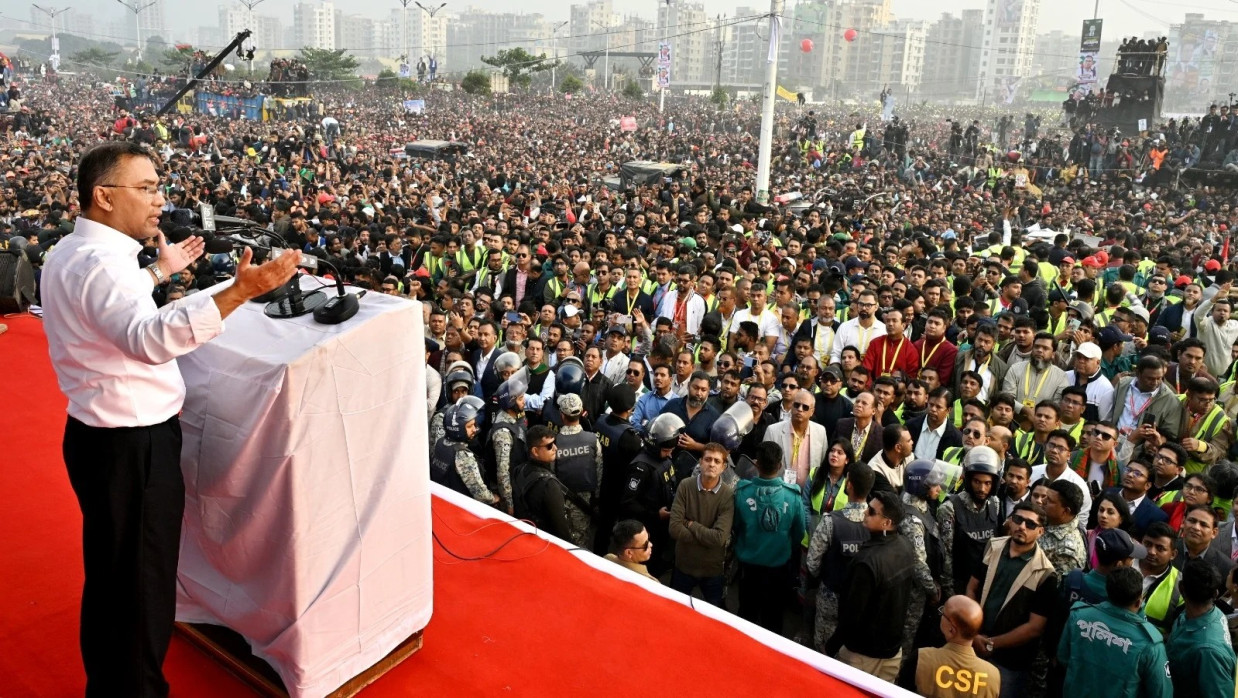
Manab Zamin editor Matiur Rahman Chowdhury stirred quite the pot during Tarique Rahman’s December 25 address by declaring it would be “recorded in world history”. Many heads were shaken. Declarations like Rahman Choudhury’s squarely drew parallels with Dr Martin Luther King Jr., mostly for effect. But to write off Tarique Rahman’s speech as grandstanding would be a mistake.
He didn’t speak like a demagogue. Nor did he annihilate his political opposition with rhetoric. What Tarique Rahman said was measured, lacked retaliatory vindictiveness, and focused heavily on process vs personal attacks.
This isn’t to say Tarique Rahman aced his performance. Far from it. He was reserved. In what many expect to be the first of many major speeches, Tarique often spoke of “a plan”. He said little about the plan itself. Ambiguity can serve leaders well. It can also alienate.
Journalists have found their voice again.
Journalists & Media: Letting the Power go to their Heads?
The real headline emerging from this series of commentaries isn’t about Tarique Rahman. It’s about Journalism in Bangladesh showing spine once more.
Journalism, for lack of a better term, has atrophied under pressure these past few years. Ganabhaban press meetés no longer resembled interrogation but gratitude exercises dressed as Journalism.
This trend seems to be reversing itself within the last few months, post the political divide of August 2024. Journalists are asking hard questions, speaking up for their rights as reporters, and demanding answers.
Tarique Rahman has not ducked when asked challenging questions. This is no litmus test for democratization, but it’s a start.
There can be no transition without a vocal Fourth Estate. Watch how Tarique Rahman handles scrutiny moving forward.
Friendly Fire: Words of Warning from BNP Supporters
If there were doubts about how Bangladesh has changed during Tarique Rahman’s exile, Mahmudur Rahman of Amar Desh laid it out plain. Simple.
“You were not in the country. You do not fully know what happened here.”
It’s not an insult. It’s caution. Bangladesh has evolved immensely during Tarique Rahman’s time away economically, socially, and institutionally. Bangladesh has become far more dependent on informal institutions. Parties are far more reliant on goon-influenced ticket distributions. Bangladeshis are far more distrustful.
Mere desire for change will not be enough to overcome the network Rahman established during his time away. Tarique Rahman must know Bangladesh better than it knows him.
Mahmudur Rahman Manna was similarly generous in his praise for Tarique’s temperament, while questioning whether it would be enough.
Do note where Rahman Manna’s praise ends and where he issues warnings. Mahmudur Rahman Manna hopes Tarique Rahman has the courage to go beyond patience. Institutions. Party. Bangladesh needs solutions, not a simple alternation of power.
Khaleda Zia: Blessing & Burden
You cannot mention Tarique Rahman without discussing Begum Khaleda Zia. Bangladesh’s only female Prime Minister is nothing short of a political martyr to her supporters and detractors. Awami League propaganda leaned into her failing health for over a decade, when in reality it was they who held her hostage in Bulletproof captivity.
Begum Zia’s perseverance through imprisonment, isolation, and personal tragedy has earned her immense moral capital with the people of Bangladesh. It also raises the bar exceedingly high for Tarique Rahman.
The people of Bangladesh don’t just want change. They want reform. Of a culture.
The image will only get Tarique Rahman so far. Substance will have to take it home.
The old Tarique Rahman is gone?
Repeatedly, analysts and journalists have said they no longer recognize “the old Tarique Rahman”. Of leaked speeches during BNP chairmanship implicating Rahman in constructing a ‘state within a state’ commonly referred to as Hawa Bhaban, nefarious party takeovers, and most damningly, Tarique’s response (or lack thereof) to dissent within BNP ranks.
We can speculate all we want about where Tarique Rahman goes from here. But if history has taught us anything, it’s that actions speak louder than political reinvention promises.
Zero tolerance for dissent within his party will poison Bangladesh. Measured response? Hopeful.
BNP Mega Rally: Capitalizing on Dissent or Buying Time?
There is no doubt that energy for change runs high. Inflation, rising cost of living, unemployment, and democratic fatigue have created the perfect storm for political change. Tarique Rahman has capitalized on this energy thus far by projecting clarity of strategic vision and unity within the BNP ranks that was previously amiss.
Mass mobilization is a strength. But it can also be damning if used improperly. There are numerous reports of transport, cooked meals, and posters being handed out to BNP supporters, funded by donations from party aspirants facing elections this year. Not inherently scandalous if true, but does gesture towards familiar patterns of political mobilization. Add to that Bangladesh’s problem with massive election-related expenditures. It has been turned into a business; thus, businesspeople are only equipped to run for this office. Once elected, they want their investments plus the profits back. How is Tareque going to change that custom?
Image once again. Perception.
Did Tarique Rahman really need to be received with protocol rivaled only by that of the Head of Government? Sure, seems that way to some.
Hope. Pragmatism. Action.
Bangladesh is at a political juncture. The old pillars no longer stand. New institutions are slow to rise from the rubble. Tarique Rahman has been cast into the proverbial fires by way of ambition and circumstance. Let us hope he sees clearly what needs to change, how to go about it properly, and the humility to accept it if he doesn’t. Immoral, it will not be. Unsentimental? Most certainly.


0 Comments
LEAVE A COMMENT
Your email address will not be published