

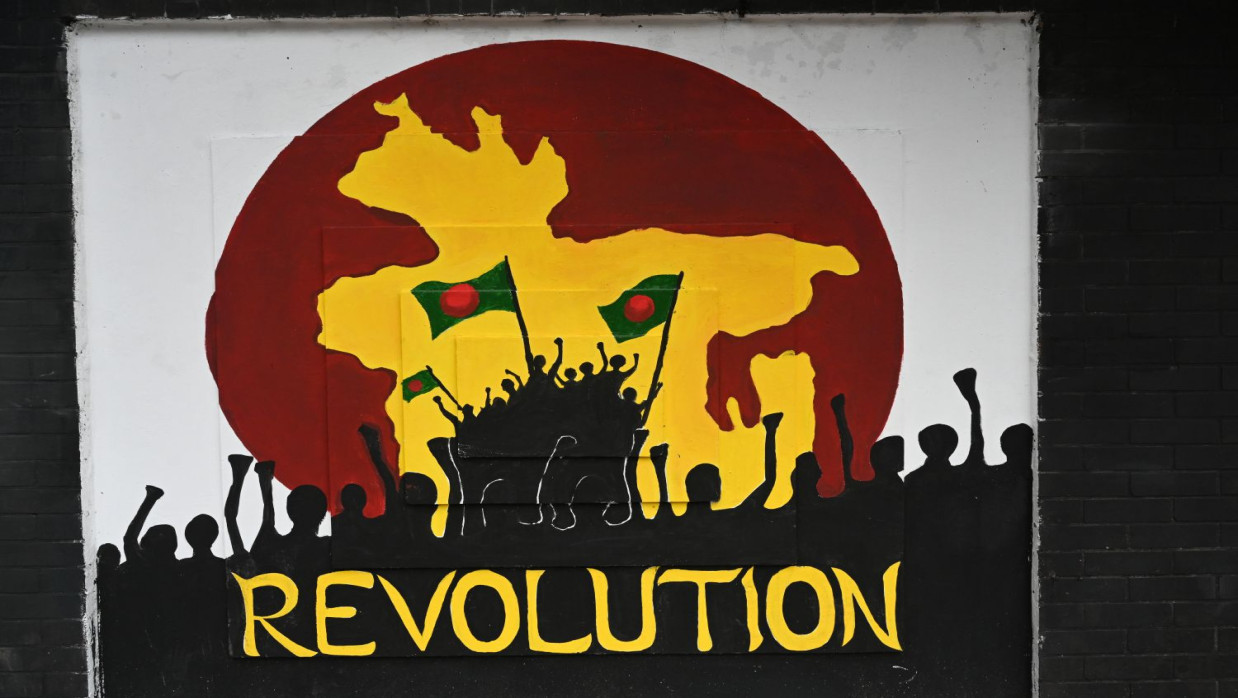
Sheikh Hasina, who led Bangladesh for 21 of the 50 years of emergence of Bangladesh as an independent South Asian country, fled to India on August 5, after a violent student-led mass uprising toppled her 15-year authoritarian kleptocratic government.
A syndicate of corruption and carnage
During Hasina’s 15-year rule (2009-2024) corruption reached peak in Bangladesh. Annually US$6 billion which also included massive siphoning off billions of dollars through trade mis-invoicing were looted and plundered, allegedly by Hasina herself and by her immediate family including the extended family who received numerous perks under the direct patronage of Hasina herself.
Hasina’s criminal syndicate, which was engaged in extortion, murder, bank theft, money laundering, and bribery, behaved like the Sicilian mafia.
Now it appears Hasina’s criminal syndicate is transforming itself from a plutocratic to a terrorist outfit, committed to creating political chaos and fear in the country and thwart the forthcoming election.
The recent assassination of Sharif Osman Hadi, the convener of the Inquilab Mancha who was also one of the key organisers of the July 2024 uprising, allegedly by an Awami League terrorist reflects that transformation.
Ego-centric, repressive, and power-hungry leaders like Hasina find it difficult nor would they wish to stay out of power simply because once out of power, autocratic and kleptocratic leaders like her often are greeted with the same kind of repressive retributions that they once treated their dissenters and opposition, with.
For dictators, losing power is not an option. Dictatorship is like sinking sand from which there is no coming out. For example, even about 45 minutes before her departure for India Sheikh Hasina wanted the army to act with force against the gathering protesting crowd. However, the army read the crowd mood correctly and decided that it was time for Hasina to go and she was made to go and where else but India her opportunistic patron, India.
An Interim Government (IG) led by Bangladesh’s Nobel Laureate Professor Muhammad Yunus has since taken over the reign of the country.
Among several initiatives that include formation of corruption enquiry commission and democracy reform the IG has since indicted and convicted and sentenced the deposed Prime Minister Shiekh Hasina to death on charges of crimes against humanity. In other cases, she has also been convicted and given jail sentences for corruption and favouritism.
Post Hasina conundrums
These have been much needed steps in accountability against autocracy, kleptocracy and crimes against humanity.
However, dynamics of a successful political revolution can go in numerous directions, from civil war to a new and broadly accepted political system, to something in between.
The challenges to restoring order in a highly polarised and politicised society such as Bangladesh is anything but easy.
IG’s faces two interconnection problems – firstly, Hasina who now lives in India, her patron is now actively aiding and fomenting chaos in Bangladesh to destabilise and unseat the IG and secondly, the fact that all public institutions including the army are filled with Hasina-government recruits loyalists making things even harder to implement policies and more importantly, restore law and order.
On October 17, 22 political parties including the major political parties such as the Bangladesh Nationalist Party (BNP) and Jamat – e- Islami signed what is called, the July National Charter 2025, a 26-point document that outlined and sought commitment of the political parties to abide by and implement reforms in governance, democratic processes and corruption control, proposed by the reform commissions set up by the IG. However, disagreements remain among political parties over timing, scope and implementation of these reforms and the student initiated newly formed National Citizen Party, the NCP is yet to sign the Charter and will do so only after the interim government clarifies its reform plans and their timelines more specifically.
Dynastic politics
Bangladesh has long been characterised by dynastic power politics as well as cronyism.
The Awami League's (AL) leadership in Bangladesh, especially under Sheikh Hasina was often labelled as dynastic.
Sheikh Mujib Rahman’s shift to single-party rule which has had severe impacts on human, democratic, and civil rights of people of Bangladesh, also established a deity cult in the society that also contributed to the promotion and inauguration dynastic politics in Bangladesh.
With his daughter Sheikh Hasina entering politics in Bangladesh in late eighties who subsequently ruled Bangladesh for over two decades, concentrated within herself and within her family and close associates, including her son, who served as a "special advisor", living overseas permanently, most power and privileges.
A recurring theme
This concentration of power within the ruling families has been a recurring theme in Bangladeshi politics, a culture that infiltrated and got entrenched in Bangladesh’s next leading political party, the Bangladesh Nationalist Party (BNP).
For decades, Bangladesh had few political alternatives. Besides periods of military rule, the country has been dominated by two political dynasties: one led by Begum Khaleda, wife of former president Ziaur Rahman, and the other by her rival, Sheikh Hasina, who is now sentenced to death. Hasina's death sentence likely to end decades of two-party dominance in Bangladesh politics.
For all practical purposes the BNP is the other side of the same coin with the AL on one side. Transparency International ranked Bangladesh as the world's most corrupt country for five consecutive years from 2001-2006 during the rule of the BNP under Begum Khaleda. A US diplomatic cable in 2008 characterised her son, Tareq Rahman, as a symbol of corrupt, kleptocratic governance. A kleptocracy is literally “rule by thieves”. This is a form of government where a network of ruling elites “steal public funds for their own private gain using public institutions”. In this regard the Hasina regime was not different from the BNP, with the added features of using severe political repression, committing political murders and abductions.
Bangladesh continues to rank among the most corrupt countries in the world - Transparency International has placed Bangladesh in corruption index at 151st out of the 180 countries.
Bangladesh will hold general elections in February 2026, along with a referendum on the July Charter. Bangladesh's political landscape is experiencing major shifts in the wake of the 2024 student uprising. The sudden end of the political configuration has thrown the entire political system into a state of flux.
February 2026 Election and the evolving political scenario
Chief Adviser Muhammad Yunus is implementing reforms and preparing for elections and past opposition political parties such as the Bangladesh Nationalist Party (BNP), the revitalized Jamaat-e-Islami and the newly formed the student-led National Citizen Party (NCP), have entered new the political scene.
The NCP and Jamat-e-Islami are strategically leveraging the current political landscape to challenge the established two-party system dominated by the Awami League and the Bangladesh Nationalist Party.
The newly formed NCP is an anti-thesis to dynastic politics and somewhat of an expression of widespread disillusionment the deeply corrupt politics of the past. The NCP, is positioning itself as a centrist force, advocating for a new constitution and a Second Republic that purports to reshape the country’s political landscape.
The Interim Government has placed a ban on the Awami League (AL), the deposed ruling party and stripped it of its registration which prevents it to contest the February 2026 election. As a result, the BNP now stands as the nation's leading political force; however, there remains a degree of caution among many observers due to perceived parallels with the methods employed by the AL. There are widespread allegations that many BNP members engage in extortion. No wonder recent opinion polls show that two-thirds of voters are still undecided for whom they would like to vote. To allay negative public perceptions of the BNP, the party is promising to form a government of national unity, implying it might include ministers from the NCP and Jamat-e-Islami in the future government.
Yunus’ commitment to reform the political landscape following 15 years of kleptocratic and autocratic rule under Hasia regime is both understandable and commendable. However, his hesitation to implement major reforms that are fundamental to rectify the existing corrupt political landscape exposes him to criticisms for adopting excessive caution if not leniency towards corruption within the bureaucracy and other state institutions.
If Yunus wants to secure a legacy as a great reformer and not just the head of an interim government, he will need to take more risks and spend more of his energy in governance, than he has to date.


0 Comments
LEAVE A COMMENT
Your email address will not be published