

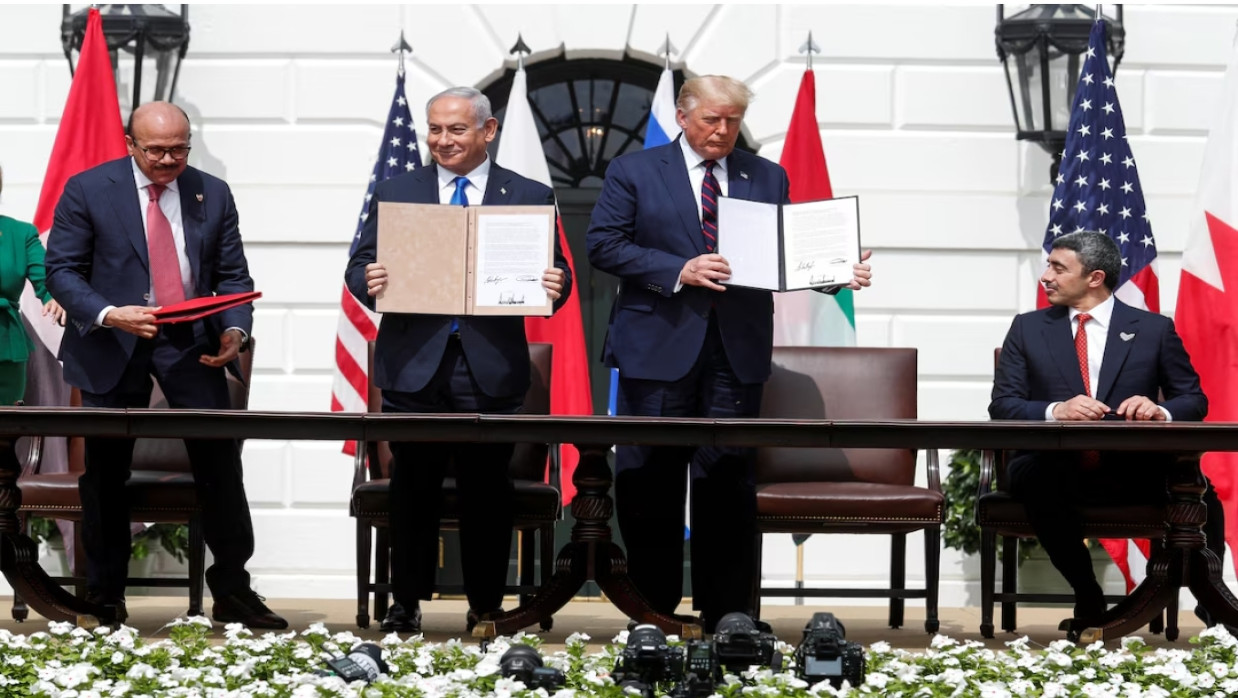
Few could have imagined the Islamic Republic of Iran joining the Abraham Accords several years ago. Now, US President Donald Trump has himself raised the idea, hinting at one of the most significant geopolitical changes in the contemporary West Asia, should talks ever come to fruition. In a recent statement issued through Truth Social, Trump indicated that ongoing negotiations with Iran were “proceeding nicely,” while simultaneously urging a broad range of Middle Eastern and Islamic countries, including Saudi Arabia, Qatar, Pakistan, Türkiye, Egypt, Jordan, Bahrain, and the United Arab Emirates, to deepen or expand their participation in the Abraham Accords framework. Most surprising, however, was his assertion that Iran itself could one day become part of the accords after a broader agreement is signed.
The Abraham Accords normalized relations between Israel and several Arab countries, brokered under Trump’s first term in 2020, including, most prominently, the UAE and Bahrain, as well as Morocco and Sudan under different terms. The accords were seen as one of the biggest foreign policy victories for both Washington and Tel Aviv, flipping decades of Arab hostility towards Israel. Now, Trump wants to expand the Abraham Accords into a regional economic and security alliance that, if fully realized, would rival other axes forming across Eurasia and the Indo-Pacific.
Yet the inclusion of Iran presents enormous ideological, political, and strategic contradictions.
Since the 1979 Islamic Revolution, Iran has positioned itself as one of Israel’s fiercest adversaries. Tehran’s support for groups such as Hezbollah and Hamas, its opposition to Israeli policies toward Palestinians, and its longstanding confrontation with the United States have defined much of the region’s geopolitical landscape for nearly half a century. Iran’s leadership has consistently portrayed resistance to Israel as a core element of its revolutionary identity.
For that reason alone, Iranian accession to the Abraham Accords seems unlikely. Middle East politics, though, has often shown that realism can trump dogma. The relationships between erstwhile foes have evolved when geopolitical and economic incentives or imperatives have aligned. As such, Trump’s suggestion may be less about considering what is possible now and more about changing the dialogue around what could be with Iran.
The fact that the idea has surfaced suggests general war-weariness in the region. After years of actual wars, proxy conflicts, sanctions, sectarianism, and financial fluctuations, much of the Middle East is ready for a change. Numerous states across the Gulf are investing more in economic diversification, technology development, and the reshaping of their international image. Saudi Arabia’s Vision 2030 and the UAE’s international investment initiatives, as well as budding regional infrastructure plans, require dependable continuity. Encouraging regional players to cooperate on security and de-escalate tensions allows the US to lessen its boots-on-the-ground presence in the region. By normalizing economic integration through a broader Abraham Accords, Washington can institutionalize the agreement and unify the signatories against instability.
Still, major obstacles remain.
The unresolved Palestinian issue continues to limit normalization efforts across the Muslim world. Public opinion in many Islamic countries remains deeply sympathetic to the Palestinian cause, especially amid continuing violence and humanitarian crises in Gaza and the occupied territories. Any attempt to bring Iran or even countries like Pakistan into a normalization framework without meaningful progress on Palestinian statehood would face intense domestic resistance.
Also, Iran’s nuclear program continues to be a major sticking point. Talks between Tehran and Washington have continually faltered over issues regarding sanctions relief, uranium enrichment, militancy in the region, and verification. Lacking a permanent nuclear deal and major de-escalation, it is hard to see broader regional integration occurring.
Trump’s statement nevertheless reveals an important reality: Middle Eastern diplomacy is entering a new and fluid phase. Former enemies are talking. Regional powers are recalculating alliances. Economic pragmatism is increasingly competing with ideological absolutism.
It may ultimately not matter whether Iran signs onto the Abraham Accords. What matters is that we are openly discussing the idea today. Iran joining the Abraham Accords was once unthinkable, but these are unprecedented times in the Middle East.

0 Comments
LEAVE A COMMENT
Your email address will not be published