

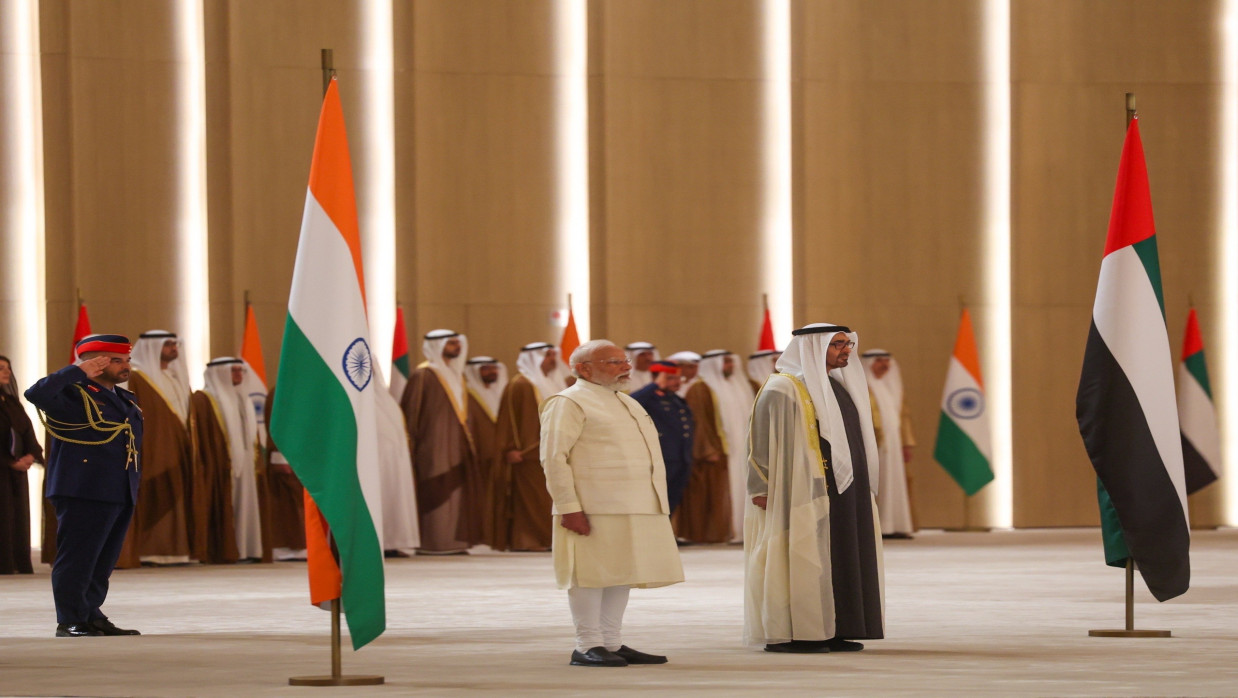
Prime Minister Narendra Modi’s recent trip to the United Arab Emirates, was officially presented as energy cooperation, more investment, and strategic connectivity. But under all that talk about economic partnership there is something bigger and honestly more complicated: India is trying, bit by bit to turn its rising economic ties with the Gulf into longer term political and strategic leverage. This is happening in a place that is already weighed down by fragmentation, rivalry and a stack of competing regional ambitions too, so nothing stays simple for long.
In the last ten years, the India-UAE relationship has moved pretty fast, like suddenly, without much pause. Trade volumes have gotten bigger, connectivity work has picked up pace, defence cooperation has leaned upward, and political coordination is now a lot more visible. For New Delhi, the UAE is not just some key commercial partner, but also a kind of strategic passage, a gateway into West Asia, especially when global power rivalry is heating up and the international system seems to be drifting toward a more fragmented multipolar setup.
India’s widening reach toward the Gulf, shows a wider shift in its foreign policy. New Delhi, at least these days, doesn’t seem content with only symbolic diplomacy or the usual non-alignment talk. Instead, it looks for more practical geopolitical leverage via economic ties, technology collaborations, logistics corridors and also a clearer regional strategic posture, which is, you know, where the leverage actually shows up.
Still, the Gulf cannot be approached just by commercial logic. Unlike Europe or East Asia, the Middle East keeps getting shaped, by security rivalries ideological legitimacy, sectarian competition and those rather fragile political balances. So when outside actors enter this space, they inevitably get tangled in its contradictions even if they did not plan on it, at least not at first.
India’s increasing alignment with the UAE, as a consequence, has implications that stretch well past economics. In several parts of the region, New Delhi’s growing closeness to Abu Dhabi is now often read as part of a broader maneuver to widen geopolitical leverage across West Asia, while at the same time dialing down Pakistan’s traditional sphere.
l strategic relevance in the Gulf, and yeah the way this is interpreted matters almost as much as the deal itself. This perception has gotten more pronounced since the post-Abraham Accords regional realignment, plus India is expanding partnerships with both the UAE and Israel. Critics in multiple parts of the Muslim world increasingly seem to look at these newer alignments through the lens of what they call shifting political loyalties, and also an erosion of regional cohesion, inside the Islamic world, though of course the conversation is not always so clean.
The worry is not only about diplomatic optics. The Middle East is already showing more fragmentation, you can see it in Yemen, Sudan, Libya and even inside the GCC itself. There are periodic OPEC+ disagreements and diverging regional priorities, those have laid bare older frictions between Gulf actors, leadership ambitions, security coordination habits and regional influence dynamics all at once.
In this environment, India’s growing strategic involvement risks creating yet another competitive layer on top of an already unstable regional landscape. Instead of acting as a balancing actor, New Delhi may slowly get pulled into rivalries it doesn’t fully command, and honestly can’t easily manage either.
The UAE, for its part , despite its rising economic and diplomatic activism, still moves inside a wider Gulf framework where Saudi Arabia keeps unmatched weight politically, religiously, and in energy. Abu Dhabi’s increasing assertiveness also can’t really stand in for Riyadh’s central role in Gulf security arrangements, oil coordination mechanisms, and the broader Islamic legitimacy that anchors the whole picture.
This is kinda precisely where India’s strategy bumps into structural limitations. Economic partnerships and trade expansion, alone, can’t so easily stand in for the historical military, ideological and institutional relationships that keep shaping Gulf security frameworks, in a sort of steady way.
For decades, Gulf security structures especially the ones tied in with Saudi Arabi have kept long-run military and institutional ties with Pakistan. Geographic nearness, defence cooperation, labour integration and a deep religious affinity have embedded Pakistan within the Gulf’s wider strategic environment in a manner that is still hard to reproduce, just by economics, even if trade looks promising.
India’s regional involvement, by contrast, stays mostly commercial and investment driven. While India-UAE trade has grown a lot, New Delhi’s regional presence still leans more on economics, diaspora links, and market interweaving than on security alignment that’s deeply set.
At the same time, the swift spread of the Indian diaspora across chunks of the Gulf has also sparked recurring labor controversies, demographic sensitivities , and discussions about workforce imbalances inside local communities. Even if these matters do not truly define bilateral ties, they still point to the social and political intricacies that ride along with large scale demographic integration.
At the same time, India’s Gulf strategy is unfolding while competition is getting more intense , involving China , the United States and various regional middle powers. Beijing’s rising influence via infrastructure investment, logistics corridors, ports, and energy partnerships has sort of turned the Gulf into a major arena for Asian geopolitical wrangling. Gulf states themselves are also diversifying their strategic ties more and more, because there’s growing uncertainty about where the international order might be heading.
For India, deeper engagement with the UAE is therefore not only a question of economics, but also a way to sidestep strategic marginalization as this region keeps getting more central to Eurasian connectivity and the ongoing Indo Pacific rivalry.
This expanding role also carries growing risks a bit more than before. India’s closer alignment with UAE–Israel strategic frameworks may make its usual balancing act toward Iran harder, especially when tensions across the region stay highly volatile. On top of that, continued instability in Yemen and Sudan, unresolved rivalries tied to Iran and shifting OPEC+ dynamics all add up to an environment that feels more unpredictable, all the time.
India’s Gulf strategy seems to reflect both ambition and overreach. New Delhi is trying to turn economic engagement into geopolitical influence in a region where security structures, older alliances and ideological legitimacy still matter more than pure commercial power, even if trade looks strong.
That strategy may generate short-term diplomatic gains. But in a Middle East already marked by fragmentation, competing ambitions and fragile alignments, India risks discovering that expanding influence in the Gulf is far easier than sustaining strategic flexibility within it.


0 Comments
LEAVE A COMMENT
Your email address will not be published