

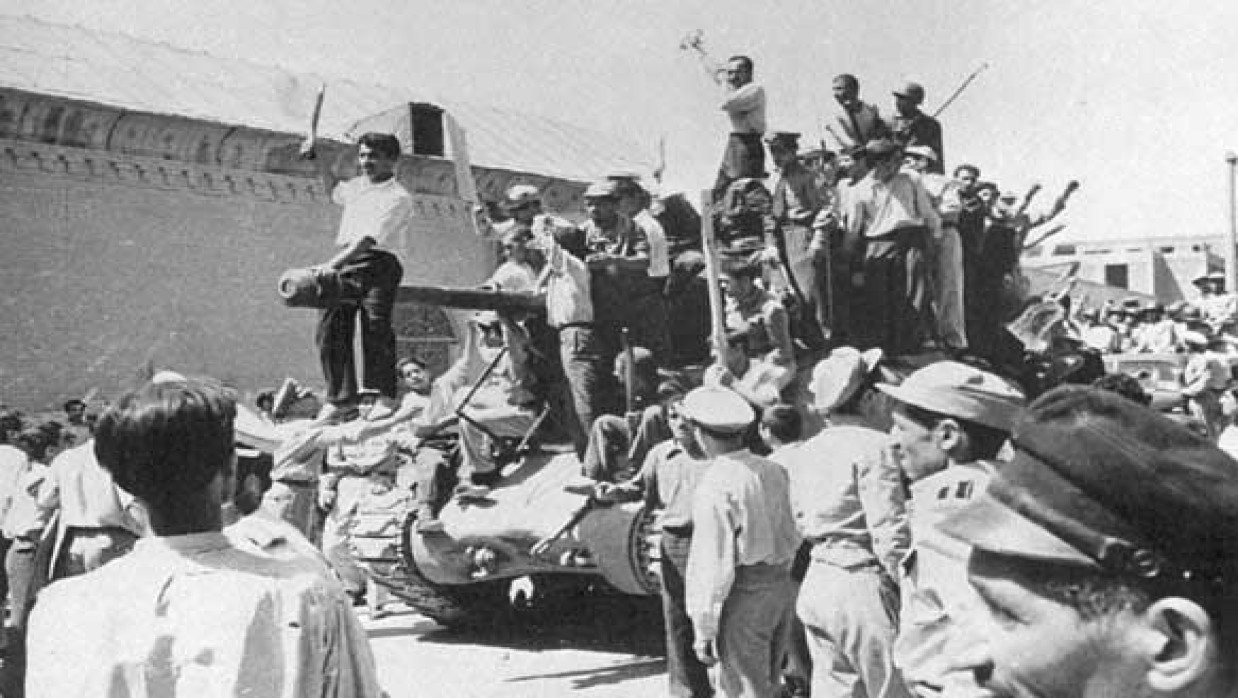
In Iran in August 1953, Prime Minister Mohammad Mossadegh was ousted in a coup supported by Britain and the United States. Fast-forward to today, and Iran is still living with many of the consequences of this coup: It interrupted Iran's democratic development, set the stage for decades of dictatorship, and fostered anti-Western sentiments that still plague U.S.-Iran relations.
So who was Mohammad Mossadegh? Contrary to what you might think if you only knew him from his relationship to recent Iranian history, Mossadegh was not a revolutionary. He was a constitutional nationalist who believed in democracy through Parliament. The son of a judge, Mossadegh attended law school and became a member of Parliament in the early 1900s. He was vocal about his belief that Iran's oil should serve Iranians instead of foreign governments like Britain, which was at the time running the country's oil industry, Iran's largest asset. He moved to nationalize Iran's oil industry in 1951 and soon became a domestic star.
However, nationalization also triggered a geopolitical confrontation. Britain viewed Mossadegh's policy as a direct threat to its economic interests and imperial prestige. When negotiations failed, London sought American support to remove him from power. Initially cautious, Washington soon interpreted the Iranian crisis through the lens of Cold War rivalry, fearing that instability might open the door to Soviet influence. These anxieties paved the way for covert intervention.
The Central Intelligence Agency (CIA), working closely with British intelligence, launched Operation Ajax, a coordinated effort involving propaganda campaigns, bribery of political actors, mobilization of street protests, and collaboration with elements of the Iranian military. Within days in August 1953, the operation succeeded in toppling Mossadegh and restoring Shah Mohammad Reza Pahlavi to effective authority. The coup demonstrated how intelligence operations could decisively alter political outcomes in strategically important states.
The effect on Iran was dramatic. Mossadegh's overthrow ended an attempt at constitutional democracy, however unstable or fledgling it may have been. It ushered in an era of strengthened autocracy in the form of a military-backed monarchy friendly to Western interests. Under the Shah, Iran underwent forced modernization and economic development, but civil liberties were curtailed, and his regime increasingly used police-state tactics to quell dissent.
The coup had lasting effects on Iranian public opinion, creating widespread belief that their own democratic evolution had been interrupted by outsiders. Memories of American and British involvement in the coup of 1953 lingered long after, fueling popular sentiment that helped to inspire the Iranian Revolution of 1979, in which the Shah was removed from power.
The 1953 coup in Iran was one example of US and British involvement in regime changes around the world during the Cold War era. There were examples such as the coups in Guatemala in 1954 and in the Congo in 1960. All of these interventions occurred when the US believed that its strategic or economic interests were threatened. As previously stated, Iranian oil and the fear of Soviet encroachment were sufficient reasons for US President Eisenhower to allow the coup to proceed.
While the coup itself was initially a victory for the US and UK, securing oil for a few more decades and preventing a communist state from forming there for the time being, it had far-reaching repercussions. There was a long-lasting resentment in Iran towards the US that persisted for decades. Many Iranians were no longer willing to accept what they called another US-orchestrated coup in Iran. Former US national security advisor Zbigniew Brzezinski said the 1953 coup was a "serious setback for Iranian democracy" and hurt US standing in Iran.

0 Comments
LEAVE A COMMENT
Your email address will not be published