

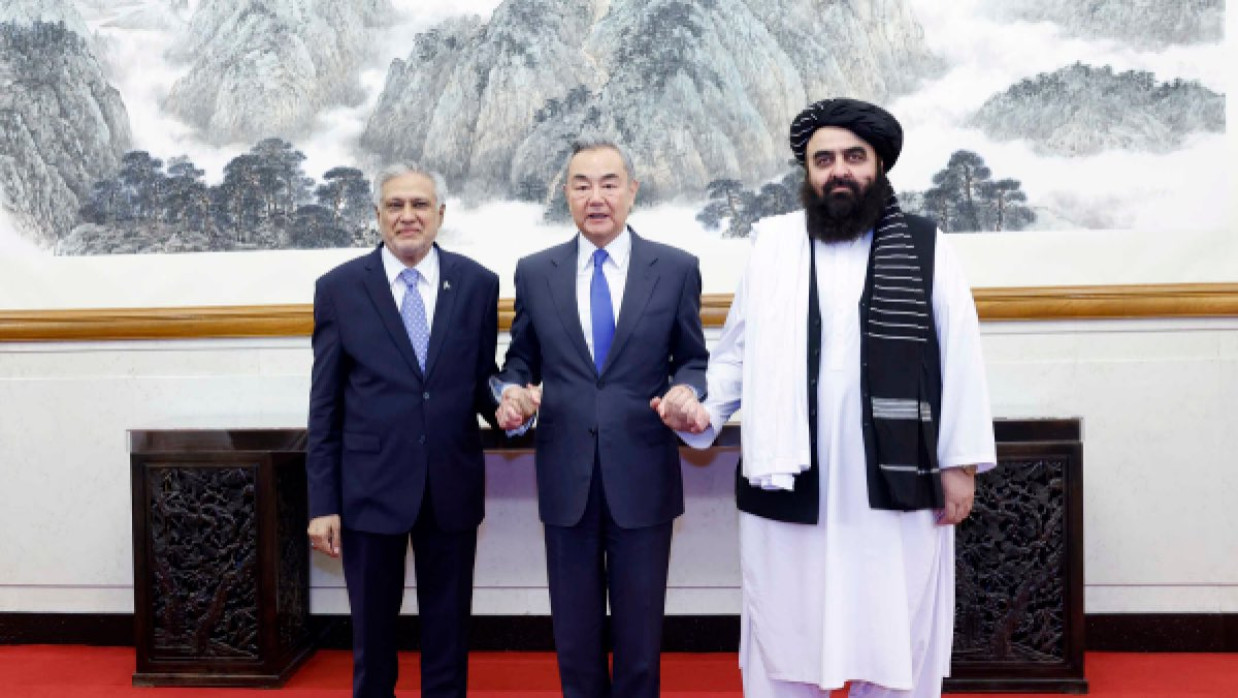
China hosted Taliban representatives in Urumqi this week for rare talks alongside Pakistani officials, a modest move that signals Beijing’s growing influence in the Afghan peace process. While fighting along the Afghanistan–Pakistan border has reached its highest levels in years, China is wary of continued bloodshed hindering its interests in the region.
The main source of contention between Islamabad and Kabul has been Pakistan’s claims that the Afghan Taliban provide sanctuary to Tehrik-i-Taliban Pakistan (TTP) extremists, who have carried out attacks throughout Pakistan near the border at an alarming rate over the past few years.
Islamabad views the TTP not merely as a domestic insurgent force but as a transnational security threat emboldened by the Taliban’s return to power in Kabul in 2021.
Pakistan’s response has included cross-border airstrikes targeting suspected militant hideouts inside Afghanistan. These strikes represent “a significant escalation” in a bilateral relationship that had soured despite Pakistan having once served as the Taliban movement’s most reliable diplomatic partner. Attacks by Taliban militants on Pakistan’s border forces have added fuel to the fire. Some analysts now worry about the potential for an “extended low-level war on the border” that could spill over into broader regional instability.
In this context, Beijing’s peacemaking is anything but performative. China has much to lose from further conflict. Militants from the TTP have attacked Chinese nationals and CPEC-related infrastructure in the past. Terrorism along Pakistan’s border thus poses an existential threat to Chinese investments there.
China has also begun to articulate interest in mining and infrastructure development (including transit) inside Afghanistan. Stability along the Afghanistan–Pakistan border is therefore essential not only for Pakistan’s internal security but also for China’s broader regional ambitions linking Central Asia, South Asia, and the Middle East.
Reports emerging from the Urumqi talks suggest that both sides agreed to avoid escalation and explore a “comprehensive solution.” Pakistan, however, has said little in response to the talks. That is not to say that Islamabad disengaged diplomatically, but rather that it has hedged its expectations on whether these Taliban officials can and will deliver on any assurances they provide. The Afghan Taliban have long-standing ties to allied militant groups throughout the region. Rooted in ideology and developed over years of fighting together, as well as complicated intra-Taliban power balances, the Taliban regime may balk at taking action against the TTP.
This structural constraint represents the central obstacle facing China’s mediation initiative.
At the same time, Beijing possesses leverage that previous mediators such as Qatar and Turkey lacked. China remains one of Pakistan’s most important economic partners and a potential gateway for international engagement with the Taliban government, which continues to face diplomatic isolation. This dual influence positions Beijing uniquely to encourage confidence-building measures between the two sides.
Yet mediation alone cannot resolve the underlying tensions unless accompanied by verifiable commitments regarding militant activity.
By breaking the deadlock with airstrikes after rounds of talks, Pakistan demonstrated its conviction that talk can only go so far without sticks. Expectations are low that Pakistan will forgo force without credible commitments from Kabul that the TTP can be contained, which China will have to elicit.
Beyond Pakistan, China’s involvement signals an evolution of its role as well. Beijing is slowly but surely shifting from being solely an economic investor to a security mediator in South Asia. If China can pull this off, it will depend not just on Beijing but also on Kabul.
For now, the Urumqi talks represent a cautious step toward de-escalation but not yet a durable solution to one of the region’s most persistent security challenges.


0 Comments
LEAVE A COMMENT
Your email address will not be published