

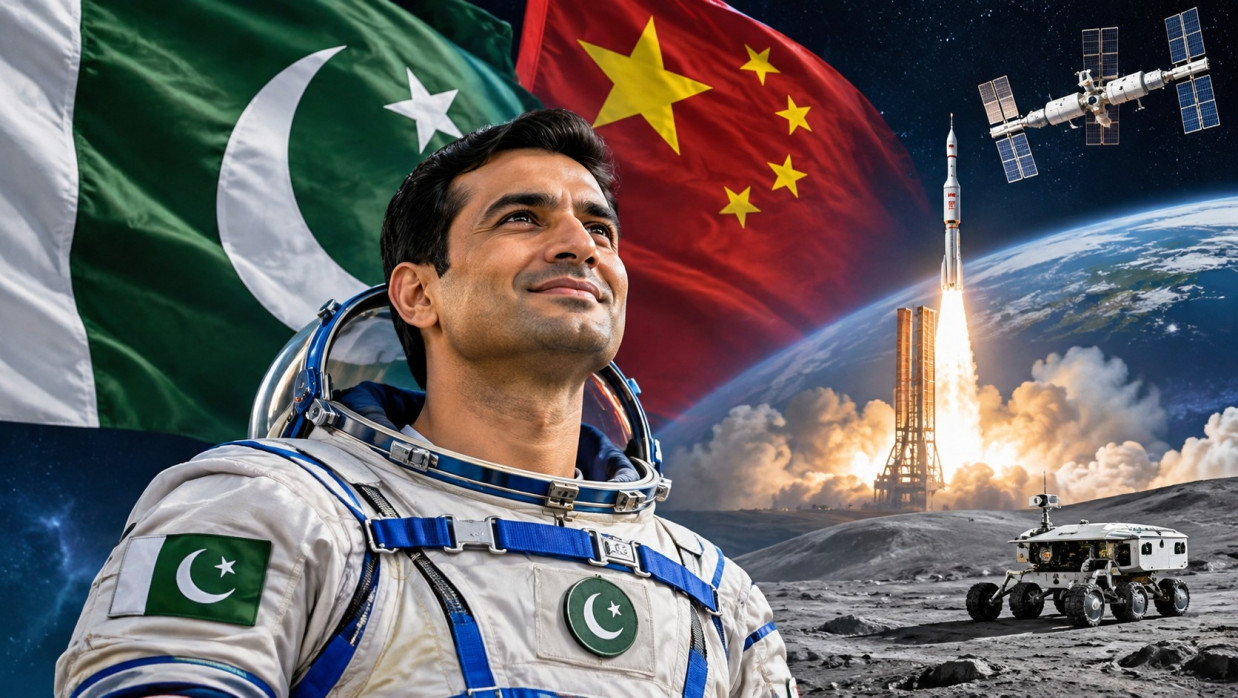
On 25th November 2026, astronaut Muhammad Zeeshan Ali became the first Pakistani to travel into space, as part of a crew on China’s Shenzhou-24 spacecraft. The spacecraft launched from China’s Jiuquan Satellite Launch Centre in the north west of China. Alongside Chinese commander Tang Hongbo and engineer Wu Yi, Muhammad Zeeshan Ali also became the first international astronaut to enter China’s Tiangong space station. Therefore, this marks a key development in Pakistan and China’s collaborative efforts, and signifies an exciting new frontier for their partnership.
As well as being an achievement for Pakistan, China’s decision to allow a Pakistani astronaut to join its manned space mission is indicative of strong institutional confidence in as well as good coordination and collaboration between the two nations. Manned space missions involve highly sophisticated technology, alongside stringent safety requirements. They are also subject to meticulous planning and there is considerable communication between astronauts and ground control. Consequently, great effort is required to train international astronauts and to then confidently allow them to join a manned space mission. Hence, Pakistan’s involvement in this area is a key development in Pakistan and China’s relationship.
This example also highlights the evolution of Pakistan and China’s partnership which has moved beyond the more traditional fields of infrastructure, defence and commerce, as well as connectivity. Pakistan and China have referred to their partnership as ‘all weather’ for many years. China-Pakistan Economic Corridor related projects have further developed economic and infrastructural links, and defence collaboration has also been integral to their strategic relationship. The Shenzhou-24 mission therefore introduces an innovative new aspect to Pakistan and China’s partnership and further develops their collaborative work in science and high technology.
Critical to the success of this project was the February 2025 agreement that Pakistan and China concluded on space collaboration. Within this, guidelines were set out for cooperation and astronaut training. Pakistan then identified astronauts for training, such as Muhammad Zeeshan Ali and Khurram Daud. Training was undertaken in China. Muhammad Zeeshan Ali’s appointment to the Shenzhou-24 mission enabled the agreement to be realised in practice. During his seven-month training period in China, he received training relating to the spacecraft and Tiangong space station as well as learning about coordination, problem solving and the Chinese language.
Successfully launching and attaching to Tiangong underlines the value of Pakistan and China’s collaboration. As a payload specialist, Muhammad Zeeshan Ali will engage in, and also co-ordinate, scientific experiments. These will include biotechnology and material science experiments. There will also be an experiment analysing photosynthetic cyanobacteria. Research of this nature can aid our understanding of biological functions in space and may also have applications for future extended space missions. Overall, the Shenzhou-24 crew are anticipated to undertake around 90 experiments and tasks.
Furthermore, China’s role in global space exploration is becoming increasingly prominent. Having finalised construction of its Tiangong space station, Beijing has increasingly emphasised its commitment to using Tiangong for scientific research and international collaboration. Through allowing a Pakistani astronaut to join its manned space mission, China has therefore given Islamabad access to a key technology and scientific resource. Pakistani scientists, engineers and organisations can then benefit from this, without needing to invest large amounts of money and/or technology, in these important areas.
Nevertheless, Pakistan should look to utilise this development to further develop its own institutional and scientific advancement. Although involvement in international space missions can be hugely beneficial, to effectively establish a continuing national space sector, Pakistan needs to continue to invest in research bodies, technical education and the manufacture of satellites, as well as in rocketry, robotics and materials. Building upon the experience acquired from Muhammad Zeeshan Ali’s mission, Pakistan’s space agency (SUPARCO) can seek to deepen collaboration with universities, research institutes and other international entities.
There is also considerable economic relevance to Pakistan’s engagement in space-related work. Aside from space missions, space technology can be utilised in a variety of sectors such as communications, farming, emergency services, meteorology, transportation and environmental protection. Moreover, research in biotechnology, material science and microgravity can also yield knowledge with terrestrial application. Given that Pakistan encounters issues relating to climate, as well as those concerning food supply and technology, enhanced engagement in space-related research can therefore offer numerous potential advantages.
From a geopolitical perspective, this mission also emphasises the value of scientific collaboration in reinforcing state-to-state relationships. Increasingly, alongside commercial and defence collaboration, technology, scientific expertise and scientific networking are also seen as important factors which influence international partnerships. Thus, by incorporating a Pakistani astronaut into its manned space mission, China has introduced a novel element to Pakistan and China’s relationship. It also serves to highlight the potential for countries to exploit high technology scientific collaboration in order to further their own technological progression.
Going forward, Pakistan needs to continue to build on this development. It is essential that Pakistan can embed the learning from Muhammad Zeeshan Ali’s mission into its overarching strategy. Afterwards, further steps should be taken to improve science, for example through provision of scholarships, additional training, and strengthening of research collaboration. Additional joint work in, for example, satellite, lunar and space-related fields, may also present further possibilities for Pakistani organisations.
Therefore, Muhammad Zeeshan Ali’s space mission is of great importance to Pakistan. His involvement in Tiangong underlines Pakistan’s capability to engage in high-level international scientific collaboration. Crucially, it also exemplifies how the Pakistan-China relationship can adapt and develop in response to new high technology prospects.
Whilst the Shenzhou-24 mission is undoubtedly an historic feat, its true impact will also depend on subsequent developments. If Pakistan can effectively use this achievement to further develop its scientific bodies, as well as to encourage innovation and improve its human resource base, then Muhammad Zeeshan Ali’s mission has the potential to form the basis of a significantly wider Pakistani accomplishment. Pakistan and China have successfully elevated their relationship above Earth. Now they need to ensure that this historic development leads to a lasting legacy in the realms of science, development and international collaboration.


0 Comments
LEAVE A COMMENT
Your email address will not be published