

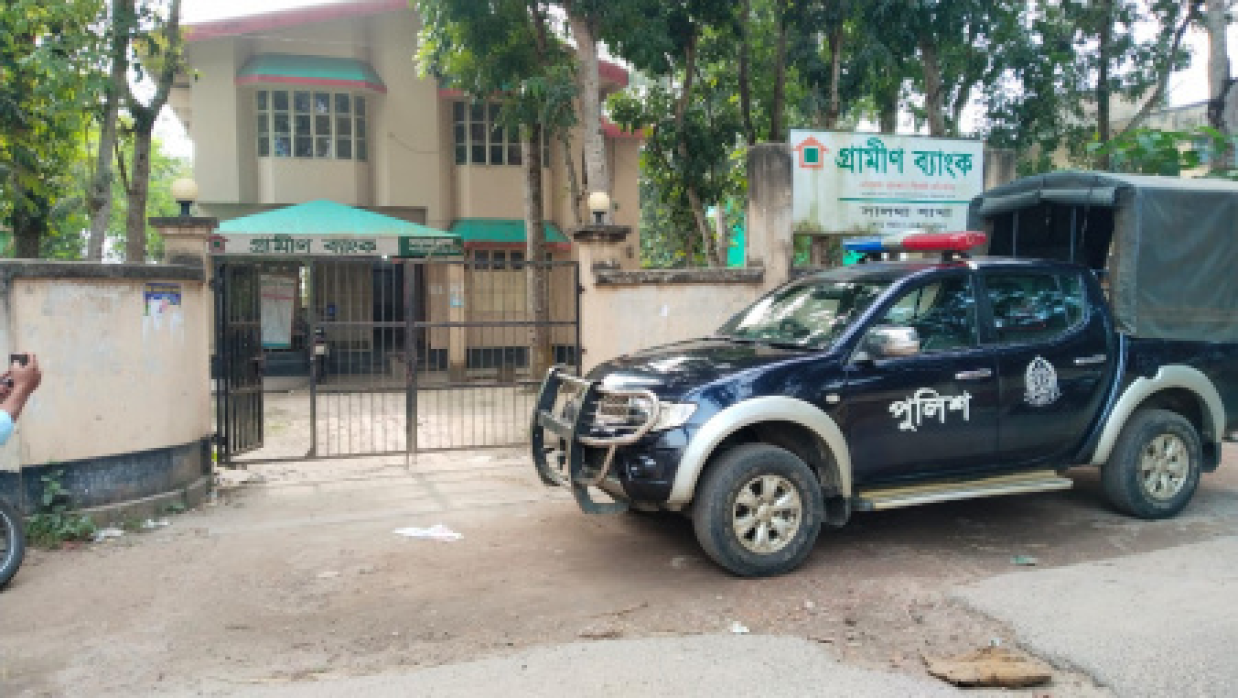
A police vehicle is parked outside Grameen Bank's Saltha branch. Photo: TBS
When financial institutions serving vulnerable communities become targets of violence, the consequences extend far beyond damaged buildings. They threaten women's economic independence, household security, rural entrepreneurship, and the social foundations of Bangladesh's development.
A country does not move forward only because of its construction projects, highway expansion, and impressive economic indicators. It moves forward because of the opportunities that it provides for its most vulnerable citizens, especially women who have traditionally been deprived of the chance to have economic independence due to poverty, social inequality, and exclusion from financial institutions. Any attempt by an institution to limit opportunities for vulnerable citizens is not just about economics; it is about social justice and a country's development.
The famous microfinance movement in Bangladesh began with the idea that poverty should not deprive anyone of the opportunity to gain economic benefits. At the heart of the movement is Grameen Bank, which has shown how to provide poor people, especially women, with economic opportunities and the ability to become entrepreneurs and financial decision-makers.
The reported cases of intimidation and attacks on Grameen Bank branches raise a question: what happens when an institution that gives vulnerable citizens the chance to improve their lives becomes the target of political dissatisfaction?
Every interruption such an institution faces can affect the life of a woman who comes there to borrow money to buy livestock, a child who needs this money to pay for his or her education, a small entrepreneur, or anyone who depends on it. Therefore, an attack on an institution that provides poor people, especially women, with chances cannot be neglected and should be seriously discussed in the country regardless of the political party.
Grameen Bank: An Institution Created to Enable Poor People
It should be mentioned that Grameen Bank has a huge historical significance because it was created to show that poor people without property or collateral can receive financial benefits from financial institutions.
The institution began its work through the innovative ideas of Muhammad Yunus, the Nobel Peace Prize laureate, who challenged the conventional view that poor people without property cannot become bank clients. Grameen Bank's unique lending model has shown that a lack of property and assets is not the reason poor people cannot become borrowers.
Traditionally, rural women cannot receive credit because they lack collateral and independent property, but the institution has shown that credit can be provided not based on assets, property, and income, but on trust, community participation, and economic opportunity. Thanks to this innovation, Grameen Bank has proved that microcredit is an efficient development strategy, and in 2006 it received the Nobel Peace Prize along with Yunus for their work aimed at economic and social development of countries.
Grameen Bank is not owned by its founder; it has its own independent legal and institutional framework, and borrowers play a key role in its ownership. Muhammad Yunus's role in creating the institution does not mean he owns it or works with it today. When political conflicts or disagreements arise over Yunus's political actions, decisions, or role during Bangladesh's 2024 uprising, that conflict should not be transferred to Grameen Bank borrowers.
Financial Independence of Women Is Not Only about Loans
Millions of Bangladeshi women use financial services from various institutions to gain personal independence and contribute to their households' economic development. These services allow women to become decision-makers in their families, receive money to start businesses, and even escape poverty. A loan can help a woman purchase a sewing machine, livestock, or a poultry farm, start a grocery business, or cultivate crops. Of course, these business activities may seem insignificant against the backdrop of national economic indicators, but their contribution to the country's economy is considerable.
In addition, women's financial independence helps them gain social independence, especially when they earn income independently, manage productive assets, and can take part in decisions about children's education, food, health, and family expenditures. Loans in themselves are not what empower women because sustainable development can only be accomplished if there is equity in lending, financial education, market participation, realistic repayment policies, and protection against over-borrowing. That is why the importance of Grameen Bank and similar financial institutions should be understood not just as opportunities to receive money, but as opportunities for economic independence. Disrupting this service can negatively affect the lives of many people who have built it over many years.
What Happens to a Community When a Bank Branch Is Attacked?
When a financial institution is damaged by intimidation, vandalism, or arson, it can lead to many hard-to-measure economic problems. For instance, consider a rural woman who runs a tailoring shop. She needs money to buy fabric before the season begins. If there is any difficulty with the bank where she operates, she will be economically challenged. A livestock farmer will not be able to receive a loan to buy animal feed, and a vegetable seller will not be able to make purchases. This shows why continuity of financial services is so important for poor communities.
Moreover, the damage from such attacks does not affect only borrowers. Small entrepreneurs usually cooperate with suppliers, transport workers, agricultural producers, local markets, and neighbors. That is why financing interruptions can negatively affect all these economic relationships. Therefore, an attack on a bank branch is not just an attack on a building; it can also undermine the economic confidence of the whole community.
Pattern of Attacks: Recent Developments
These problems have become especially topical now, with reports of attacks on Grameen Bank branches. As it was reported in The Daily Star, Grameen Bank informed on November 19, 2026, that 72 Grameen Bank branches and offices have been subjected to arson attacks or attempted arson attacks since November 10. The number of attacks increased to more than 100 by the 24th. The attacks damaged computers, furniture, documents, and security equipment, and destroyed some offices. So far, the attacks have taken place in many districts. For example, according to Prothom Alo, in Madaripur, petrol bombs and crude bombs have been thrown at two Grameen Bank branches, but there has been no interior damage. These attacks took place amid broader political unrest. There were claims that these attacks were organized by Awami League activists, but responsibility for each incident has to be proved.
Grameen Bank has many branches, which makes the situation even more worrying. According to October 2026 figures, there are approximately 10.67 million borrower members, the majority of whom are women, and they live in more than 81,000 villages. The consequences of intimidation by this kind of institution can be very significant for the poor population of Bangladesh.
Political Disagreements Should Not Be Transferred to Poor Population
The political situation connected with Bangladesh's 2024 uprising and transition is complicated, and different political groups have opposing views on the legitimacy and consequences of the uprising and transition. These discussions are an inherent element of democratic processes, and they can be held within the scope of lawful political activity and independent journalism. They should not include violence towards institutions that serve ordinary people. Dr. Yunus founded the bank, but he is not the institution's owner, and he does not manage its day-to-day operations. The institution's key goal is to provide financial services to economically disadvantaged communities. If there are disagreements about Yunus's activities, there are lawful ways to criticize and show the political parties' position on the issue, but not by attacking bank branches. Political disagreements must be separated from economic punishment of poor people who are not connected to these issues in any way. A society committed to democratic accountability should protect political opponents and institutions from political pressure and violence.
Hidden Damage for Families and Communities
The economic consequences of intimidating financial institutions are usually accompanied by psychological harm. Women who use the services of financial institutions will be afraid of visiting them and conducting financial meetings when violence is possible. In addition, employees may fear threats to their personal safety, families may postpone investments, and entrepreneurs may be reluctant to develop their businesses. All of these factors can harm poor communities because they have thin economic margins and find it difficult to access services from other institutions. Women's economic activities provide communities with financial stability during floods, agricultural disruptions, inflation, and other emergencies. In this way, women's economic activities protect families and communities from financial shocks.
A social danger of institutional intimidation is the erosion of trust in institutions that provide services to all citizens, regardless of political beliefs.
Protection of Financial Institutions Is a National Task
The government of Bangladesh should ensure law enforcement, protect institutions, and maintain transparency in the process. It must conduct impartial investigations, identify perpetrators, preserve evidence, and provide due process to establish responsibility. Security measures are needed to protect employees, borrowers, and banking facilities from threats while avoiding unnecessary restrictions on citizens who come to use their services. The institution should prioritize restoring disrupted services, protecting financial documents, and assisting borrowers whose transactions have been disrupted. In addition, political leaders must condemn violence against financial institutions, regardless of their political stance toward the institution's founder.
Journalists and civil society organizations should also distinguish allegations from verified evidence. In this way, reliable information can be provided.
Therefore, public confidence in financial institutions should be maintained despite political disputes.
Conclusion: Do Not Burn the Future of Bangladeshi Women
Bangladesh's outstanding economic achievements in women's economic independence have been achieved through decades of entrepreneurship, innovation, determination, and women's courage.
This achievement should not be used as collateral for political conflicts. Grameen Bank deserves criticism, as do all other financial institutions, because of its lending practices, governance, transparency, and treatment of borrowers. Nevertheless, such criticism should be provided by lawful means. It is inappropriate for the country to glorify women's empowerment and at the same time to allow the institutions that are the source of this empowerment to become the target of violence. When a bank branch is burned, it burns not only documents and furniture, but also women's opportunity to become financially independent, educate their daughters, and build their future. Bangladesh's political disagreements are numerous, but protecting women's economic independence should become a national task.
As Nobel Peace Prize laureate Muhammad Yunus said:
"Poverty does not belong in civilized human society. Its proper place is in a museum."


0 Comments
LEAVE A COMMENT
Your email address will not be published