

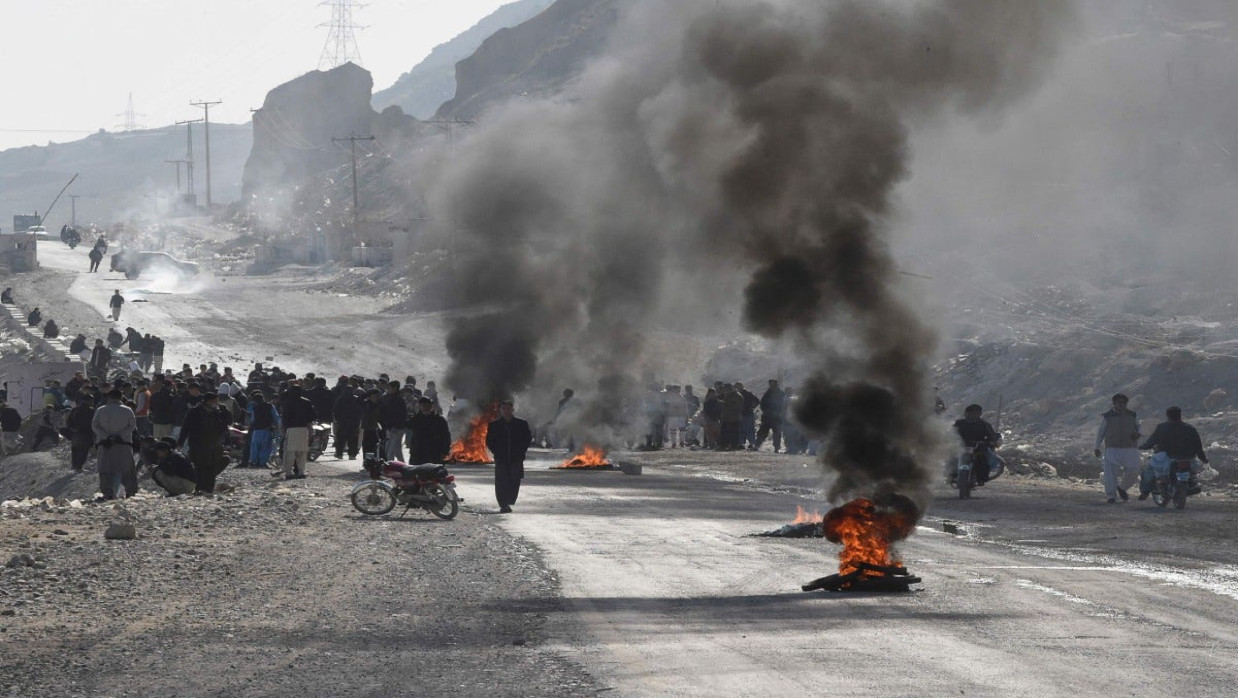
The media really does like a good rebellion story, but there’s a pretty thin boundary between talking about a geopolitical friction point and then, basically printing the props for some kind of stage act. When the Indian magazine Darpan Desh gave a glossy, special section to Hyrbyair Marri, with that same reverence kind of tone that’s normally saved for real world statesmen, it went past that line. The whole thing came packaged with mock banknotes, all meant for a made up “Republic of Balochistan,” so in the end it felt less like journalism and more like a propaganda performance piece.
Before anyone gets too carried away by the aesthetic of independence, there’s one basic thing we have to ask, does this republic actually exist?
The short answer is, no. It does not exist diplomatically, it does not exist territorially and it does not exist in any administrative capacity that really matters. What people witnessed was basically a hollow media stunt dressed up like an editorial deep-dive, with that polished narrative tone. it’s hard to ignore. Rolling out this media offensive right when Pakistani courts are issuing critical verdicts in major Balochistan-related legal matters is not some innocent coincidence, it looks like a calculation.
The Microblogging Independence Movement
The real birth of this “republic” shows, kinda plainly, how flimsy the whole founding story is. There wasn’t some underground parliament, no genuine democratic referendum, and no working government-in-exile running quietly from the shadows. What was actually there? A single user on X, that’s the whole thing.
On May 9, 2025 Mir Yar Baloch—writer and digital activist, no institutional backing at all—basically, alone, unilaterally declared Balochistan’s independence. He picked a messy 48-hour window while India and Pakistan were still trading military strikes as part of Operation Sindoor, betting that the confusion of a wider confrontation would manufacture attention, and clicks. At the same time, he asked, in the same breath, for India to open a “Balochistan embassy” in New Delhi, promised Indians visa-free entry, and even suggested a makeover of Mumbai’s historic Jinnah House, to “Balochistan House.”
Then, a flag, a national anthem, plus a state emblem, were “created” in one digital sitting, like ordering comfort food off a menu, then expecting it to count as a national process. Naturally, not a single country on Earth recognized the announcement. Pakistan, for its part, dismissed it as “terrorist propaganda stunt”, and that reaction tracks. If you remove the shiny digital graphics from the equation, what else could any reasonable person call it, really?
The Gentle Landlord of Self-Exile
Then again there is the man Darpan Desh picked for its cover, or something like that. Hyrbyair Marri has had a comfortable life of self-exile in London since 2000, with a flight from Pakistan after a high-profile murder investigation that implicated his well-known family. While a British court acquitted him of terrorism charges in 2009, and the UK granted him asylum in 2011, his legal survival in London doesn’t rewrite the older facts, not really.
Pakistan has, for years, treated Marri as the founder and chief planner behind the Balochistan Liberation Army (BLA). He says no, of course, but these denials don’t land with much force when stacked against international law. Look at the general picture: Pakistan listed the BLA under its Anti-Terrorism Act in 2006. In the same span, the British Home Office also banned the group. The United States Treasury, perhaps more aggressively, went further, sanctioning the BLA as a Specially Designated Global Terrorist entity, and more recently, it folded in his notorious lethal wing, the Majeed Brigade, into the same counter-terrorism register.
Three different governments, using three separate legal processes, ended up with the exact same conclusion. Marri’s British asylum status doesn’t erase this reality; it just means London has picked to shelter the alleged architect of an organization that its own laws, prohibit.
The New Delhi connection
Marri keeps repeating, a lot, that he never once solicited Indian help. If that is really the case then a handful of obvious oddities, honestly, need a quicker explanation not later.
New Delhi has to clarify how a senior BLA field commander in charge of operations in the Khuzdar area somehow managed to remain in the Indian capital for about six months, under a false name, meanwhile getting high-level medical care for kidney problems. Investigators also have to spell out, in practical terms, how another wounded BLA commander was able to enter a major New Delhi hospital without any real red flags popping up.
This isnt some loose conspiracy idea; it’s more like a paper trail already documented showing designated terrorists moving with ease across Indian soil. And Pakistan’s cross-border strikes into Iran’s Sistan-Balochistan region didn’t aim at random places—they hit verified BLA and Balochistan Liberation Front (BLF) hideouts. So when a well-known Indian media outlet suddenly publishes a polished flattering, multi page spread praising Baloch “statehood”, it feels less like normal detached editorial curiosity and more like the next part of a coordinated proxy play.
The Real Cost of Mock Banknotes
When the camera flashes finally settle down and those shiny magazines get recycled, what’s really happening on the ground in Balochistan is written in blood, not in fake currency. The movement that Darpan Desh tried to kind of soften into something romantic, is in practice defined by extremely brutal violence aimed at civilians, not at some abstract idea.
In March 2025, BLA militants hijacked the Jaffar Express train, and killed at least 26 passengers while more than 400 innocent people were kept as hostages. This isn’t some sudden break; it matches a grim historical script. Way back in 2009, leadership tied to the separatist movement publicly urged the targeted killing of non-Baloch residents, sort of as a matter of policy. Then the campaign that followed went on to claim roughly 500 civilian lives, mostly low paid laborers, teachers, and small shopkeepers, people who were Punjabi, Pashtun, Sindhi, or Saraiki, depending on where they came from.
The group has also been going after Chinese nationals in a sort of deliberate move to ruin the China Pakistan Economic Corridor, (CPEC). And the record of these atrocities is, well, extensive and pretty well documented, like the 2019 attack at the Pearl Continental Hotel in Gwadar, the assault on the Chinese Consulate in Karachi, and then that terrible suicide bombing aimed right at Chinese language teachers at Karachi University.
Based on information put together by Pakistan’s Ministry of Interior, the main casualties linked to these separatist groups aren’t really military personnel. It’s more like the infrastructure that keeps daily life running, plus regular working-class citizens that the militants claim they’re trying to “free”.
Sure, putting fake money in the mix for a fake republic can look provocative on some magazine cover, but it kind of insults the intelligence of people watching from outside. Balochistan , meanwhile, has genuine constitutional, economic, and political problems that call for serious involvement. Yet doing the whole dress up thing with an imaginary state, just ends up hiding the very real terror happening right there on the ground.


0 Comments
LEAVE A COMMENT
Your email address will not be published