

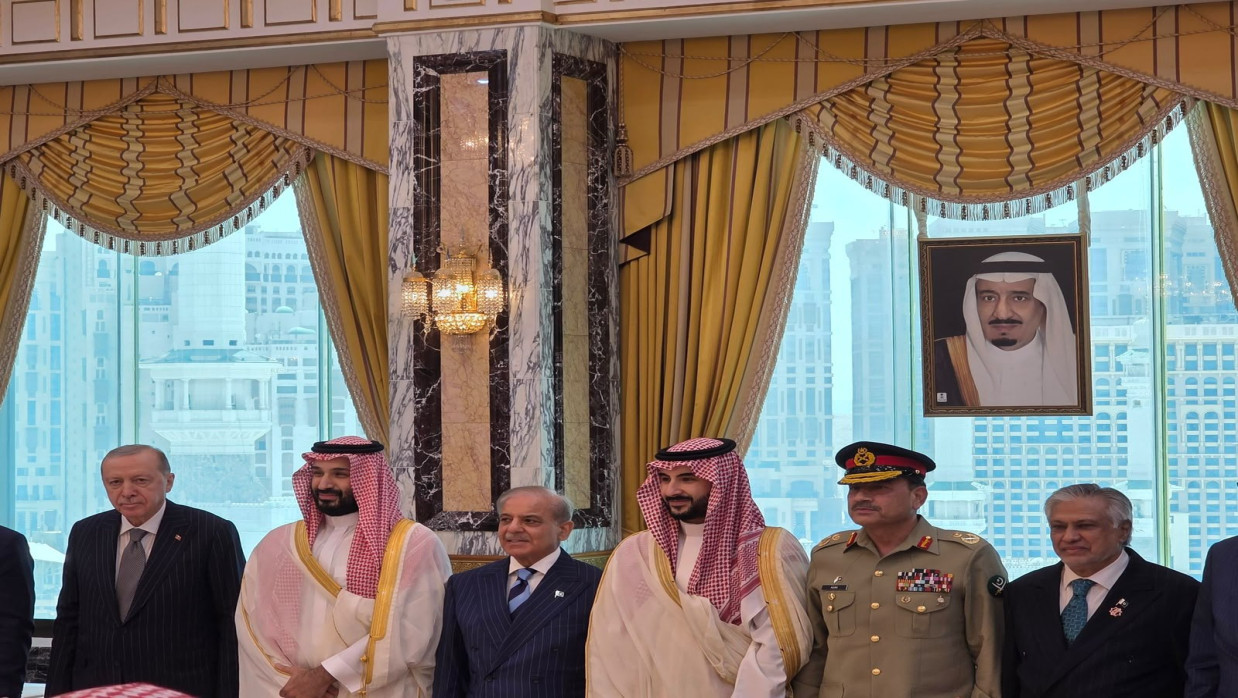
On August 7, 2026, Turkey, Saudi Arabia, and Pakistan entered into a tripartite defense pact called the Mecca Joint Defense Agreement. It is one of the most significant security arrangements to develop between countries in the Middle East and South Asia in recent years. Turkish President Recep Tayyip Erdogan, Saudi Crown Prince Mohammed bin Salman, and Pakistan's Prime Minister Shehbaz Sharif inked the pact in Mecca. According to the agreement, an armed assault on any one of the three nations would be considered an assault on all three.
Pakistan's Foreign Ministry said that the pact will help increase mutual deterrence and advance peace, security and stability "in the region and beyond." Turkish and Saudi officials have stated that the deal is defensive in nature, is not targeted at any country and should not be seen as forming a religious or sectarian military alliance. However, the language around collective defense brings comparisons to NATO's Article 5 provision.
The pact builds upon a preexisting Saudi-Pakistani security alliance. Riyadh and Islamabad reached a bilateral Strategic Mutual Defense Agreement in September 2025 that includes a comparable clause stating that if either party is attacked, it will be regarded as an attack against both parties. Now, with Turkey on board, that agreement has been upgraded to a much more powerful triangle of strategic depth.
Each brings distinct sources of power. Saudi Arabia has vast wealth, energy dominance and centrality to the Arab and Islamic worlds. Pakistan provides one of the region's most sizable and battle-tested militaries and is the Muslim world's only recognized nuclear power. Turkey offers NATO experience, major capabilities for naval and air power projection, and a fast-growing defense industry churning out drones, missiles, armored vehicles, frigates, and Electronic Warfare systems.
The complementary aspect of this partnership could pave the way for coordinated military drills, intelligence cooperation, joint air and missile defense, defense-industrial investments, and coproduction of arms. Turkish and Pakistani weapons platforms could be funded by Saudi investment, while Ankara's defense-tech industry and Islamabad's warfighting expertise can enhance Riyadh's security.
The timing couldn't be better. Tensions are rising in the Middle East. Iran, Israel, the United States, Yemen' 's Houthis and other militias are sliding towards open conflict. Missiles and drones have revealed how easily Gulf oil refineries, ports, airports and sea lanes can be attacked. All three governments seem keen to develop regional security architectures less dependent on the US.
Turkey's involvement is particularly significant because it is a member of NATO. Ankara will have to reconcile its commitments made in Makkah with its NATO obligations. The deal does not automatically indicate Turkey pivoting away from its western ally. Turkey's involvement with these countries also aligns with Erdogan's foreign policy strategy of diversifying allies and enhancing Turkey's leverage in an evolving multipolar world.
Key details are missing. For example, the released language does not define what an "armed attack" is, whether a military response would be automatic, or whether the pact includes strikes by terrorist groups and other non-state actors. There's also no mention of how decisions would be reached if one country found itself in a conflict that the other two strongly opposed.
The Mecca pact should therefore not yet be heralded as an "Islamic NATO." There is no integrated command structure or permanent headquarters staffed with planners and diplomats. There are no operating plans and established consultation mechanisms either. But it is more than words on paper. Linking Saudi wealth with Pakistani soldiers and Turkish armor could form a powerful security triangle spanning the eastern Mediterranean, the Gulf, and South Asia. The real test will be what Riyadh, Islamabad, and Ankara do with their new commitment to collective defense, not how lofty the agreement's wording is.


0 Comments
LEAVE A COMMENT
Your email address will not be published