

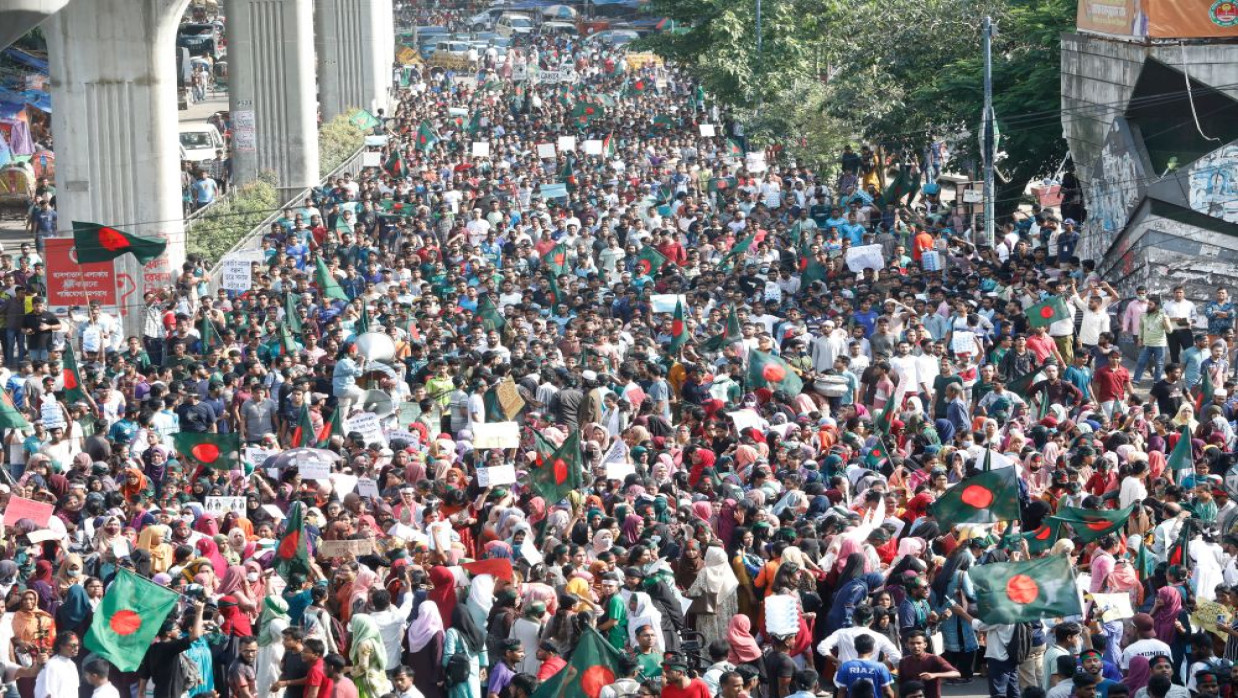
A National Awakening
Two years after the July 2024 uprising, Bangladesh continues to wrestle with the meaning of one of the most consequential popular movements in its history. What began as a student protest against an inequitable quota system rapidly developed into a nationwide revolt against authoritarian government, political exclusion, corruption, and the erosion of democratic rights. Students were soon joined by teachers, professionals, workers, parents, opposition supporters, and ordinary citizens who had long felt powerless before the state.
Of course, the uprising did more than bring down Sheikh Hasina. It punctured the fear factor. Many Bangladeshis had watched their politicians neuter democratic institutions, turn elections into a circus, silence dissent through coercion, and bully their way into hijacking state agencies for political profit. But behind the veneer of seemingly omnipotent state power lay the ugly truth that they had lost the people's legitimacy. When those children dared challenge the Awami League and refused to back down even as the police opened fire, authoritarianism began to unravel.
For that reason, the second anniversary should be about more than commemorating another year since the revolution. Instead, it should be a day we set aside to honor the dead, to heal the wounded, and to take stock of our state institutions and assess whether or not the dreams that inspired us to revolt have ushered in real reform.
Abu Sayed and the Courage That Overpowered Fear
Abu Sayed was a student at Begum Rokeya University in Rangpur. He quickly became one of the uprising's most iconic images. Photos of Sayed standing in front of police with their guns drawn and his hands defiantly raised in the air spread like wildfire. When Sayed was killed, his death became a rallying cry for protesters. Instead of scaring students into compliance, the killings showed the world the cowardice of murdering unarmed civilians.
At some point in every mass movement, the fear factor reverses. Abu Sayed's death sped up that process in Bangladesh. Thousands watched footage of the frail young man confronting the might of the state, defenseless, with no bulletproof vest and knowing that his death may or may not inspire any real political change. In standing up to fear, Sayed recalled other immortal moments of peaceful courage, such as the lone "Tank Man" who stood before a row of tanks during China's 1989 Tiananmen Square protests.
Heroes like them are important, of course, but there's something else going on as well. When people stand up like that, it liberates pent-up righteous energy in society. When thousands of Iranians decided, after Abu Sayed and others were killed, that there was no safety in standing down and no virtue in keeping quiet, the martyrs themselves became the argument.
The Enormous Human Cost
Victory, however, was not won without cost. The United Nations found that between July 1 and August 15, 2024, as many as 1,400 people may have been killed. Thousands more were injured. Many survivors suffered permanent disabilities, including loss of eyesight, limbs, mobility, education, employment, or ability to care for their family. Getting access to education again and learning a livelihood that would allow them to feed and care for their families was a struggle. Life was far from easy for them.
The transitional government worked to coordinate medical care, financial payments, and rehabilitation. However, their efforts were limited by resources, bureaucracy, faulty or contested lists of victims, political rivalry, and the overwhelming scale of the tragedy. Some injured protestors claimed to have faced unnecessary delays, indifference, or insufficient long-term assistance. Victims' families who pursued recognition and justice had to deal with the very bureaucracy whose institutional shortcomings played a role in the tragedy.
Bangladesh owes the victims far more than memorials and rhetoric. Physically maimed survivors require medical assistance, rehabilitation, counseling, education, skills training, and a dignified monthly allowance. Families of the deceased are owed justice through transparent inquiries and fair trials. Don't let political bandits hijack their grief or turn it into an ego contest about who owns the revolution.
The Military at a Moment of Conscience
One of the most important turning points occurred within the armed forces. The military was deployed during the crisis and therefore became part of the state's response. Yet accounts of the final days suggest that considerable unease existed within its ranks. Officers and soldiers could see the widening gap between government orders and popular sentiment. Many reportedly understood that the crowds included students, relatives, veterans, and ordinary citizens demanding political change.
The military was a corporate actor torn between obligation to follow the lawful civilian order and professional responsibility to defend the country and its people. An order to restore public order is not an order to shoot civilians indiscriminately. Military personnel have an obligation to disobey manifestly unlawful orders, such as intentional attacks on civilians who are not fighting. This was exactly the issue at stake as events unfolded.
Reuters reported that on the evening before Sheikh Hasina's departure, the army chief met with senior officers and decided that troops would not open fire on civilians to enforce the curfew. That decision effectively demonstrated that the government could no longer rely on the army to preserve its authority by escalating violence. The military's restraint helped prevent what might have become an even greater national catastrophe.
Reports of hesitancy by younger officers carry particular weight. Having grown up in the shadow of the coup-backed government of 2007–2008 and its political aftermath, as well as the stigma of the 2009 Bangladesh Rifles mutiny that left dozens of army officers dead, many soldiers developed a resolve not to be party to another malevolent political deal.
Assertions that Hasina was betting on the installation of a martial law government led by a military strongman she could later come back to power under still await documentary evidence. But the larger political calculus makes sense: If the police were overwhelmed, only open military repression could have maintained her government for long; the army's refusal to allow a wider reign of blood foreclosed that option.
We shouldn't glorify the military's actions. But its refusal to escalate violence further shows how constitutional values and institutional norms can restrain a state's violent tendencies.
The Mystery and Danger of August 5
August 5, 2024, was thick with uncertainty, rumor, and mortal peril. Word spread that an unknown voice had placed a warning call that the leaders of the march to Dhaka might be sniped. Whether all the details of that call can be independently confirmed doesn't matter. The scenario it depicted was plausible.
The protesters had no reason to believe that the army would stand down or that counterrevolutionary loyalists would not try assassination tactics. Lines of communication were cut off, security forces were mobilized, and the last few weeks had proved that certain factions of the regime would use deadly force if necessary. Thousands would not back down. They were not brave because they thought they would live. They were brave because they could no longer accept submission.
Flattery, Sycophancy, and the Rise of Authoritarianism
The rebellion also revealed a chronic weakness of Bangladesh's political culture: turning loyalty into servility. Authoritarianism rarely springs from the mind of one person. It is perpetuated by ministers and legislators, officials and businesspeople, intellectuals and journalists, and party workers who find that flattery pays better than honesty.
Everyone around Sheikh Hasina kept telling her that she was irreplaceable and loved everywhere. Most people justified her government not because they believed in her ideology, but because proximity to power meant position, contracts, patronage, money, and influence. They loved their leader, not the country or its people.
Bangladesh's history of being ruled by imperial courts, colonial administrations, foreign dynasties and centralized elites may have contributed to sycophancy as a means of social mobility. History, however, is no excuse. A republic needs to develop a cultured and independent-minded elite who are willing to advise their leaders truthfully, stand up for institutions and put country before self-interest.
Compliments and political maneuvering destroy responsibility. Leaders listen only to compliments and become out of touch. Bureaucrats are promoted based on compliance, not ability, and organizations decay. Dissent becomes treason, and errors become disasters.
What was shocking in Sheikh Hasina's 5th August, 2026, interview was her lack of empathy towards the killings, injuries, oppression, and purported wrongdoings that occurred during her years in power. Many of those around her have proven themselves equally indifferent to the agony that many Bangladeshis have experienced over the last decade and a half. Rather than speaking out or distancing themselves, they continue to unquestioningly and hypocritically defend her, citing her position as daughter of Bangabandhu Sheikh Mujibur Rahman like it somehow excuses her from criticism or consequences. They describe her as beyond reproach; a visionary leader taking Bangladesh to new heights while ignoring the cost her regime has had on human life and institutions within the country.
India's response to the crisis has also left much to be desired. Many Bangladeshis feel India's political elite has continued to view Hasina as a trusted friend above all else, failing to show the same level of respect for the sufferings of Bangladeshis, their democratic will and their national sovereignty. Hasina has leaned heavily on India to save her, provide her with refuge, and keep her political legacy intact after years of her administration dutifully aligning with New Delhi's interests. Public anger at this reality runs deep and risks turning sentiments against one leader into anti-India sentiment. If New Delhi wants a sustainable partnership with Bangladesh going forward, it can't continue to place all its faith in a single person or party. True friendship with Bangladesh will require respecting the Bangladeshis and their demands for justice, dignity, and democracy.
The Politicization of the Police and Administration
The police institutionally paid a particularly heavy price for politicization. Years of deploying police against political opponents, protesters, journalists, and dissent had worn away at public trust and officer morale. Officers were worn down, terrified, or downright refused to carry out orders utilizing deadly force in the streets by the end of the uprising. Police were also attacked as tempers reached a fever pitch.
A police force is essential to a democratic state, but it must be both effective and lawful to earn public confidence. Political interference in hiring, promotion, transfers, and discipline should end. Police who commit serious abuses must be held accountable through due process of law. However, officers who were merely doing their jobs should not be indiscriminately condemned.
The civilian bureaucracy faces the same dilemma. If jobs are handed out based on party loyalty, and corruption becomes endemic, then the state ceases to be an impartial instrument of power. Everyone views every action through a political lens, and one government replaces one clique with another. If that continues, the revolution will have altered only who gets paid off.
Infiltration, Vested Interests, and Unfinished Reform
Events since the uprising have revealed how quickly special-interest groups can co-opt student unions, political parties, and reform movements. Some to suck up, some to make a buck; others to spread chaos and stifle reform. Fractionalism ensues.
But we cannot crack down more. Reform must start with democratic reform movements built on principles of open leadership, financial transparency, internal democracy, and codes of conduct. Political Parties must purge criminals and political jump seats from using their party tickets. And we, the people, must distinguish between dissent and destruction. Otherwise, we will call every critic a conspirator and go back to thinking like totalitarian monsters with fancy new diction.
August 2024 felt ripe for constitutional and institutional change. There was more change than a change of government. Free elections, judicial independence, decentralization, limits on executive authority, accountable policing, and the protection of rights all require tools that are enforceable under our constitution and statutes. Hope and platitudes won't prevent the next seizure of power.
Internal Unity and External Resilience
Long-term stability of our foreign policy can come only through consensus at home. Divisions and weak institutions make a country vulnerable to pressure from big powers. Let no foreign power based outside of Bangladesh determine our politics, select our leaders, or interfere with how we run our country.
Catchy slogans do not ensure a nation's independence. It is ensured by the people's faith in their state, rule of law, functioning institutions, economic justice, and a political system that allows a change of government without bloodshed. Countries that can withstand foreign pressure are those with strong institutions that reflect a sense of common citizenship at home. Bangladesh will grow stronger by unity and reform, not by patrons abroad.
Honoring July Through Democratic Renewal
Millions of Bangladeshis are now conscious because of the July uprising. We cannot let that consciousness go to waste by venting it in a thirst for revenge, corruption, political party bickering, or the re-establishment of authoritarianism under new leadership.
The only way to honor Abu Sayed and all of the others who were killed is by building a country where no more martyrs have to die just to make their voices heard. The wounded need care. Those who committed crimes must be tried fairly, and due process must be observed. And then it's time to start rebuilding what was destroyed, but this time on the basis of meritocracy. July 20th was never about toppling a regime. It was a revolution against tyranny for dignity, justice, accountability, and a government that listens. Today, on the movement's second anniversary, that battle continues. Now Bangladesh needs to show the world that it has the smarts to match its bravery.
Sources consulted include the United Nations Human Rights Office’s fact-finding report, Reuters’ investigation into the army’s refusal to suppress the protesters, and reporting on the government’s continuing treatment and rehabilitation commitments.


0 Comments
LEAVE A COMMENT
Your email address will not be published