

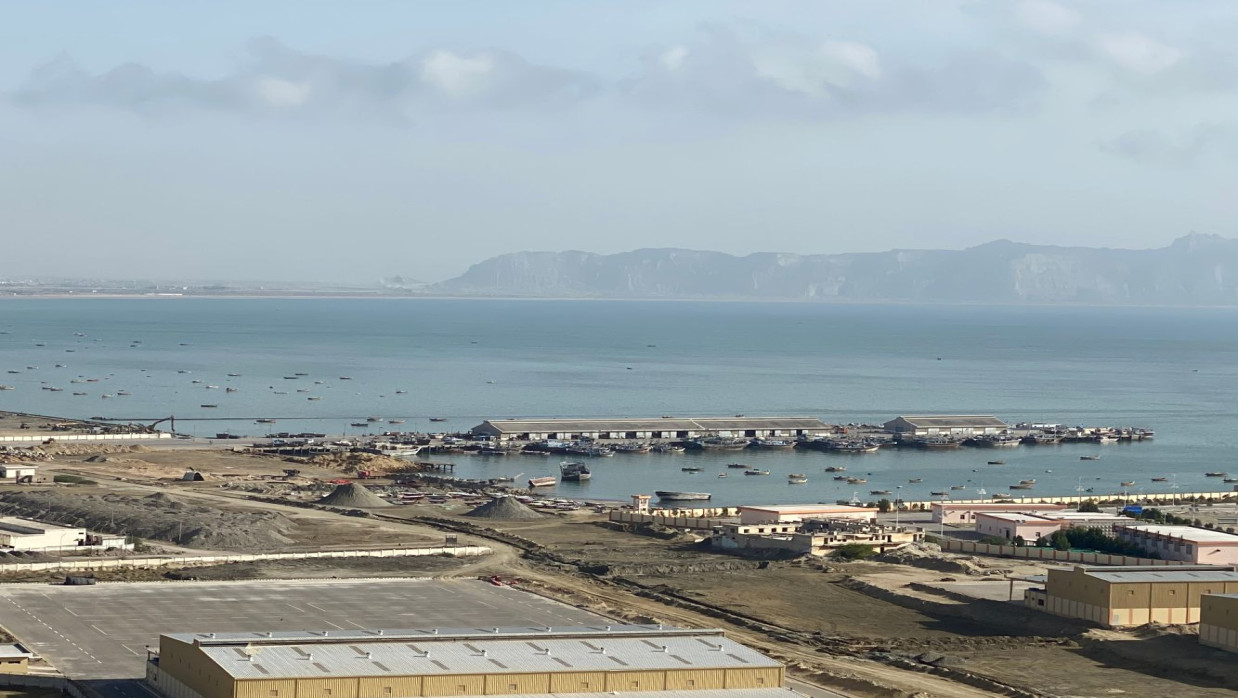
There is a number that stopped me mid-sentence when I first read it. In April 2026, Gwadar Port processed around 11,000 standard shipping containers in a single month. For context, the same port handled roughly 8,300 containers in the entirety of 2025. This is not a record broken by a whisker. It is a record shattered, and behind it lies a story about geography, patience, and a province that will majorly benefit from this.
The trigger is the Strait of Hormuz, the narrow throat of water through which nearly 20 percent of the world's oil and LNG passes. As tensions there have rattled global shipping lanes, freight operators have scrambled for alternatives, and quietly, almost as if the map had always known this day would come, the answer has materialised on Pakistan's southwestern coast.
The Geography That History Forgot, Until Now
Gwadar sits roughly 400 kilometres from the Strait of Hormuz, at the exact point where the Arabian Sea opens toward the Gulf of Oman. Its eastern bay is one of the deepest natural harbours in the entire region, capable of accommodating large cargo vessels that shallower ports simply cannot handle. These are advantages Pakistan was born with.
The UAE has its Fujairah bypass pipeline. Saudi Arabia has its East-West link to Yanbu on the Red Sea, but both are partial solutions, they handle a fraction of export volumes and cannot absorb a global rerouting. Gwadar, backed by the full logistics architecture of the China-Pakistan Economic Corridor, offers something categorically different, a complete alternative corridor connecting the Arabian Sea to Central Asia and western China. When the world's shipping industry needed a detour in April 2026, Gwadar did not raise its hand. It was simply there, in the right place, at the right time.
The Numbers Do Not Lie
On April 16 alone, two cargo vessels docked carrying 368.7 tons of machinery and 5,000 metric tons of fertilizer. Earlier in the month, a single ship brought over 14,000 metric tons of transshipment goods. A port that historically saw fewer than 20 ships in an entire year is now processing that kind of cargo in days.
This is not a blip. This is the beginning of a structural shift, one that Islamabad must now work urgently to make permanent.
CPEC: The Infrastructure That Made It Possible
Gwadar's surge does not stand alone. It stands on a decade of infrastructure-building under CPEC. The New Gwadar International Airport, inaugurated in January 2025, was built through a $230 million Chinese grant, spanning 4,300 acres, making it Pakistan's largest airport by area, capable of handling Airbus A380s. The Eastbay Expressway Phase-I, the Khuzdar-Basima Road, and the M-8 motorway linking Hoshab to Gwadar have collectively reduced travel time between Quetta and Gwadar from over 24 hours to roughly eight. These are not headlines. These are the foundations on which April 2026's cargo volumes rested.
CPEC Phase II is now shifting focus toward Special Economic Zones, agriculture, minerals, and IT, a deliberate pivot from hardware to economic depth. The Planning Commission estimates CPEC has already generated over 200,000 direct jobs nationwide. Gwadar's moment is the dividend on that investment.
Balochistan Is Being Built Up
For fiscal year 2025-26, the federal government has allocated a record Rs205.99 billion to Balochistan under the Public Sector Development Programme, representing nearly 68 percent of the total combined PSDP for Balochistan, Federal/ICT, and AJK. This is not a marginal increase. It is a statement of intent. By March 2026, Rs73.5 billion had already been disbursed across 148 active projects in the province, spanning roads, water, power, and education.
In Gwadar specifically, 22 projects with a combined cost of Rs184 billion are currently underway. The Pak-China Friendship Hospital, funded with $100 million from China, treated around 43,000 patients from poor communities in 2025, for free. A Chinese-funded desalination plant is providing eight million gallons of drinking water to Gwadar residents.
The Balochistan Special Development Initiative (BSDI), launched in collaboration with the Pakistan Armed Forces, allocated Rs5 billion toward 137 development projects across some of the province's most rural districts, Kech, Khuzdar, Washuk, Chagai, Panjgur, and Kalat. By end of 2025, 13 projects had already been completed, including solar installations in rural health centres and street lighting in remote areas.
On youth, the provincial government launched its first-ever Balochistan Youth Policy, targeting overseas employment opportunities for 30,000 young people. More than 6,000 skilled youth have already secured jobs abroad. The Balochistan Education Endowment Fund disbursed roughly Rs4 billion in scholarships spanning school, university, and PhD level in 2025 alone. These investments in human capital are the ones that compound over time, and benefits the youth.
The Asian Development Bank approved an additional $48 million for water resource development in Balochistan in November 2025, co-financed by Japan. The project focuses on the Zhob and Mula river basins. Meanwhile, 27,000 agricultural tube wells are being solarised at a cost of Rs55 billion, one of the most significant rural interventions the country has seen.
Perhaps the most consequential long-term development is Reko Diq. One of the world's largest undeveloped copper-gold deposits sits in Balochistan's soil. In late 2025, the project secured $3.5 billion in international financing, from the ADB, the US Export-Import Bank, and other partners, formally moving it from planning into construction. First copper exports are projected for 2029. At full production, Reko Diq is expected to employ between 7,500 and 13,500 workers. Over 35 years, it could generate $75 billion, greatly benefitting Pakistan.
Pakistan's New Leverage
Gwadar offers a new ooportunity, a leverage that grows with use. Pakistan does not merely collect transit fees from Gwadar. It earns geopolitical standing. Gulf states, whose own energy exports depend on Hormuz, have a direct stake in a stable Pakistan with a functional western port.
That calculus is already translating into cash. Saudi Arabia transferred $2 billion to Pakistan in April 2026, with a further $3 billion pledged. These flows reflect Riyadh's recognition that Pakistan's stability, and Gwadar's functionality, serve Gulf interests in a volatile maritime environment. When your port becomes indispensable to your neighbours, your neighbours become invested in your wellbeing. This is soft power expressed in hard currency.
The Window Is Open, But It Will Not Stay That Way
Crises are temporary. The Strait of Hormuz has seen threats before and has reopened each time. When it does, Pakistan cannot rely on emergency rerouting to keep Gwadar busy. The shipping companies arriving now need reasons to stay when normalcy returns. That means there should be competitive port charges, fast customs clearance, security guarantees, and reliable road and rail connectivity.
The $390 million railway connectivity project linking Balochistan's mineral belt to national logistics networks, with construction beginning in 2026, is a step in that direction. So is the continued development of the Gwadar North Free Zone and the push to operationalise Special Economic Zones that turn Gwadar from a transit node into a production hub. When goods are being made in Pakistan, not merely passing through, the economic stakes deepen permanently.
The New Gwadar International Airport, Pakistan's largest by area, stands ready. The deep-water berths are receiving cargo. The road network connecting the port to the national grid is expanding. The architecture exists. What is needed now is the commercial and administrative follow-through to make it stick.
Pakistan is building toward that. The investments are real. The projects are underway. The momentum is here. The cargo ships are docking. The cranes are moving, and the country is ready to see a new beginning.
0 Comments
LEAVE A COMMENT
Your email address will not be published