

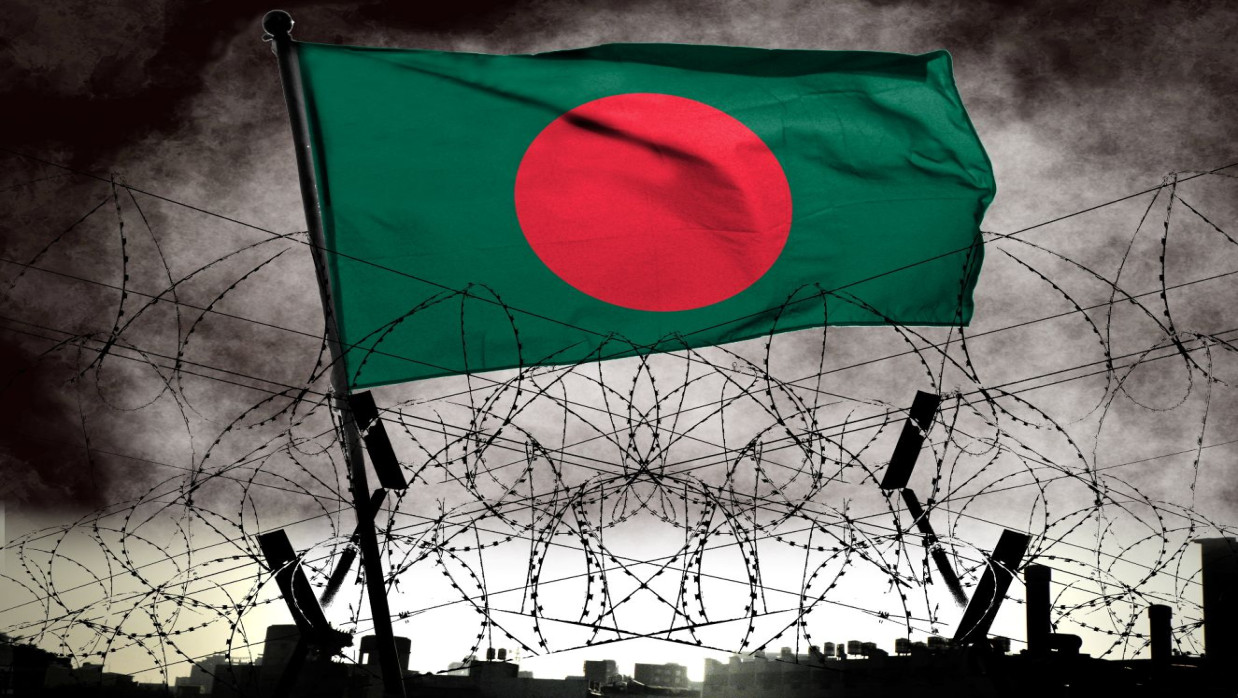
Terrorism, and often the very fear of it, has been at the center of political debate and policymaking in Bangladesh since the early years of its independence. For years now, allegations of terrorism have been used as a convenient label by those in power to delegitimize the opposition and persecute dissent. However, in reality, the country has grappled with actual extremist violence and terror attacks by radicals against minorities, cultural centers, educational institutions, factories, and security forces, among others. Bangladesh saw a trend in which terrorism became less of a security-related term in the course of two decades, transforming into a political tool that helped construct narratives about terrorism, escalate political rivalries to electoral battles, and justify crackdowns on political opponents and curtailment of civil liberties.
Over the years of the Awami League-led government, accusations of extremism were thrown around carelessly, many argued, to jail political activists and suppress political opposition. There have been repeated claims and examples of innocent people being framed or victimized by using the label of terrorism because they belonged to a particular political party or expressed anti-government sentiments. However, since similar rhetoric has persisted even after the change of government in 2024, it is less about which political party is in power and more about the system itself. Government officials have been contradicting themselves on whether or not the threat of terrorism even exists in the country. There are multiple question marks surrounding what role, if any, terrorism plays in Bangladesh and how it will impact the elections. To comprehend terrorism in Bangladesh, one must look at not only the acts of terror but also misinformation, security narratives used by politicians, and structural factors that cause radicalization.
The Contradictory Official Narrative on Terrorism
The government's ambiguous stance on terrorism was reflected recently in two contrasting statements from none other than the Home Minister and the Prime Minister's adviser, made within hours of each other. In his public address, Home Minister Salahuddin Ahmed tried to convince us that Bangladesh is not currently threatened by terrorism. He even went on to say that terrorism was a term used by political opponents in the past to drag his name into the mud. Hours later, Prime Minister's adviser Dr. Zahidur Rahman presented a different picture to reassure the international audience during his meeting with representatives of the European Union in Brussels. Terrorism may not be on the rise now, but extremist elements still exist and have not been completely flushed out from the system, he said. "There are still individuals operating in terrorist networks," Zahidur Rahman added.
What Dr Zahidur Rahman means is that although the situation is under control now, extremist elements may act anytime and anywhere if the government does not remain vigilant. It seems that while the minister wants to show the international community and instill faith among voters that everything is under control as the election and his US visit draw close, the adviser wants to show that at least someone in the government is concerned about national security. Official statements such as these confuse people.
Historical Roots of Extremism in Bangladesh
Bangladesh has not been facing extremism for the first time. Groups that espouse militancy have popped up since the late 1990s, grown over the years, and some of them have been suppressed after security crackdowns. The coordinated bomb explosions that happened around the country, attacks on literary clubs, and killings of members of religious minorities revealed that the country had established linkages to operate.
Bangladesh’s political parties, irrespective of ideology, have faced these threats head-on for years with varied degrees of ferocity. The Awami League banned multiple extremist outfits when they were in power and ramped up security offensives. Opposing political parties claimed counterterrorism operations have been politicized and used selectively against them, while extremists across the political spectrum were ignored.
The previous regimes under the leadership of the BNP were also accused of allowing terrorists to run amok or turning a blind eye towards them. However, they have also conducted major security offensives during their terms.
The point that can be made here is that terrorism has seldom been approached as a national security threat in Bangladesh. Terrorism usually spilled over into partisan politics.
Terrorism as a Political Instrument
One extremely common theme throughout Bangladesh’s political landscape has been the use of accusations regarding terrorism as a tool to suppress opposition. Hundreds of opposition leaders and activists were jailed under extremism or seditious charges throughout the Awami League's years in power. Some of these cases were legitimate offenses against national security, but many also seemed to stem from larger motivations to dominate all facets of civil life.
This culture of fear has since generated an environment where extremism allegations, true or not, can lead to arrests and severe stigma. Even if individuals or organizations cannot be convicted of these charges, they will be politically blacklisted.
The fact that similar tactics have been employed by both the AL and BNP suggests that this behavior is systemic within government bodies.
Instrumentalizing anti-extremism initiatives will only harm Bangladesh's ability to combat real terrorism.
The Electoral Dimension of Security Narratives
Security discourse often takes on greater prominence during election seasons. Government officials like to claim there needs to be administrative crackdowns, surveillance, etc., in order to prevent extremism and keep things stable. Meanwhile, opposition parties believe this behavior to be government election control.
Securing the vote becomes a contest between political agendas. If those in power point to terrorism, they're able to justify a need for tougher control. If the opposition can make it seem like there is no threat, the government can be accused of overusing state power.
Terrorism becomes a security concern and a campaign talking point.
Real Threats That Cannot Be Ignored
To be sure, fears of politicization should not lead us to pretend terrorism exists only as a specter in Bangladesh. Attacks on shrines, cultural programs, and minority communities have occurred; bombings at Shahjalal International Airport and previously across the country showed extremist cells are alive and well within our borders. Ideological militancy is a very real threat that merits continued attention both within law enforcement and intelligence communities. Reactive policing has yielded results, but without addressing root causes, this success will be short-lived.
Structural Drivers of Radicalization
Radicalization will not be defeated solely by law enforcement actions such as detentions and surveillance. More intellectuals are pointing out that it must deal with ideological, economic, and geopolitical factors. Root causes of radicalization in Bangladesh's experience include unemployment, lack of economic opportunities, and the absence of participatory democracy, amid ideological currents from abroad and regional geopolitical factors.
Ideological influences from abroad and regional geopolitical factors play their parts too, often behind the scenes. Disillusionment and frustration brew when politics becomes a zero-sum game of 'us vs them' instead of embracing the competition of ideas.
To tackle these root causes, efforts must focus on educational reform, job creation, and a strong civil society rather than short-term measures.
Disinformation and the “Photo Card” Phenomenon
Photo cards” or editing of digital content and spreading false information is a relatively recent trend in our security discourse. Most of these “cards” or photoshopped images are old pictures overlaid with unrelated narratives that sow doubts or ridicule. The spread of misinformation through these media has been condemned by law enforcement. The ruling party has also been vocal about these activities, believing they might serve as a trigger to increase political violence. While it can be technically difficult to trace the source, criticizing these practices can easily turn into political witch hunts.
Cases have emerged in which those who were Photoshopped or falsely identified on these cards were interrogated or arrested, even if they had no hand in distributing them. It’s unclear whether due process was followed in each case or how cyber laws were used to justify such arrests.
Leaders and citizens must take responsibility for not falling prey to these narratives, as we stand to lose all sense of decorum online if we let misinformation become a blood sport of reputation-damaging.
The Challenge of Verification and Accountability
Bangladesh needs better fact-checking systems so that those handling misinformation can go after whoever manipulated it, rather than whoever happened to get caught in it. Putin should also avoid prosecuting people just for being mentioned in misinformation campaigns, lest Russians grow even less trust in a system where people can get dragged into trouble simply by being accused. Establishing clear digital forensics processes and stronger whistleblower protections may be part of the solution.
The Geopolitical Context of Terrorism Narratives
When examining Bangladesh's counterterrorism strategies, one must consider how external pressures affect the situation. The interests of international donors and allies in mitigating extremism will play a factor in how Bangladesh navigates political and security partnerships.
Likewise, if a government wants to maintain a strong global reputation, it may boast about successes in counterterrorism. If they want sympathy, foreign aid, or intel sharing, highlighting a persistent threat can work in their favor.
This may be why you see different narratives from officials about whether a terrorist threat exists.
Toward a Balanced Approach to Security and Democracy
Bangladesh's experience shows that terrorism can be both an existential threat and a politically constructed threat. Careful analysis is needed to separate a genuine threat from politics.
Bangladeshi police can do much more to defuse tensions before they escalate into violence. However, to win hearts and minds, we need to invest in educational opportunities for all, inclusive economic growth, and counter ideological narratives.
We must not let anti-terror/militancy crackdowns destabilize democracy. The government needs to allow transparent investigations coupled with accountability through an independent judiciary and free media.
Conclusion: Beyond Policing Toward Institutional Credibility
Bangladesh’s politics and elections have long been affected by the issue of terrorism. While terrorist networks have existed in the past and continue to exist today, accusations of terrorism can often be weaponized and used against opponents. Due to this continued trend of weaponizing terrorism, both the threat of terrorism and false accusations of terrorism have hurt the perception of terrorism in Bangladesh.
Officials are also sending mixed messages about terrorism when they condemn terrorist attacks, yet turn a blind eye when it is politically convenient. False information is also becoming a massive issue with the recent emergence of “photo cards” being used to spread disinformation online. These cannot be solved by relying on traditional counterterrorism measures.
Going forward, Bangladesh will have to work on not just countering terrorist activity, but countering the false perception of terrorism as well. Bangladesh will have to improve its democracy, strengthen institutional trust, and work towards inclusion if it wants its counterterrorism efforts to be effective.


0 Comments
LEAVE A COMMENT
Your email address will not be published