

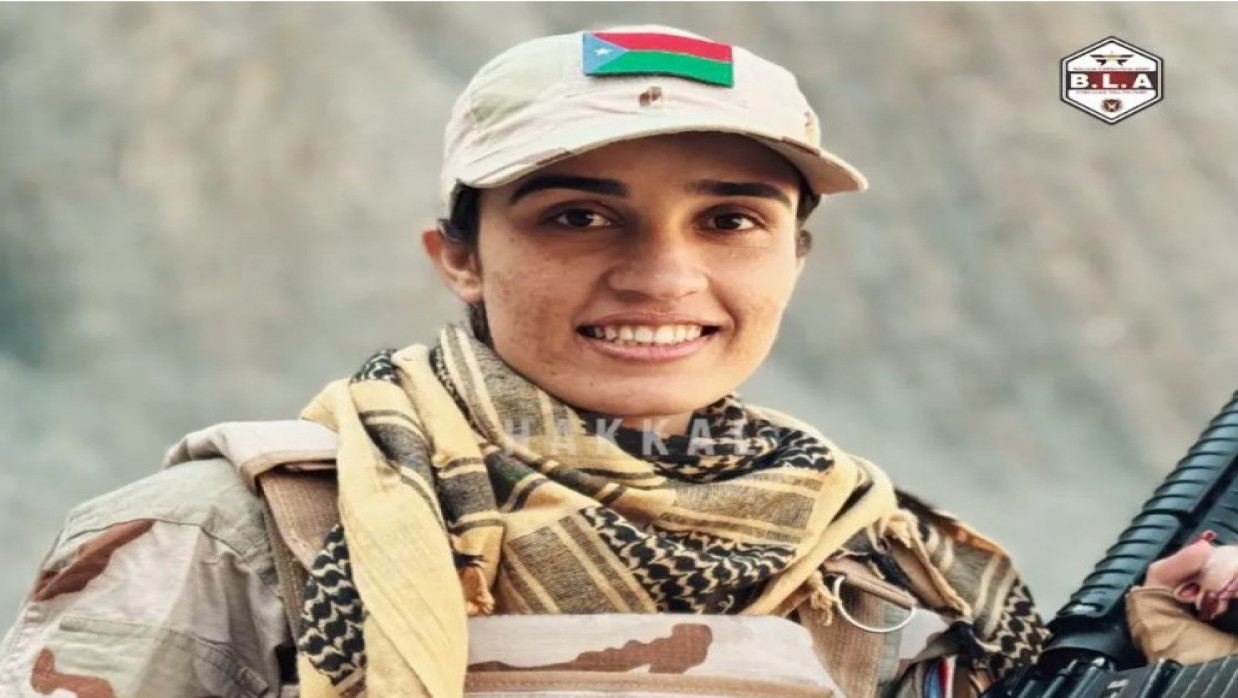
Exploring gender, grievance & political legitimacy in Balochistan
One of the most alarming recent developments in Pakistan's long-running insurgency in Balochistan is the increasing visibility of educated Baloch women fighting alongside militants. For years, common perceptions of the Balochistan conflict were shaped by images of tribal elders, male militants hiding in the mountains, and rural tribal society. However, in recent years, young, educated Baloch women, along with civil society activists and politically aware youth, have been increasingly becoming the faces of resistance in Balochistan. During a recent conversation with a group of newly recruited civil servants in Pakistan's emerging port city of Gwadar, the Corps Commander of Balochistan, Lt. Gen. Rahat Naseem Ahmed Khan, recently asked why educated Baloch women are taking up arms and responding to this evolving trend, which should be viewed through a political lens rather than solely a security lens.
While there are many layers to this question, some fundamental aspects to consider include historical marginalization and distrust of state institutions, the narrowing of civic space for political expression and mobilization, and the use of women as symbols.
Historical Roots of Alienation
Before answering this question, we need to examine militancy in the broader context of Balochistan's unsettled political history. Balochistan has seen many insurgencies since it joined Pakistan in 1948. However, the current insurgency differs in both longevity and scope. This is the fifth insurgency in Balochistan, but it is also the longest one.
Unlike previous insurgencies, which were largely comprised of tribal elites, this particular resistance has seen an influx of students, professionals, and urbanized youth. Women participating in militancy is just another example of the resistance growing beyond tribal lines and becoming more political.
For generations of Baloch families living in parts of Balochistan, enforced disappearances, extra-judicial killings, and the shutting down of political discourse have been normalized. When this continues for generations, you begin to see shifts in how people perceive their identities. So for many young educated women, what was once taboo, taking part in armed political conflict, has become politicized.
The Collapse of Political Representation
One of the main reasons Balochistan has become radicalized is due to the lack of credible political alternatives. Provincial administrations have often been seen as out of touch with their own populace and owe their positions to hierarchies of favor from Islamabad.
This perception was reinforced by the formation of the Balochistan Awami Party (BAP) following the 2018 election, with many claiming the election was gerrymandered. Accusations of election engineering have continued ahead of the 2024 elections.
Coupled with that, the young of Balochistan, especially women, feel that parliamentary means no longer serve the people of Balochistan well, with peaceful agitation being criminalized and sidelined continuously. This leaves people with limited space to operate within the democratic spectrum, fueling the rise of alternatives.
Criminalization of Peaceful Activism
Take, for example, how women activists in leadership positions within protest movements are treated. Activists like Dr. Mahrang Baloch and Sammi Deen Baloch became symbols of peaceful protest against enforced disappearances and human rights abuses. The state retaliated by placing them on watch lists and incarcerating them—even though they had expressly condemned violence. This sends a terrifying message to young activists: they will be jailed if they try to change things within the law.
Criminalizing peaceful mobilization as treason blurs citizens' understanding of where dissent ends and militancy begins. This emboldens what some are calling "political displacement"—the slow disenchantment with institutions and the recruitment into extra-institutional measures. "The continued detention of female leaders," reads the report, "has led to growing anger among Baloch youth and further alienation from the state."
The takeaway for educated women watching these events unfold could not be any clearer: stand up as peaceful leaders and risk similar repression.
Gender as Symbol and Strategy in Insurgency
In Balochistan, there has been an increased recruitment of women into militant ranks over recent years. This trend is unlikely to be incidental; insurgent groups have symbolic and strategic reasons to deploy female fighters.
Traditionally, Baloch culture has placed great importance on female virtue. Militants have tried to exploit this reality to their advantage. Female suicide bombers, for instance, can evade security measures more easily. They also garner more media attention and exposure. Female fighters can delegitimize government narratives concerning the Balochistan conflict.
A notable example was the suicide bombing at Karachi University in 2022. Before this attack, women had primarily been used as supportive figures in militant operations. However, the Karachi University bombing illustrated that women could also actively conduct attacks. Women have been increasingly used in recruitment pipelines, intelligence roles, media operations, and logistical planning since then.
Similar trends emerged with Sri Lanka's Liberation Tigers of Tamil Eelam (LTTE). Female cadres eventually became ubiquitous within the LTTE. Women are fast becoming a ubiquitous component of militant groups in Balochistan as well.
Psychological Drivers and Identity Formation
Structural grievances matter, but motivations matter too. Educationally privileged women do not always join because of financial need. Instead, they see their choice as fighting identity-based injustice and collective humiliation.
Children of the disappeared and political prisoners have also grown up with stories of armed struggle. From a young age, they become familiar with the language of militancy. Years later, what began as stories can turn into moral obligations.
Militant groups have also leveraged despair through brainwashing, social media recruitment, and isolation from families. Extortion, blackmail, and threats to family honor have also played a role in some recruitments. But we cannot reduce women's recruitment to these factors. They would not work if there weren't a widespread sense of injustice fueling them.
Information Gaps Between Center and Periphery
A contributing factor to radicalization is the disconnect between Balochistan and Pakistan's power center. Many policymakers based in Islamabad and Punjab grew up disconnected from Balochistan's social issues. Mainstream media sensationalizes instability, often attributing it to foreign involvement.
This delegitimizes civil strife and makes policymakers hesitant to probe deeper. For average Baloch citizens, it feels like their issues don't exist.
Systematic alienation from political discourse furthers this notion. Balochistan has fewer seats in the national assembly than many big cities, less industry, and rarely sends students across the province to attend school. Thus, their problems aren't felt at the forefront of Pakistani policy.
Baloch women with college degrees often take this alienation to heart.
The Role of State Narratives and Political Rhetoric
Words matter. Calling protesters agents of foreign states or anti-state jihadists encourages polarization and suspicion. Heightened crackdowns and media smear campaigns against protesters and activists only discourage cooperation.
Painting activists as threats to security instead of proponents doesn't help de-escalate tensions either.
Activism may soon be considered as shameful and risky as joining jihadist groups are in the eyes of young women looking to make a change politically without picking up arms.
The Propaganda Value of Female Militancy
Women attackers draw disproportionate attention. One suicide bomber can make international news; the visibility of women in militancy can alter the narrative of a conflict. Militant groups are well aware of this fact and weaponize gender accordingly.
The iconization of women also forces a reconsideration of gender roles in patriarchal societies. The attack on prevailing gender norms has secondary value-adds; it heightens the affective intensity of militant attacks and bolsters recruitment propaganda.
Women as symbols of sacrifice are becoming part of a larger martyrdom narrative in Balochistan.
Lessons from Comparative Insurgencies
An analogy provides important lessons for the future of women's militancy. As women get institutionalized in rebel groups, women fighters tend to proliferate at an astonishing rate across the fighting spectrum.
Female cadres started as auxiliaries in Sri Lanka, soon took up arms as frontline fighters, sources of intelligence, and suicide bombers. These women altered movement's dynamics from within and its perception from outside.
Should that happen in Balochistan, it will be hard to turn back.
Rebuilding Trust and Preventing Escalation
Counter-terrorism and security operations alone will not be able to stem the growth of women's militancy. Sustainable solutions should aim to restore the state's political legitimacy and mend fences between the state and society. Ending forced disappearances, freeing nonviolent protesters from incarceration, empowering representative institutions, and providing greater opportunities for education and employment are critical steps toward building public trust. Gender-responsive de-radicalization and rehabilitation programs can also help former female militants reintegrate into society.
Attention should also be given to developing counter-radicalization programs that work with women's organizations, teachers, and community leaders. Above all, prevention strategies should not treat women as mere victims of conflict.
Conclusion: Beyond the Security Lens
Weaponizing educated Baloch women is neither new nor a short-term trend that militants use as a strategy. It sends a strong political message to all those concerned about failing governance, closing civic spaces, and historical injustices.
Viewing this development purely through the lens of security and terrorism will not only further alienate the population but also fail miserably to address the real issues. Political will and credibility, space for civil society, and freedom of speech can ensure grievances are addressed peacefully.
Until then, Generals in Pakistan will have to keep asking themselves why more women aren't picking up arms.


0 Comments
LEAVE A COMMENT
Your email address will not be published