

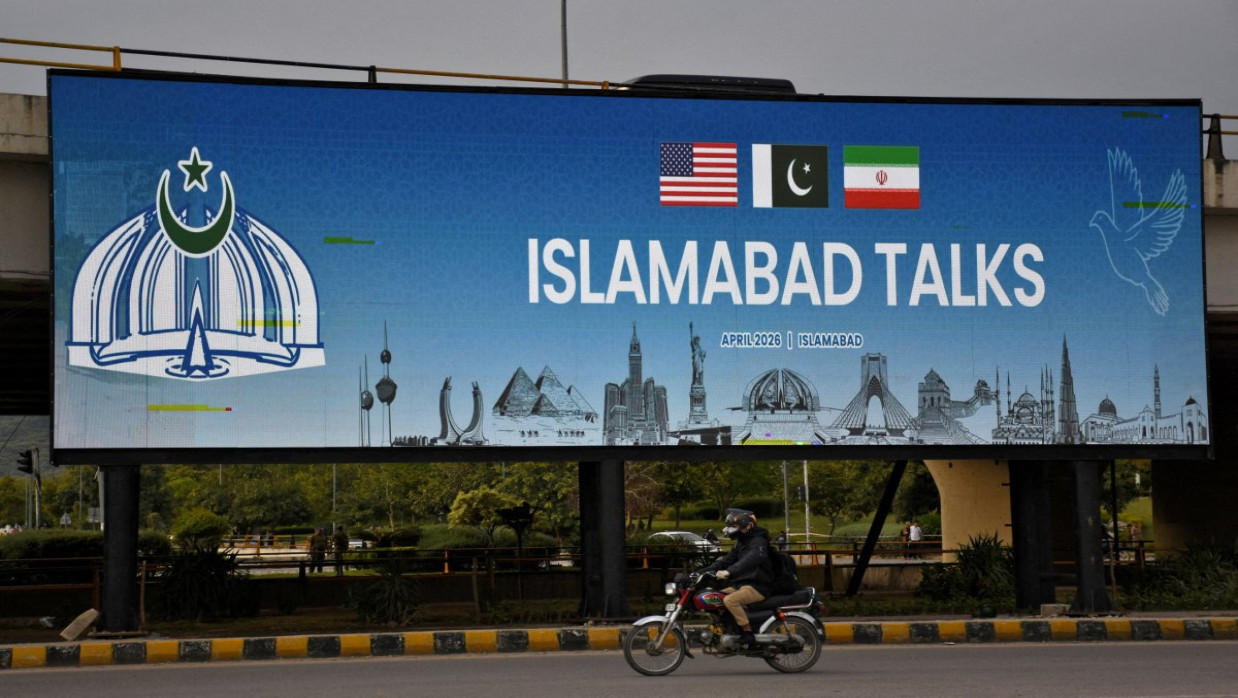
The 21‑hour talks in Islamabad ended. And right away, people started asking: Where is the breakthrough?
To answer the question, we need to step back from the social media frenzy and look at the history of high-stakes diplomacy. It becomes clear that the first meeting is rarely about solving the problem. It is about making sure everyone is still willing to talk. Expecting a solution in a single day is like expecting two people who haven't spoken in years to settle a deep family feud over one cup of coffee. That's not how humans work—or nations.
Peace deals are not magic. They do not appear out of nowhere. Real negotiations take time. Months. Sometimes years.
So why would anyone expect the first face‑to‑face meeting between Tehran and Washington—after so much bad blood—to end with a signed paper agreement? What took place in Islamabad should be understood as the opening chapter of a much longer process, not its conclusion.
History offers a useful reality check. The last Iran Nuclear Deal (JCPOA), finalized in Vienna on July 14, 2015, did not materialize overnight. It took nearly two years of sustained, technical, and politically fraught engagement. Teams of experts spent endless hours in conference rooms, arguing over commas and technicalities, with progress often invisible to the outside world. That is the nature of high‑stakes diplomacy: slow, iterative, and frequently frustrating.
Expecting instant results from an initial contact ignores this basic truth.
What Islamabad offered was something far more valuable at this stage: a setting where both sides could sit in the same room, under a neutral host, and see whether they could stand each other. In an atmosphere thick with tension and mistrust, simply agreeing to face each other across the table was itself an achievement.
Pakistan understood this. That is why it offered a safe space, a controlled environment to break the initial inertia.
Pakistan’s role in this process has been to provide an "off-ramp" at a moment when both sides were heading toward a head-on collision. It was less about resolving disputes and more about determining whether resolution is even possible.
Success in this scenario requires things that are currently in short supply: patience, protection from spoilers, and the political will to walk away from the battlefield. Every time a dialogue starts, there are "spoilers" on the sidelines who profit from chaos. Maintaining quiet confidence during these times is harder than it looks. It requires leaders to ignore the loud voices calling for "strength" and instead choose the difficult work of compromise.
Let us also be honest about what was actually gained.
One of the most significant achievements of this session was providing a ceasefire at a moment when escalation seemed not only possible but imminent. Before the talks, both Tehran and Washington were moving closer to miscalculation. The words were harsh. The proxy fighting was picking up.
Some critics point to minor violations as proof of failure, but in such an inflamed environment, a perfectly clean ceasefire is almost unheard of. There will be violations. Someone will test the line. A group will try to spoil things. That does not mean the process is dead. It means the process is real.
Pakistan's civil and military leadership worked day and night to make these talks happen. They did not do it because they expected a big signing ceremony. They did it because Pakistan has spent years building trust with both Washington and Tehran.
But here is the truth that outsiders often miss: Pakistan can help set the agenda. It cannot make the final decisions for other sovereign states. That responsibility lies with the players themselves. It is an exhausting role, one that requires balancing a dozen different sensitivities, but it is the only way to move toward stability.
The Islamabad talks are over, but the process is just starting. Both Iran and the United States need time to think and to weigh their options. They need to talk to their own people back home. Red lines will be revisited. Possible trade-offs will be examined. When discussions resume—and they likely will—they will do so based on what has been quietly assessed during this interval.
The Islamabad talks, therefore, should not be judged by what they did not produce in their first iteration. Rather, they should be assessed by what they made possible: a shift from confrontation toward conversation.
That shift is fragile. It will require nurturing. And it will certainly be tested.
But it is a beginning. Beginnings, however, are precarious — easily undone if not protected. The next 30 days will be decisive: if either side uses the pause to sharpen rhetoric, or if spoilers manage to provoke a breach, the process could collapse. That is why Pakistan’s diplomats cannot afford to sit back. They should be shuttling between Washington and Tehran, pressing for modest confidence‑building steps — technical working groups on sanctions relief and nuclear monitoring, or even a joint statement affirming navigation rights in the Strait of Hormuz.
From there, Islamabad should quietly propose a follow‑up round within 60 days, hosted again on its soil. Consistency of venue matters; it signals that this process has a home.
In diplomacy, small steps taken away from the glare of cameras are often the ones that protect fragile starts.


0 Comments
LEAVE A COMMENT
Your email address will not be published