

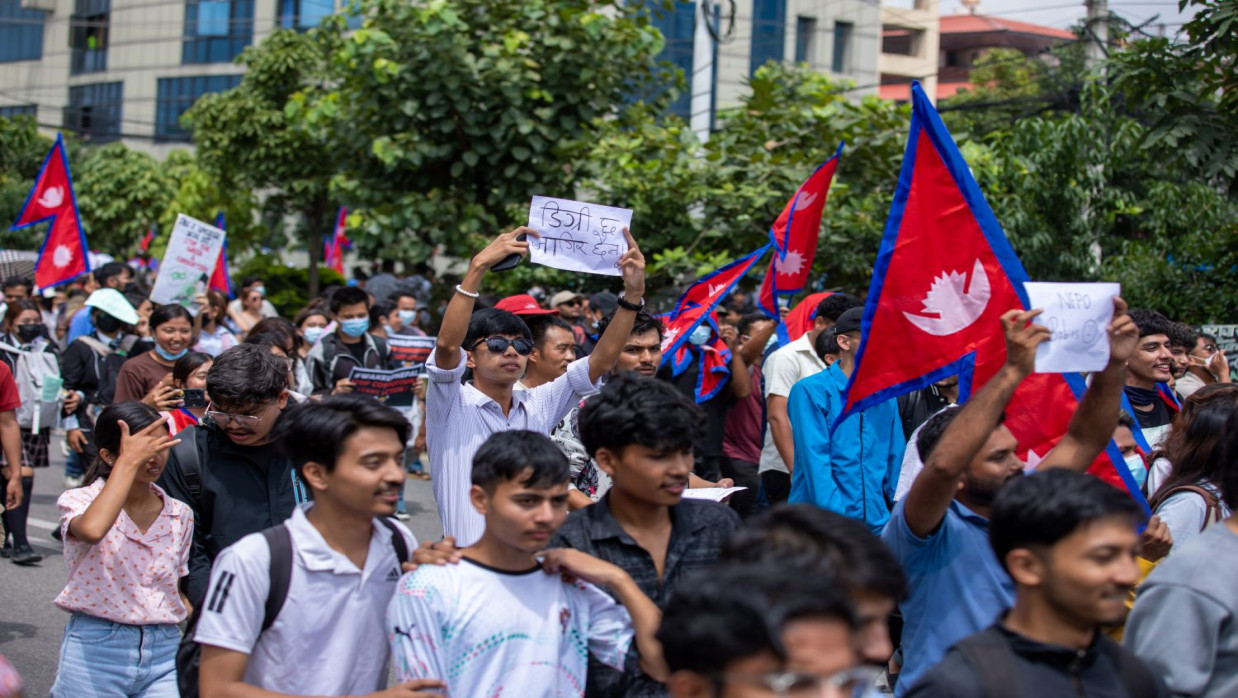
A peaceful protest led by youth on September 8th, 2025, turned into the most violent single day in Nepal’s democratic history, after the state-sanctioned firing on demonstrators, many of whom were teenagers and in school uniform. As the country prepares for the election this March, the results will be a testament to whether the revolt was just a moment or a movement in the making.
Thousands of Nepalis gathered in the streets that Monday, not under any political party banner, but united by their frustration with corruption, censorship, and class divide. By the end of the day, nineteen civilians were killed and hundreds severely injured. The following three days included more casualties, curfews, riots across the country, arson of several government offices and residential properties owned by politicians and wealthy business families. While the audience of the global north glorified the images of burning buildings and politicians being chased out of their mansions, Nepalis across the world found hope in videos and pictures of protestors turning into patriots- people cleaning the streets, rebuilding the damaged public buildings, returning the looted items to small shops, organizing blood donation banks, taking care of each other. An air of celebration, along with a sense of obligation, engulfed the country, especially once the entire parliament was dissolved and the protest deemed successful. The world witnessed an uprising. Some Nepalis like myself also saw (and still see) an opportunity for a much larger and necessary change.
Rebellion is not new to Nepal. We have had many for a nation this small and new. The one in 1951 against the authoritarian Rana Regime remains crucial, as it set the course for democracy. But as the Indian writer Phanishwar Nath Renu stated regarding the said uprising, ‘this revolution is not unsuccessful but rather unfinished.’ And in the words of Roman Gautam from Himal SouthAsian, ‘that seems to be the case for all of Nepal’s revolutions.’
Five months ago, seventy-six lives were stolen, two thousand people were severely injured physically, and more were left with mental and emotional traumas. Nepal now has a fresh opportunity and an obligation to nourish this uprising to its full potential, i.e., hold corrupt politicians accountable and reimagine our relationship to class in a liberatory way.
One of the main demands of the GenZ protests was to overthrow the government and create opportunities for newer (and less controversial) political candidates to lead the country. In spite of pressure from those against the uprising, the interim government led by the popular former Chief Justice Sushila Karki has successfully seen the election to take place within the six months as promised. What is also noteworthy is that, unlike the giant democracies in the global north and South Asia, Nepal has made it possible for newer (and much smaller) political parties to run against the major groups that have monopolized the government for decades.
On the other hand, the same politicians who were chased out of their mansions in September for corruption cases, alleged and/or proved, are now on the ballot boxes representing some of the popular political parties. Members (including the PM) of the administration that issued the shoot-at-sight order during the protest are running election campaigns instead of being penalized for the deaths, especially of the children. It is crucial for people to vote on March 5th and choose change, accountability, and consideration for those who were forced to martyrdom.
And while there is no overemphasizing the significance of this election, electoral politics alone do not make revolutions successful. Politicians will fail us without the continuous work to guide them and hold them accountable. This work can take the form of organizing (unions, civic associations, activist groups, etc.), alternatives (feminist spaces, queer groups, community-owned cottage factories, etc.), and cultural work (using art, literature, media, etc. to share justice-based values and norms). These are the spaces and mediums to keep consciousness alive beyond and between eruptions like those Nepal has experienced many times.
Politicians cannot be the only reason why the richest 1% of Nepalis hold 519 times more wealth than the poorest 50% (Oxfam Int. 2025). There are geographical, geopolitical, and cultural issues that need to be addressed to make the country more economically equitable. There is a need for reflection on culture, not only as in our customs and traditions (e.g., caste, gender, religions, etc.) but also, current shared beliefs, norms, and behaviors in the country (e.g., relationship to consumerism, celebrity culture, profit over planet lens, etc.). Utilizing resources to strengthen formal and informal bodies that engage in these areas is equally important.
The images of luxurious mansions, walls stashed with billions of rupees, exotic valuables in every corner, a Christmas tree decked with designer items, and other vulgar displays of wealth in a country that ranks among the bottom 40 poorest in the world, are surely to enrage us, and they did. And at the same time, this rage requires us to reckon with our own greed and personal relationship to corruption. There is no way to complete a revolution without also turning the questions of accountability inward. The politicians need to change, and so do we individually and as a society.
Uprisings create conditions for revolutions, not just short-term superficial change but new ways of being politically and personally, systematically and culturally, if we are able to utilize that fire strategically and tactically. Nepal has that chance right now. The odds are in our favor if we choose to act on it. One murdered child is already too many martyrs.

0 Comments
LEAVE A COMMENT
Your email address will not be published