

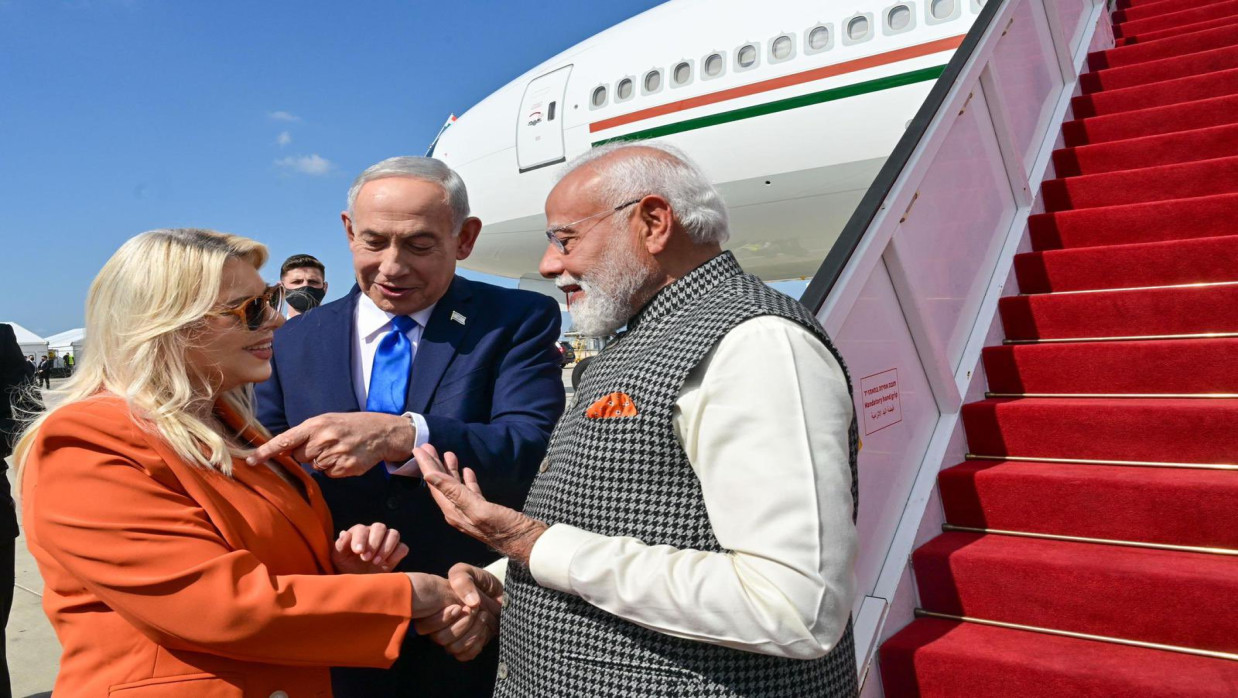
Indian Prime Minister Narendra Modi’s latest visit to Israel marks a significant diplomatic moment. Nearly nine years after his last trip, Modi arrived in Jerusalem at a time when Israeli Prime Minister Benjamin Netanyahu is articulating a bold new geopolitical vision, a so-called “hexagon of alliances.” It is not a coincidence. Six sides make up a honeycomb because a hexagon is the strongest geometric shape found in nature. Honeybees construct their honeycombs with hexagons because it creates a sturdy, level foundation with which they can operate at maximum efficiency. Bibi, it seems, understands geometry as well. He’s talking about building a sturdy, tessellated web of partnerships that can hold firm even as storm clouds gather around Israel.
Of course, there is far more serious geopolitical import behind the speech than colorful metaphors.
What Is the “Hexagon of Alliances”?
Netanyahu has described the initiative as “an entire system, essentially a hexagon of alliances,” not necessarily a rigid six-member bloc, but a flexible web of like-minded states cooperating across security, economic, and technological domains.
The confirmed core participants include Israel, India, Greece, and Cyprus. These four already maintain strong ties in defense cooperation, energy connectivity, and innovation. Greece and Cyprus are central to Eastern Mediterranean energy projects, while India’s defense and technology collaboration with Israel has expanded dramatically over the past decade.
Potential partners extend into the Arab world, particularly the UAE and Bahrain, under the Abraham Accords, along with Egypt and Jordan. African and Asian technology-driven states such as Kenya, Rwanda, Japan, South Korea, and Singapore may also intersect with this network.
The “hexagon” is thus conceptual rather than literal, a strategic architecture built to counter what Netanyahu calls both the “radical Shiite axis” and an emerging “radical Sunni axis.”
Why the Framework Appeals to India
For New Delhi, this emerging structure aligns comfortably with India’s pragmatic, multi-aligned foreign policy. India has long avoided rigid bloc politics, preferring issue-based coalitions that enhance its economic and security interests.
Defense ties between India and Israel are already deep. Israeli drones, missile systems, border surveillance technologies, and counter-terrorism tools play a significant role in India’s security matrix. Intelligence sharing has intensified. Joint ventures in weapons manufacturing are expanding.
Economically, it aligns with India’s self-reliance (Atmanirbhar Bharat) strategy. Israel’s “Startup Nation” environment will aid India in AI, cybersecurity, semiconductors, ag-tech, and water tech, among others. Modi’s attendance at innovation conferences during the trip highlights this focus.
Initiatives like the India-Middle East-Europe Economic Corridor (IMEC) strengthen the rationale for converging with Israel, Greece, Cyprus, and Gulf allies. The hexagon model will help alleviate trade chokepoints and energy routing dependencies.
From a diplomatic standpoint, Netanyahu’s public acknowledgment of India as a “global power” elevates New Delhi’s regional stature. Modi’s address to the Knesset is a first for an Indian prime minister, symbolizing a partnership that has moved beyond quiet cooperation to overt strategic alignment.
The Palestinian Shadow
However, this deepening intimacy comes as the war rages on in Gaza. The Palestinian cause dims further with Modi and Netanyahu shaking hands. India’s arms sales and joint ventures with Israel have come under increasing criticism amid claims of disproportionate civilian death tolls in Gaza.
Questions have been raised about India providing arms, labor support, and even logistical help during Israel’s attack on Gaza. Pro-Palestine protests within India have faced limitations or discouragement, being labelled by authorities as indirect support for Hamas.
Adds a level of complexity to business-as-usual talk of a tech/economic relationship. For many, the India-Israel alliance is seen as growing increasingly ideological alongside its strategic ties.
Hindutva and Zionism: An Ideological Convergence?
Critics worry about what Hindutva, the Hindu nationalist ideology that currently governs India, has in common with Zionism in Israel. The two organize national identity in exclusive ethno-religious terms and securitize Muslim populations.
Hindutva leaders have long admired Zionism as an inspiration for religious nationalism. This personal affinity has translated into state-to-state camaraderie.
India now buys billions of dollars’ worth of weapons from Israel. Israel exports surveillance technology and crowd-control weapons that India uses in Kashmir. India offers Israel market opportunities to scale up production.
Israeli and Indian officials may have lessons to learn from one another about how to overwhelm Gaza or Kashmir with soldiers and police. Human rights organizations have rightly compared the two occupied territories, pointing to Israeli tactics that India appears to be replicating.
Rising Tensions at Home
India’s growing closeness to Israel has been challenged at home over rising hate crimes and hate speech against minorities, especially Muslims. Civil society groups allege there has been a noticeable uptick in such incidents over the last year; many have occurred in BJP-ruled states.
Media reporters and human rights activists who have been critical of the government say there is less democratic space for dissenting voices. Accusations of economic boycotts of Muslims, targeted demolitions of properties, and harsh language have added to Muslim insecurities in a country home to over 200 million Muslims.
India’s critics say the deepening India–Israel relationship buttresses a narrative in which right-wing governments provide cover for each other.
A New Geometry of Power
Domestic dissent aside, there is merit to Netanyahu’s geopolitical gambit from a practical standpoint. The hexagon promises more diversified partnerships, greater economic integration through corridors, intelligence coordination, and an Indian foothold in maintaining stability in West Asia.
The question is whether domestic and diplomatic costs will outweigh benefits. India was once seen as the champion of the Palestinian cause; its non-aligned movement gave it moral authority as the voice of the Global South. Outwardly embracing Israel will certainly impact India’s relationship with parts of the Arab world, and deepen fissures at home over India’s pluralist identity.
After all, the politics of the Middle East are in constant flux. Will Israel’s handful of moderate Arab partners benefit in the long run? More importantly, can such a formation survive without succumbing to the region's volatility?
India stepping into such a formation will give it more agency on the world stage. But it is also remaking its identity within the evolving politics of the Middle East.
“The honeycomb is one of the strongest geometrical structures because the hexagon evenly distributes weight,” said Kanwar.
If Netanyahu’s honeycomb, which seeks strength in Jewish solidarity, holds, India stands to gain economically and militarily. India, though, is no longer on the sidelines of Middle Eastern geopolitics. It is at the table, drawing up the blueprint.


0 Comments
LEAVE A COMMENT
Your email address will not be published