
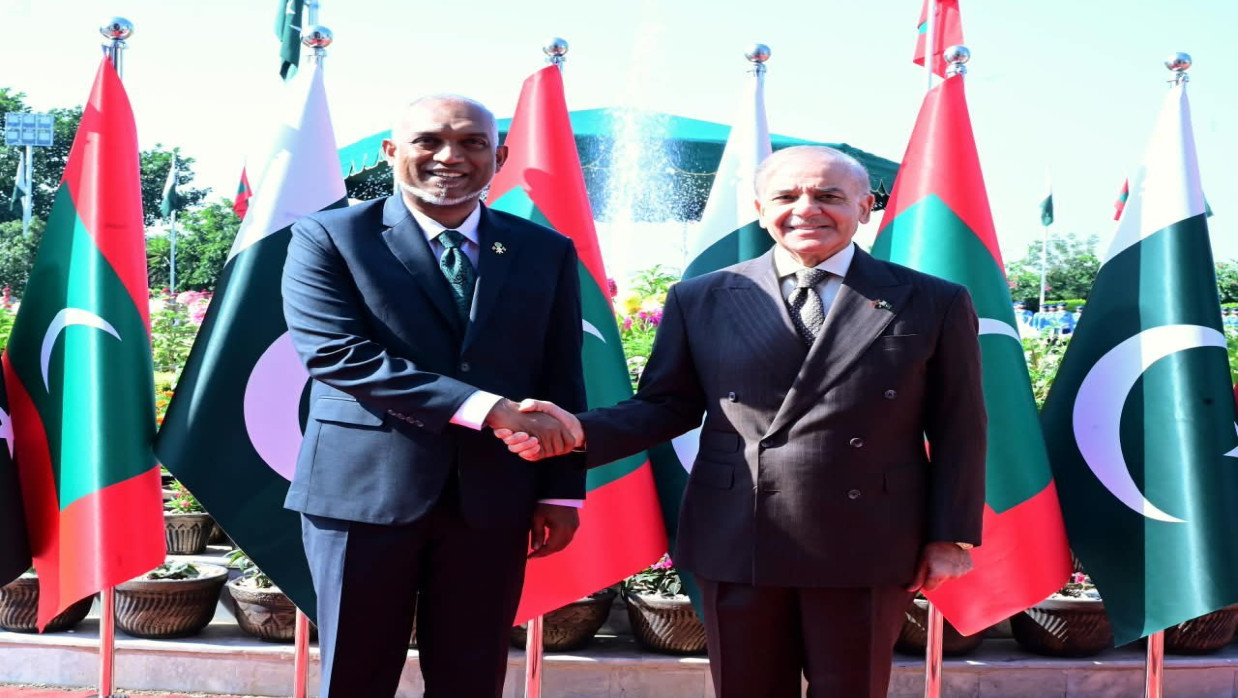
After the President of the Maldives visited Pakistan and said they would like to see SAARC return, it has once again brought India and Pakistan into the limelight. One can fathom India’s concern towards Pakistan. Why can't India allow other South Asian nations to thrive? Will India ever open up to the region and allow economic growth in South Asia?
The President of the Maldives, Mr. Mohamed Muizzu, recently traveled to Pakistan, sparking many questions in India. This whole scenario shows how weak diplomacy is when it comes to Pakistan and India. Something as simple as the Maldivian president visiting Pakistan and speaking to them has become a talking point for why we don't allow others in South Asia to flourish. He held talks with several Pakistani officials, including Army Chief Field Marshal Asim Munir. He also stated that they would like to see SAARC revived.
India's fear may not be baseless. They have had several wars against Pakistan and many claims of terrorist activities by Pakistan. But should India not allow other countries in South Asia to do business with Pakistan? This mentality only pushes away neighboring countries that could benefit from relations with India.
Mr. Muizzu spent October 20th – 22nd visiting Islamabad. He signed around 20 MOUs that will support military collaboration. These include maritime, technology, and cybersecurity. He will also add flight services between Male and Islamabad, which will increase trade between the two countries. It's not that out of the ordinary for two countries to want to build better relations. But when those countries are Pakistan and other South Asian countries, India feels threatened.
One of the Maldivian former foreign ministers, Mr. Abdulla Shahid, said Mr. Muizzu will bring back the anti-Indian agenda he ran on during his 2023 term. These are valid points that Shahid could make. Since politics have gotten involved with the current government of the Maldives. We have to keep in mind that Mr. Shahid wants to run against Mr. Muizzu in 2028, so his statements are not factual.
The Maldives has legitimate reasons to diversify its diplomatic and economic relationships. Its strategic position along important Indian Ocean shipping routes makes maritime security an essential national priority. Cooperation with Pakistan, India, China, or other countries should not automatically be interpreted as hostility toward any particular power. A small sovereign state cannot reasonably be expected to subordinate its foreign relations permanently to its larger neighbor's strategic preferences.
But India has its own security interests in the Indian Ocean. The Maldives lies close to trade, energy, and defense sea lines of communication, which are crucial for India. So, if any deal involves foreign bases or information sharing, India will naturally view it with suspicion. Especially since Pakistan has a very good relationship with China.
But there is a fine line between suspicion and being overly suspicious. There are many areas where countries can collaborate without threatening each other's security. Unless we see that the deals between Maldives and Pakistan affect India's security. It will be detrimental if India takes it upon itself to view the relationship as hostile.
Another issue that arises from this visit is his plea to restart SAARC. The South Asian Association for Regional Cooperation (SAARC) was formally established on 8 December 1985, during its first summit in Dhaka, Bangladesh, held on 7–8 December 1985.
Seven members founded the organization: Bangladesh, Bhutan, India, Maldives, Nepal, Pakistan, and Sri Lanka.
Bangladesh played a pioneering role in its creation. President Ziaur Rahman first formally proposed regional cooperation among South Asian nations in 1980.
Afghanistan joined SAARC in 2007, becoming its eighth member.
SAARC's primary objectives were to promote economic growth, regional cooperation, social development, and mutual understanding among South Asian nations.
With so many nations, it has huge potential but has never been utilized because of rivalry among them. The last SAARC summit was held in 2014 in Kathmandu. The next one was scheduled to take place in 2016 in Islamabad but was canceled after India refused to participate due to terror strikes across borders and an unfavorable environment to promote peace.
India has always claimed that Pakistan promotes terrorism across the border, which hinders SAARC from functioning properly. This appears to be an excuse by India to derail SAARC. India prefers bilateral relations with its neighbors to wield authority, while a common organization may dilute its supremacy.
SAARC's inability to function properly costs more countries than just India and Pakistan. Countries such as Bangladesh, Nepal, Bhutan, Sri Lanka, and the Maldives all stand to benefit from a better-connected South Asia. Trade, better means of transportation, and connectivity. Better access to energy resources and help to fight climate change. They deserve better than to be tied to the India-Pakistan relationship.
South Asia remains one of the least interconnected regions on earth. The World Bank has estimated that trade within South Asia makes up only 5% of its overall trade. Trade relations could grow much more if we improve them. With many countries having strict trade laws, poor connectivity, political tension, and slow border crossings, we lose many business opportunities.
Bangladesh would greatly benefit from a more connected South Asia. It would allow access to Nepal's and Bhutan's hydropower resources and open trade with Pakistan and other countries. It could also improve connections between countries in South Asia. SAARC can only supplement what already exists between these countries.
India has started looking at other partnerships to achieve this, such as BIMSTEC. BIMSTEC allows for collaboration with other countries in Southeast Asia but does not include Pakistan. This is beneficial because it lets India focus on working with these countries without having to deal with the India-Pakistan relationship. But we can't ignore the fact that BIMSTEC will not be able to replicate SAARC.
As India's neighbor, it will be expected of it to grow and provide other nations with opportunities. If smaller countries feel that India is trying to limit their relationship with other countries, they may turn to China and Pakistan. This will only harm India's image in the long run.
SAARC can still work if both India and Pakistan are willing to put their differences aside. They can do this by helping one another with public health, natural disasters, and better ways to combat climate change, and by expanding trade.
South Asia should not be stuck with its two biggest rivals clashing over power. India has the right to protect itself, but it can also learn to work with other countries and open more business opportunities. We will never know how Muizzu's decision to travel to Pakistan will impact things in the near future. Only if India takes action to show it wants to become one big South Asian economy.


0 Comments
LEAVE A COMMENT
Your email address will not be published