

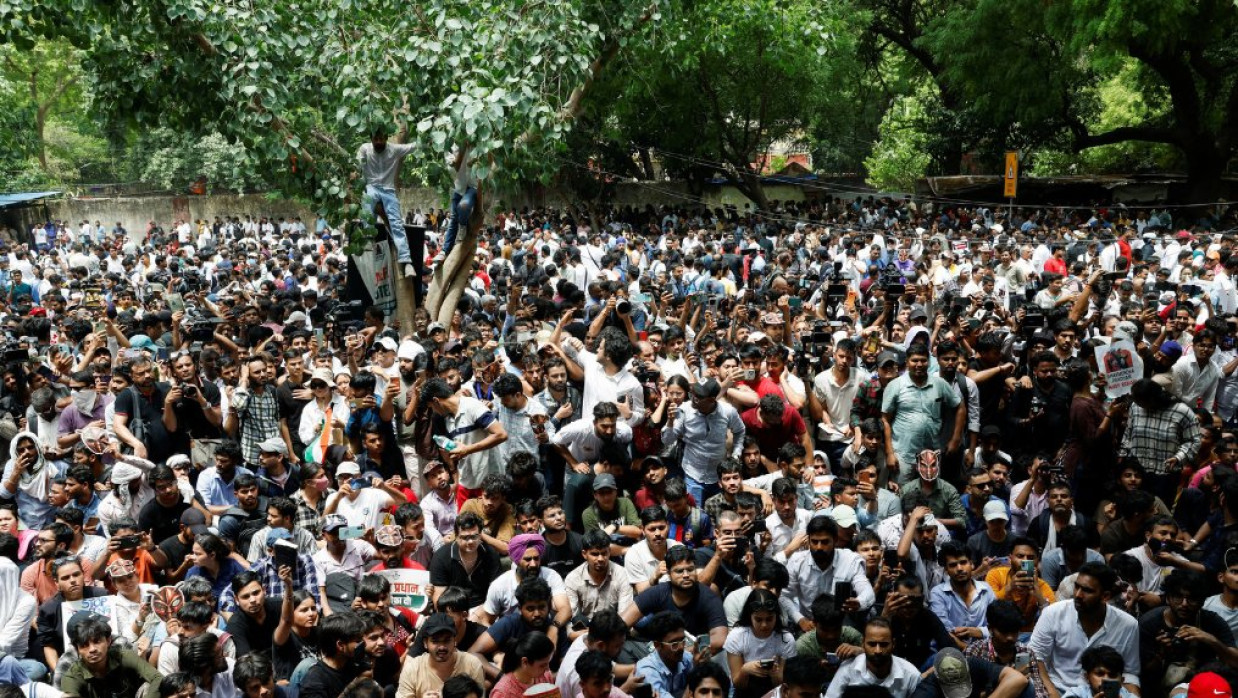
India has seen students shake governments before. But the Cockroach Janta Party (CJP) may be different: a digitally networked generation crossing India’s political divisions. The question is whether young Indians will reshape parties, or be absorbed by them.
In 1973, a protest over hostel food prices in Gujarat grew into the Navnirman Andolan, forced Chief Minister Chimanbhai Patel to resign and helped ignite Jayaprakash Narayan’s Sampoorna Kranti. India should remember how far that trigger travelled.
This time, the trigger was an exam. The cancellation of NEET after a paper leak affected roughly two million candidates. Weeks of protests followed, including mobilisation at Jantar Mantar, clashes during a march on Parliament and the resignation of Education Minister Dharmendra Pradhan on July 25.
The obvious reading is that students forced out a minister. The more important one is that a generation discovered its leverage. What happens when millions of young Indians, divided by caste, religion, region and party, realise they can act together?
India has seen student power before
Youth politics is not new. Navnirman helped produce the JP movement; the Assam Movement led to the Assam Accord; anti-Mandal protests exposed links between youth politics and caste; Anna Hazare’s 2011 campaign produced the Aam Aadmi Party; and anti-CAA protests returned campuses to confrontation.
What makes 2026 notable is how this movement formed and spread.
From the organised student to the networked citizen
Older movements needed meetings, pamphlets, unions and leaders before achieving scale. This generation reverses the sequence. A grievance becomes a meme, then a shared vocabulary, an audience and an identity. Organisation comes later.
CJP’s Instagram following crossed 20 million, mostly Gen Z, within about a week. Rap, satire, short videos and online mockery became political tools. An absurd name became recognisable enough that the government had to negotiate with it.
Earlier generations learned to use media; Gen Z grew up inside it. The BJP built a sophisticated digital machine, yet parties remain unprepared for millions who converge without formally joining anything.
What really united the protesters?
There is no evidence that every caste, religion or region participated equally. But the grievance escaped its original constituency. It stopped being only the anger of medical aspirants and became a question of fairness. People divided by politics or religion can still agree that an examination should not be rigged.
The Indian Express reported that daughters of BJP-aligned politicians supported the protests. Governments expect criticism from opponents; what unsettles them is weakened loyalty among presumed supporters.
NEET was the trigger. Opportunity is the issue.
Gujarat’s students did not reshape politics because hostel food mattered so much; the mess charge symbolised something larger. NEET does too. For millions, an exam bridges education and economic mobility. Families spend savings on coaching and hope one child enters medicine, engineering or the civil services.
The bargain is simple: work hard, compete and succeed on merit. When the system fails, the injustice is obvious. Beneath it lies a harder question: what if hard work is no longer enough?
Reuters pointed to that deeper anxiety: youth unemployment remains well above the national average, while concern about jobs is growing. India’s youth are celebrated as a demographic dividend. These protests showed what happens when optimism meets limited opportunity. The demand is not merely for a better exam, but for a fair chance.
BJP faces a problem — but so does every party
CJP is not only a BJP problem, though the ruling party has the most at stake. More than 40 percent of India’s roughly one billion voters are between 18 and 39. In January 2026, the BJP selected 45-year-old Nitin Nabin as its youngest-ever national president, widely seen as an appeal to younger voters.
As CJP gained traction, BJP leaders in Maharashtra were reportedly told to promote Modi’s record rather than engage directly. After 36 days of agitation and Pradhan’s resignation, the party reviewed its response.
Congress amplified the protests, Rahul Gandhi challenged the government over the leak, and AAP backed the agitation. The danger begins when parties stop asking how to address youth demands and start asking how to capture the constituency.
Can a movement remain political without becoming party politics?
Political independence made CJP attractive. Once a movement belongs to one party, opponents have a reason to leave. Someone may support Modi yet oppose a paper leak; another may dislike every party and still demand accountability. That ambiguity is powerful but fragile.
Established parties control money, media access, candidates and electoral machinery. They can offer tickets, recruit influencers, borrow slogans and reconnect young voters to caste, religion and region.
Two futures follow. In the first, Gen Z changes Indian politics by becoming a swing generation whose loyalty must be earned issue by issue: examinations today, employment tomorrow, pollution or living costs next month. CJP need not become a party.
In the second, Indian politics changes Gen Z. The grievance fades, visible leaders are recruited and older identities return. The network survives, but unity disappears. No Navnirman Party governs India today, and the JP coalition eventually splintered. Movements agree easily on what is wrong; they struggle over what should replace it.
And India is watching its neighbourhood
In Sri Lanka, the 2022 Aragalaya forced President Gotabaya Rajapaksa from office. In Bangladesh, job-quota protests escalated into Sheikh Hasina’s resignation in August 2024. Yet the youth-linked National Citizen Party won only six of roughly 300 seats in the 2026 election, showing that street authority does not automatically create electoral machinery.
Nepal offers the opposite example. Youth protests forced Prime Minister K.P. Sharma Oli’s resignation in September 2025. Balendra Shah then led the Rastriya Swatantra Party to 182 of 275 seats and became prime minister in March 2026. Youth anger can move from the phone into government.
India may follow neither path. A third model is possible: networked accountability without regime change. Mobilise, force a response, stand down and organise again when institutions fail. Governments would know young citizens can impose political costs.
Pakistan represents another path
Pakistan has not produced a unified Gen Z movement like Nepal or India; its youth remain fragmented. But its demographic question is equally serious. Will a large young population become a dividend through education and employment, or will its most educated citizens seek their future elsewhere?
An Ipsos survey found economic concerns dominate youth priorities, with three in five saying leaders do not understand their problems. Most did not want to emigrate, suggesting the desire to build a life at home remains if opportunity exists.
On July 30, Interior Minister Mohsin Naqvi reportedly used the “cockroach” vocabulary while discussing Pakistan’s youth, arguing that stipends and tablets were insufficient and warning about frustrated, united young people. This does not mean Pakistan will reproduce India’s protest. It shows that regional establishments are watching the same generation across borders.
The real regional contagion is expectation
It would be sensationalist to describe a coordinated South Asian Gen Z revolution. These countries differ in politics, history and grievance. But expectation travels.
A young Indian watches Bangladesh and sees students move national politics. A Nepali watches Sri Lanka and sees an establishment lose legitimacy. A Pakistani watches Indian protesters force out a minister. One movement does not cause the next, but each expands political imagination.
The smartphone gives this generation regional memory in real time. Young people no longer learn decades later that students changed a country; they watch it happen tonight.
India’s biggest question comes after the victory
Pradhan’s resignation was the first test, not the last. Forcing a concession is easier than sustaining a movement. CJP plans a nationwide grassroots network to hold the government to its commitments. That may determine whether July 2026 becomes an episode or a turning point.
If CJP becomes a party, it must take positions on taxation, religion, federalism, foreign policy and national security. Every position creates supporters and opponents, turning a broad movement into ordinary politics. If it remains only a digital identity, attention may fade. The difficult middle path is to become organised enough to matter without being owned.
The generation BJP helped politicise may become harder to predict
There is an irony for the BJP. It mastered digital communication and youth outreach, making politics highly visible. But political technologies are never permanently owned. Competitors learn them, then citizens do too. This generation can create a political identity without waiting for a party.
That does not mean the BJP has lost young voters or that Congress will inherit them. The opposition’s eagerness to associate itself with CJP could backfire if protesters see appropriation. The real contest may be India’s parties versus Gen Z’s desire to remain autonomous.
Fifty years later, the question returns
In 1974, Gujarat’s students inspired Bihar. Bihar produced the JP movement, which reshaped Indian politics. Many it shaped later became the establishment. Half a century later, another generation is testing that establishment: not with pamphlets but reels, not through one ideological organisation but a shared grievance, and not demanding revolution but fairness.
India should not dismiss CJP because its name sounds unserious. Political history is full of movements whose beginnings appeared smaller than their consequences. The real question is not whether CJP will rule India; it probably will not. It is whether July 2026 taught a generation that it need not belong to a party before exercising political power.
The movement may fragment, be absorbed or produce future ministers. Or it may become a constituency no party can fully own. Its legacy may not be one minister’s resignation, but a question every Indian party must answer:
What happens when a generation stops asking which party it belongs to and starts asking which party deserves it?


0 Comments
LEAVE A COMMENT
Your email address will not be published