

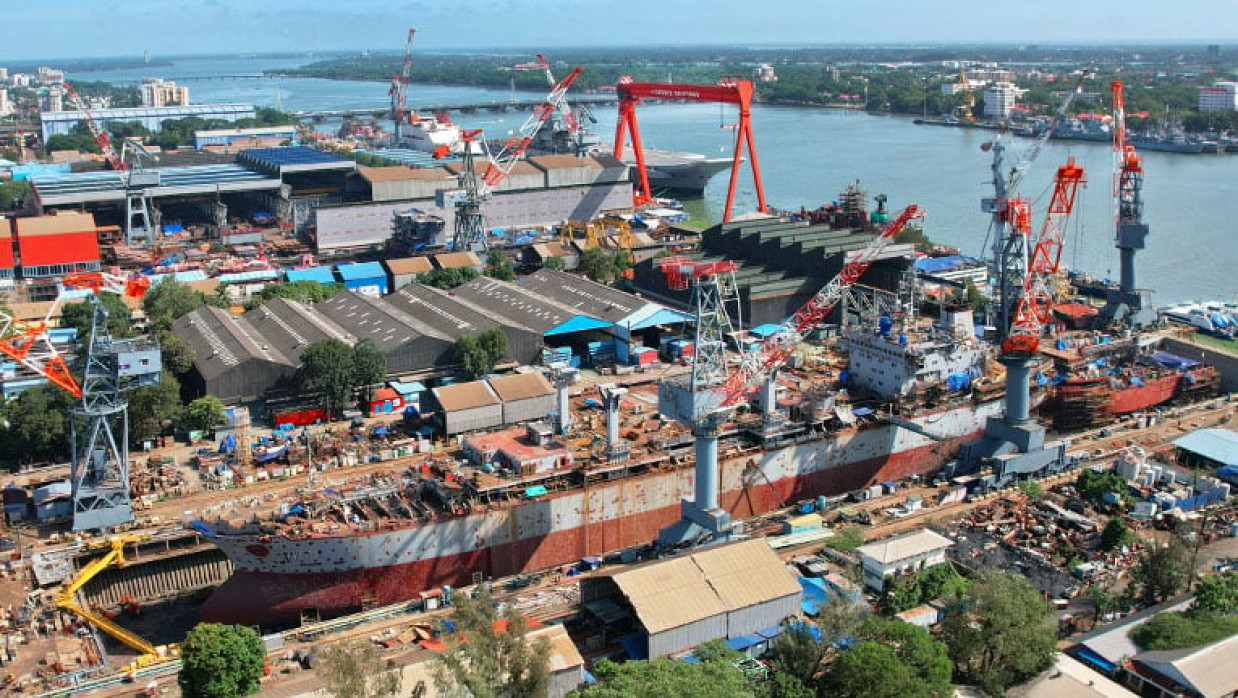
There is a scene playing out in the corridors of Indian maritime policy that deserves far more philosophical scrutiny than it is currently receiving. India, armed with ₹24,736 crore in financial assistance, plans for mega shipbuilding clusters, and a stated ambition to hold 5% of the global market by 2030, is preparing to enter one of the most consequential, and most environmentally catastrophic, industries on the planet.
The applause is loud. The questions are quiet.
The loudest question is not being asked at all: Should India build ships the way ships have always been built?
The answer, arrived at through hard economic logic, planetary science, and a reading of what history rewards in the long run, is an unambiguous no. India must not become just another shipbuilding hub. It must become something the maritime world has not yet produced: a nation that treats green shipbuilding not as a compliance requirement or a marketing label, but as the philosophical and industrial core of its entire maritime identity.
This is not idealism dressed in policy language. It is, as this essay will argue, the most strategically rational, economically sound, and morally defensible path India can take, for itself, for the Global South, and for the living systems of this planet.
The Monster in the Water
Before one can argue for a green maritime future, one must confront the present with honesty.
Maritime transport is the backbone of the global economy, carrying over 80% of the world’s traded goods by volume. This is the statistic that appears in every shipping industry brochure, usually followed by an implicit argument: the industry is indispensable, therefore it must be accommodated. What the brochures omit is the ecological bill that accompanies this indispensability.
The scale of that bill is staggering. Shipping emits nearly 1,000 million tonnes of CO₂ per year, roughly 3% of global CO₂ emissions, and roughly 11% of lifecycle transportation CO₂ emissions. In 2023 alone, global shipping emitted about 911 million tonnes of CO₂ equivalent emissions using 100-year global warming potentials, with nearly 86% resulting from international shipping. And rather than declining, these numbers are rising: greenhouse gas emissions from international shipping increased by 20% in the last decade, according to UNCTAD’s Review of Maritime Transport 2023.
The emissions picture is further darkened by non-CO₂ harms. Ships produce nitrogen oxides, sulfur oxides, black carbon, which has strong short-term warming effects, underwater noise, sewage and grey water discharges, invasive species via ballast water, and physical damage via anchoring and ship strikes. These cumulative pressures degrade marine biodiversity, particularly in coastal, shallow, coral, and estuarine ecosystems.
Perhaps most striking of all is the blunt comparison that cuts through all regulatory nuance: if the international shipping industry were a country, it would be the sixth-largest emitter of greenhouse gases on Earth.
This is not a fringe sector struggling to find its footing. This is one of the largest industrial polluters in human history, operating across the commons of the open ocean, largely outside any single nation’s jurisdiction, and, crucially, outside the commitments of the Paris Agreement. Despite this sprawling ecological footprint, international shipping operates under weak regulatory frameworks and enjoys immunity from national carbon commitments under the Paris Agreement.
This is the system India is proposing to join at scale. The question is: on whose terms?
The IMO’s Paper Harbour
There is a regulatory framework meant to address all of this. The International Maritime Organization’s (IMO) Net-Zero Framework, approved in April 2025, has been described in certain quarters as a “historic breakthrough” - the first mandatory emission limits and carbon pricing across an entire global sector. India’s policymakers would be wise to read the fine print before pinning their maritime ambitions to this framework’s sails.
Almost 90% of shipping’s climate pollution will escape penalties on excess carbon under the IMO Net-Zero Framework. Independent analysis has cast serious doubt on whether it will deliver even its intermediate targets. Major shipowners have highlighted that the framework lacked a comprehensive impact assessment, did not ensure a level playing field, is wildly unrealistic, and also lacked clarity on governance and use of funds. The Clean Shipping Coalition, an international body of civil society environmental organisations, has accused IMO member states of falling far below the UN body’s own 2030, 2040, and 2050 climate targets, and of “failing the people and regions most vulnerable to climate change.”
To call this a paper harbour is generous. The framework is, at present, a regulatory aspiration dressed in the language of obligation, one that, if enacted as designed, would lock the industry into what analysts have called a “pay-to-pollute scenario.” Steep targets coupled with relatively weak investment signals risk locking the industry into a smaller asset base into which zero or near-zero emission fuels can be deployed.
India must understand what this means strategically. A country that invests now in conventional shipbuilding - diesel engines, heavy fuel oil systems, traditional propulsion architectures - will find itself owning an industry of stranded assets by the 2040s, when fuel standards will have tightened dramatically regardless of the current IMO framework’s inadequacies. The world’s shipping lanes are moving toward decarbonisation not because regulators are leading the way, but because the physics of climate change is forcing the direction. Nations that build the fleet of the past will be dismantling it in twenty years.
India, entering the industry as a relative latecomer, has a rare and unrepeatable advantage: it has not yet built the wrong thing.
The Blame Game and Its Lesson for India
An WGI article (written by the present author), at the heart of this essay makes an argument that may be deemed as both careful and courageous: that environmental discourse has systematically scapegoated infrastructure projects in the Global South - India’s Great Nicobar, Thailand’s Landbridge, port developments across Africa and Latin America - while allowing the global maritime industry itself to operate under what the author calls a “green pass.”
This, in author’s view, is an important observation, and India must sit with its full implications rather than simply using it as political cover. Let’s understand why.
The disproportionate criticism directed at infrastructure development in the Global South ignores a critical reality: if the goal is to protect marine ecosystems and stabilise the climate, then the top priority must be systemic reform of how goods move across the globe: maritime decarbonisation through zero-emission fuels and technologies, investment in green ports and sustainable bunkering infrastructure, and stronger enforcement of international maritime regulations.
This is precisely the argument for an Indian green maritime strategy, but notice that it cuts both ways. Yes, India has a legitimate right to build ports and develop its maritime industry. Yes, the double standard applied to Global South development is unjust. But the same logic that dismantles that double standard also demands that India not reproduce the ecological model of the very industry that has caused the harm. To use the injustice of selective criticism as a reason to build carbon-intensive ships at scale would be to win an argument about fairness while losing the larger one about survival.
The future of our oceans cannot be secured by sacrificing development in the Global South. Nor can it be won through performative outrage at individual infrastructure projects, while the global shipping industry remains structurally unsustainable and under-regulated. India’s task is to hold both truths simultaneously: to claim its development rights and redefine what development in the maritime sector means.
That is the civilisational opportunity. And it requires a different kind of ambition than simply building more ships.
Leapfrogging Is Not a Metaphor - It Is an Economic Strategy
The concept of industrial leapfrogging is sometimes treated as a romantic notion: developing nations jumping straight to the latest technology, bypassing the messy intermediate stages. In fact, it is a hard-nosed economic strategy, and it has worked before. India did not build the telephone infrastructure of the 1970s before embracing mobile telephony. Parts of Africa went directly to solar microgrids without ever laying copper wire across a continent. The logic is simply this: when the endpoint is known, building toward it directly is cheaper than building through it.
In maritime, the endpoint is increasingly well-defined. The direction of regulatory pressure, fuel economics, and institutional investor expectations all point toward the same destination: zero-emission vessels powered by green hydrogen, green ammonia, green methanol, or advanced battery systems, operating out of ports that are themselves carbon-neutral. This is not a utopian projection. It is the asset class that will dominate global shipping by 2050, and the market that every serious shipbuilder will be competing in by 2040.
The question for India is not whether this transition will happen. It is whether India will be a customer of that future or a manufacturer of it.
The existing shipbuilding giants - South Korea, China, Japan - are burdened by enormous installed capacity in conventional shipbuilding. Their yards, their supply chains, their worker skill sets, their financial models, are all calibrated to a technology that is in the process of becoming obsolete. Retooling is possible, but expensive, politically contested, and slow. India’s yards, by contrast, are in the early stages of major investment. The ₹24,736 crore being mobilised right now is, in effect, an option on the future. The question is what future it buys.
If that money flows into conventional propulsion systems, conventional steel fabrication processes, and conventional port infrastructure, India will have purchased a depreciating asset. If it flows instead into modular green shipbuilding architecture, green hydrogen bunkering, ammonia-capable vessel designs, and digital-twin enabled sustainable operations, India will have purchased the future that the rest of the world will need to buy from someone.
What Green Shipbuilding Actually Means
It is worth being concrete, because “green” is a word that has been stretched to cover everything from slightly-less-dirty diesel to genuinely zero-emission operations. India’s maritime ambition should be defined against the most rigorous standard available, for a simple reason: the easiest version of “green” will not create competitive differentiation, and it will not solve the ecological problem.
Genuine green shipbuilding means, at minimum, four things.
First, it means building vessels designed from the hull up for zero-emission operation: optimised hydrodynamics to reduce drag, propulsion systems capable of running on green ammonia or hydrogen, onboard energy management systems that minimise consumption, and structural choices that reduce the embodied carbon of the ship itself. The ship is not just a delivery mechanism, it is the product, and its entire lifecycle carbon must be designed.
Second, it means building with green steel. The production of conventional shipbuilding steel is itself a major carbon source. India’s steel industry, including the growing green hydrogen-based direct-reduced iron (DRI-technology) sector in Odisha and Gujarat, positions the country to potentially become the first shipbuilder in the world producing vessels from low-carbon steel at scale. This is a supply chain advantage no incumbent possesses.
Third, it means situating shipyards within green port ecosystems: facilities powered by renewable energy, with electric or hydrogen-fuelled internal logistics, zero-discharge wastewater systems, and active coastal ecology management. The real leverage in protecting marine ecosystems lies in investing in green ports and sustainable bunkering infrastructure. India’s new mega shipbuilding clusters can be designed as living proof of this principle from the ground up.
Fourth, and most ambitiously, it means treating the design and certification of green vessels as an intellectual property frontier. Countries do not just compete in shipbuilding by building ships; they compete by defining the standards that other builders must meet. If India leads in developing the design frameworks, safety certifications, and operational protocols for ammonia-fuelled vessels or hydrogen-electric coastal ships, it becomes a standard-setter rather than a standard-follower. That is where the durable economic power lies.
India’s Unique Position in the Global South
There is a dimension to this argument that transcends India’s own economic interests, and it connects directly to the earlier WGI article’s broader point about environmental justice.
High freight rates due to port inefficiencies or exclusion from global shipping networks can raise import prices by 24%, especially for essential goods, according to UNCTAD analyses. For many developing countries, freight and transport costs constitute large parts of final consumer prices. The Global South does not merely suffer from the ecological consequences of the current maritime system, it also pays a disproportionate economic price for the inefficiencies and power asymmetries built into that system.
India, uniquely among large developing economies, has the industrial scale, the technical capacity, the renewable energy potential, and the geopolitical positioning to reshape this dynamic. A green Indian shipbuilding industry does not merely supply zero-emission vessels to wealthy shipping companies serving wealthy markets. It can supply affordable, appropriately-scaled green coastal vessels to Pacific island states. It can build green port infrastructure for African nations unable to finance European technology at European prices. It can create a Southern-led ecosystem of sustainable maritime development, in which the ecological standards are set not by the IMO’s inadequate consensus process, but by the revealed preferences of the world’s largest democratic emerging economy.
This is what it would mean for India to lead rather than follow. Not leadership in the sense of volume (China already has that), but leadership in the sense of direction. The country that defines what clean maritime trade looks like for the developing world will have more durable influence over the future of global shipping than the country that builds the most ships by weight.
The Philosophical Register: Dharma Meets the Deep Blue
It would be dishonest to write this essay without acknowledging that there is something deeper at stake than competitive strategy. India is not merely an economy seeking market share. It is a civilisation with a philosophy about the relationship between human activity and the natural world: a philosophy that, for all the complexities of its application, contains insights that the purely transactional frameworks of maritime economics cannot provide.
The concept of dharma, often translated as duty or righteousness, but better understood as the right ordering of relationships, applies here with unexpected precision. In the Arthashastra’s treatment of trade, Kautilya is meticulous about the conditions under which commerce serves the common good rather than only the merchant. In the Mahabharata’s ecological passages, the ocean is not a resource to be extracted but a system to be respected. These are not merely cultural ornaments. They are frameworks for thinking about long-term sustainability that predate, and in many ways surpass, the risk-adjusted discount rates of modern economic analysis.
The oceans cannot wait for discount rates to converge on the right answer. They are experiencing, right now, acidification, thermal stratification, biodiversity collapse, and plastic contamination at rates that the economic instruments of shipping regulation have utterly failed to address. India’s maritime ambition, if it is to be worthy of the civilisation it represents, must not simply optimise within the system that produced these harms. It must choose differently.
Choosing differently, in this context, means treating the ocean not as a highway to be exploited but as a commons to be stewarded. It means building ships that belong in a world worth living in. And it means recognising that the nation which makes that choice first, and makes it credibly, at scale, with the industrial seriousness it demands, will have done something that no amount of conventional shipbuilding volume could accomplish: it will have earned the moral authority to speak for the future of the seas.
The Practical Architecture of a Green Maritime India
Philosophical conviction without institutional architecture is poetry. Let me be concrete.
India’s green maritime strategy requires, at minimum, the following structural commitments, and none of them is incompatible with the existing ₹24,736 crore framework if that framework is redirected with sufficient clarity of purpose:
A Green Shipbuilding Mandate. Every rupee of the financial assistance scheme should carry a green conditionality: new yards must be designed to produce vessels capable of operating on zero-emission fuels, with LNG considered only a transitional fuel, not a destination. Yards that design for ammonia and hydrogen propulsion from the outset should receive preferential support. The government-owned Cochin Shipyard (CSL) in southern India, for example, has adopted a resolute green shipbuilding strategy. The need is to expand the efforts across all shipyards (private, public or joint-ventures) and make it into a comprehensive national policy.
Green Hydrogen and Ammonia Bunkering Corridors. India’s coastline of over 7,500 kilometres, combined with its enormous renewable energy capacity, particularly in Rajasthan, Gujarat, and Tamil Nadu, makes it perhaps the most naturally positioned country in the world to develop green hydrogen at scale for maritime bunkering. The Sagarmala programme should incorporate dedicated green fuel infrastructure at every major port by 2032.
A Centre for Green Maritime Design. India should establish, under the Ministry of Ports, Shipping and Waterways, a national institution for green vessel design and certification, analogous to what IITs have done for engineering education, but oriented entirely toward sustainable maritime technology. This institution would develop India’s own green vessel certification standards, which could eventually be offered as an alternative framework to IMO certification for Global South nations.
A Green Maritime Finance Instrument. The Ministry of Finance, in coordination with the RBI and SEBI, should develop a sovereign green maritime bond instrument, enabling pension funds and sovereign wealth funds, which are already under ESG (environmental, social and governance framework) pressure to exit fossil fuel shipping, to invest in Indian green shipbuilding and port infrastructure. This would draw international capital that conventional shipbuilding cannot access.
A Global South Green Shipping Alliance. India should use its G20 presidency legacy and its leadership within IORA (the Indian Ocean Rim Association) to convene a multilateral Green Shipping Alliance for the Global South, a coalition of developing maritime nations that collectively commits to higher environmental standards than the IMO requires, and that pools demand for zero-emission vessels to create a market large enough to drive manufacturing scale.
Conclusion: The Ship That Does Not Yet Exist
There is a ship that has not yet been built. It runs on fuel made from sunlight and seawater. It leaves no exhaust plume above the horizon. Its hull was fabricated with steel whose production did not warm the atmosphere. It docks at a port powered entirely by wind and solar. The fish beneath its keel are not startled by noise or poisoned by discharge. When it reaches the end of its working life, it is dismantled by workers in safe conditions, and its materials are returned to industry.
That ship is not science fiction. Its components exist, in prototype and in principle, across laboratories and yards in Norway, South Korea, Japan, and increasingly in India. What does not yet exist is a country that has made the building of that ship - in volume, at price, with the full industrial weight of a major maritime power - its national mission.
India can be that country. Not because it is the most obvious candidate, but because it is the most consequential one. A green maritime India would not merely add another column to the table of global shipbuilding market share. It would change what the table is for. It would demonstrate that the Global South can develop its maritime capacity without replicating the ecological model that the Global North built and is now desperately trying to reform. It would give the world’s most climate-vulnerable nations, examples: the small island states, the low-lying deltas, the tropical coastlines, a partner in building the shipping system that their survival requires.
The monsters in the water are real. Without additional policy action, shipping’s greenhouse gas emissions are expected to grow 16% from 2018 to 2030, and 50% by 2050. The oceans that sustain a third of humanity’s protein, regulate the global climate, and define the identity of every coastal civilisation are under sustained industrial assault. The regulatory frameworks designed to address this are, as the evidence shows, chronically insufficient.
India cannot fix all of this. But it can choose which side of the line it stands on. It can choose to be the country that, when historians look back at the maritime transition of the mid-21st century, is remembered as the nation that understood the moment, and built accordingly.
The real question before India is not how many ships it can build by 2047. It is what kind of civilisation it wants to be when those ships sail.

0 Comments
LEAVE A COMMENT
Your email address will not be published