

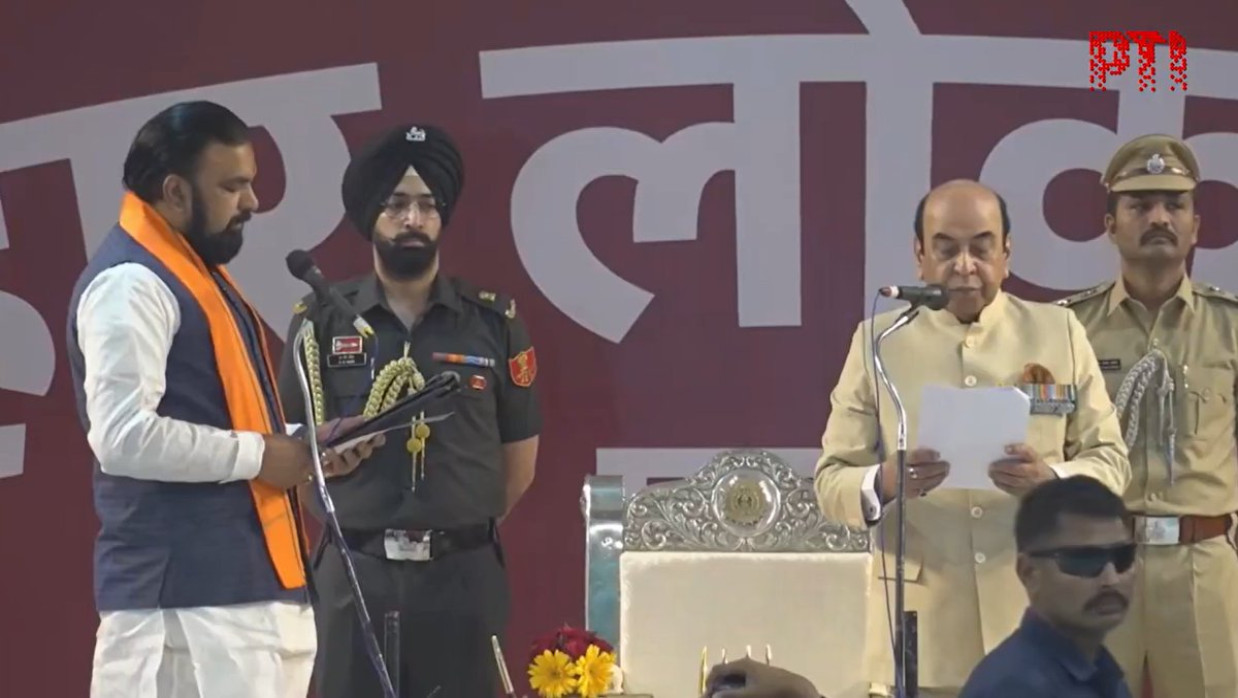
Bihar has long been the most honest mirror of Indian democracy - a place where ideology is ornamental and caste is constitutional. On April 15, 2026, at Lok Bhavan in Patna, Samrat Choudhary was sworn in as Bihar’s 24th Chief Minister, becoming the first BJP politician to hold the office in the state’s post-independence history. Bihar Governor Syed Ata Hasnain administered the oath, marking what many are calling the end of an era defined by Nitish Kumar’s “Sushasan (good governance)”, and the beginning of a new NDA chapter. Yet to read this transition as merely a change of faces is to misread Bihar entirely. What happened on that stage at Lok Bhavan was decades in the making: a convergence of caste arithmetic, personal ambition, political theatre, and institutional transformation.
To understand why it matters, you have to go back, not just to Nitish Kumar’s first innings in 2005, but all the way to the 1930s.
The Deep Grammar of Bihar’s Caste Politics
Bihar’s political vocabulary was forged in the Triveni Sangh of the 1930s, when the three dominant agricultural castes - Yadav, Kurmi, and Koeri - first united to challenge the stranglehold of upper castes over public life. That alliance was always fragile, held together by shared exclusion rather than shared vision. When it fractured, it fractured loudly.
The fracture came in the 1990s. Lalu Prasad Yadav’s rise was a genuine social revolution: the first time in Bihar’s history that a genuinely subaltern leader dismantled upper-caste hegemony and made the word samman (dignity) ring from village squares. But Lalu’s coalition, the MY equation of Muslims and Yadavs, was hegemonic in a different way. The Kushwahas (Koeris), though numerically the second-largest non-SC caste group in Bihar after the Yadavs, fell behind both in terms of education and political representation, despite their numerical strength. The Yadav had captured the revolution; the Koeri was left applauding from the margins.
It was Nitish Kumar who heard that applause and monetised it. In 1994, a massive Kurmi Chetna Rally was organised against the alleged casteism of Lalu Yadav, who was blamed for promoting Yadavs in politics and administration at the expense of others. Since the 1990s, Nitish Kumar had garnered the support of Kushwaha leaders including Shakuni Choudhury, Nagmani, Tulsidas Mehta, and Upendra Kushwaha, forging the alliance that came to be called the Luv-Kush equation. “Luv” for the Kurmis, “Kush” for the Koeris - a mythological branding of political necessity.
Nitish’s Long Wager: Development as Caste Sublimation
The genius of Nitish Kumar, when he came to power in 2005, was that he reframed the question entirely. He did not simply offer Kushwahas power, he offered Bihar governance. Roads where there had been mud. Law and order where there had been kidnappings. Girls on bicycles where there had been school dropouts. The message was seductive: we are beyond caste now.
But sublimation is not resolution. Nitish, coming from the Kurmi caste, also needed vote engineering. He chose women and Extremely Backward Classes for this: giving 50 percent reservation to women in panchayats, and 20 percent to EBC Hindus and Muslims, earning criticism from his own caste community who felt sacrificed for broader coalitions. It was clever politics masquerading as social justice. The Luv-Kush equation remained the engine, but Nitish kept repainting the carriage.
The deeper contradiction was structural. The Kurmi community’s support, which JD(U) relied on, was about 2.87 percent of the state’s population, while the Koeris were significantly more at 4.21 percent. Nitish’s coalition was, in other words, the politically junior partner wearing the crown. Numerically, the Kushwaha had always been the larger half of the Luv-Kush alliance. Symbolically, they had always been its silent backbone.
For over two decades, that silence held. The Kushwaha community delivered votes, tolerated Kurmi leadership, and received in return what Bihar’s political economy gives to the loyal but unassertive: developmental schemes, occasional ministerships, and the rhetoric of inclusion. What they did not receive was the thing that defines power in Bihar: the Chief Minister’s chair.
Samrat Choudhary: A Biography Written in Ironies
No figure in contemporary Bihar politics embodies its contradictions as vividly as Samrat Choudhary. He was born in Lakhanpur village of Munger district to Parvati Devi and Shakuni Choudhary, an army man-turned-politician who began his political journey with the Congress and later aligned himself with Lalu Prasad and Nitish Kumar. Political inheritance runs in the blood here. His father Shakuni Choudhary was a six-time MLA from the Tarapur constituency, and his mother Parvati Devi won the same seat in 1998 from the Samta Party.
Samrat’s own journey began, fittingly, inside the very machine he would one day help dismantle. He was appointed minister of horticulture, weight and measurement in the RJD government headed by Rabri Devi, only to be sacked by the Bihar Governor, a senior BJP leader, following allegations about his eligibility, specifically the presentation of three different dates of birth in various official documents. For years after, he aggressively attacked the BJP for what he saw as a politically motivated removal.
The story of Samrat Choudhary is really a story about how Bihar recycles its political protagonists. His trajectory spans affiliations with the RJD, JD(U) and the BJP, each shift coinciding with changing power equations. By 2014, estranged from the RJD, he joined the JD(U) government under Jitan Ram Manjhi, only to lose his ministerial berth when Nitish Kumar made his comeback. In 2017, he joined the BJP, by virtue of being a Koeri, transforming himself from critic to cadre.
Then came the turban, that remarkable piece of political theatre that defines him more than any portfolio he has held. In 2022, when Nitish Kumar joined the Mahagathbandhan, Choudhary publicly declared he would not remove his saffron turban, his muretha, until Nitish Kumar was removed from power. When Kumar returned to the NDA in 2024, Choudhary went to Ayodhya, tonsured his head before the Saryu river, and removed the turban. The symbolic arc was complete: the man who had sworn to unseat Nitish Kumar now became his chosen successor.
The Architecture of Succession: Whose Choice Was This?
The most revealing detail about this transition is not the outcome but the process. According to reports, Samrat Choudhary was not the leading face of the RSS for the CM’s post. Instead, it was understood to prefer a Dalit or Extremely Backward Caste face as Bihar’s first BJP Chief Minister. Even within the BJP, there was opposition to Samrat’s name, with some citing the perception of Choudhary being an “outsider” within the party’s core structure.
So how did he prevail? Senior journalist Vivekanand Singh Kushwaha suggests that Samrat Choudhary’s rise to the Chief Minister’s position is largely driven by Nitish Kumar’s backing. In this case, Nitish’s preference appears to have outweighed that of the BJP. Instead of handing over the Chief Minister’s post to the party broadly, Nitish Kumar has effectively positioned Samrat Choudhary as his chosen successor.
This is Nitish Kumar’s final political statement, and it is a complex one. Throughout the Samriddhi Yatra, Bihar’s development tour conducted last month, Nitish Kumar placed his hand on Deputy Chief Minister Samrat Choudhary’s shoulder and repeatedly hinted that after him it would be Samrat who would carry the responsibility forward. Amit Shah had already telegraphed the message even earlier: at a public meeting in Tarapur on October 30, 2025, Shah told the crowd, “People of Tarapur, we have already given you a ready-made Deputy Chief Minister. Trust us and ensure Samrat ji wins by a huge margin. Modi ji will make Samrat ji a big leader—a very big leader.”
In Bihar’s political culture, where the gap between a hint and an announcement is the size of an ocean, these were unmistakable declarations.
What Nitish has done, then, is not simply retire. He has authored his own succession, selecting a Kushwaha to lead precisely because, after two decades of Kurmi-led governance, it is the Kushwaha community’s turn to hold the symbolic crown. Whether this is magnanimity, political calculation, or belated acknowledgment of a structural debt owed to his coalition’s larger half is, perhaps, a question Bihar itself must answer.
BJP’s Bihar Gambit: From Passenger to Driver
For the BJP, the significance of this moment is structural rather than merely symbolic. Combined, the Kurmis and Kushwahas make up about 7.08 percent of Bihar’s population, while Yadavs account for 14.26 percent, but the Luv-Kush combine matters in more than 40 of the 243 assembly seats. In the BJP’s strategic calculus, a political analyst notes that in the 2024 Lok Sabha polls, the opposition Samajwadi Party consolidated non-Yadav OBCs, including Luv-Kush, in Uttar Pradesh, resulting in the BJP’s poor performance, and the elevation of Choudhary is specifically designed to prevent such erosion in Bihar.
A senior BJP leader candidly remarked: “Chaudhary is the OBC face of the party and the Bihar results showed that the Kurmi-Koeri political alliance (collectively referred to as the ‘Luv-Kush’ vote) has taken over in the state. Considering the kind of support we received in the Bihar elections and the way Chaudhary has managed things, the party did not wish to disturb the continuity.”
But the BJP’s ambition extends beyond caste arithmetic. Deputy CM Bijendra Prasad Yadav has signalled continuity: “We will move forward on the basis of the development model of Nitish Kumar in Bihar and the patronage of Prime Minister Modi.” The formula is elegant in its political efficiency, inherit Nitish’s governance legacy, repackage it under BJP branding, and consolidate the non-Yadav OBC + EBC + upper caste coalition that has been the party’s national template. Bihar, for decades an exception to BJP’s Hindi-belt dominance, is being brought into alignment.
The Weight of What Was Left Undone
Yet any honest reckoning with this transition must grapple with Bihar’s unfinished business. Nitish Kumar’s record is genuinely impressive. The transformation from “jungle raj” to functioning governance is real, and deserves acknowledgment. But governance improvement and social transformation are not the same project. The agrarian crisis facing middle-farming communities like the Kushwahas, squeezed between the failure of irrigation infrastructure, the collapse of crop prices, and the absence of rural industry, was never adequately confronted. The caste survey of 2023, one of Nitish’s most consequential acts, documented Bihar’s inequalities with unflinching clarity, but the political will to act on its findings remained elusive.
Power is now shifting from Nitish Kumar’s Kurmi leadership to Samrat Choudhary’s Kushwaha leadership, as quipped by a senior journalist, but whether that shift translates into anything material for Bihar’s agrarian communities, or whether it remains confined to the symbolic register of representation, is the central question the new government must answer.
The Laboratory Prepares a New Experiment
Bihar’s political history moves in a rhythm that is almost dialectical. The Lalu era was about assertion, the forcible democratisation of social power. The Nitish era was about correction, imposing governance discipline on a state that had become ungovernable. The era now beginning is something else: a reconfiguration, where the BJP attempts to synthesise both legacies while asserting its own institutional dominance.
Choudhary is known for his combative leadership style, which is, in its own way, a departure from Nitish Kumar’s technocratic, almost professorial approach to governance. Where Nitish operated through patient institution-building and careful coalition management, Choudhary is a man of the crowd - combative, instinctual, emotionally connected to the Kushwaha belt.
The challenges before him are not small. He faces the daunting task of turning Bihar into a BJP stronghold like other Hindi heartland states, while also managing its alliance with JD(U), which may feel uneasy about losing its position as the chief minister’s party. He must also navigate the controversies that trail him: questions about his educational qualifications, the inconsistencies in his age declarations, and the perception, within both the RSS and parts of the BJP, that he is still an outsider who arrived through Nitish’s patronage rather than through party organic growth.
But perhaps the most profound challenge is one that no Chief Minister of Bihar has yet resolved: the challenge of being not just the face of a caste’s aspiration, but the instrument of its genuine material uplift. The Kushwaha community did not simply want one of their own to wear a crown. They wanted what they had been promised and denied for three decades: proportional share of power, land, water, education, and economic dignity.
Samrat Choudhary has the crown. Whether he has the answer to that older, deeper demand is what the Bihar laboratory, as restless, unsentimental, and unforgiving as ever, is now waiting to find out.


0 Comments
LEAVE A COMMENT
Your email address will not be published