

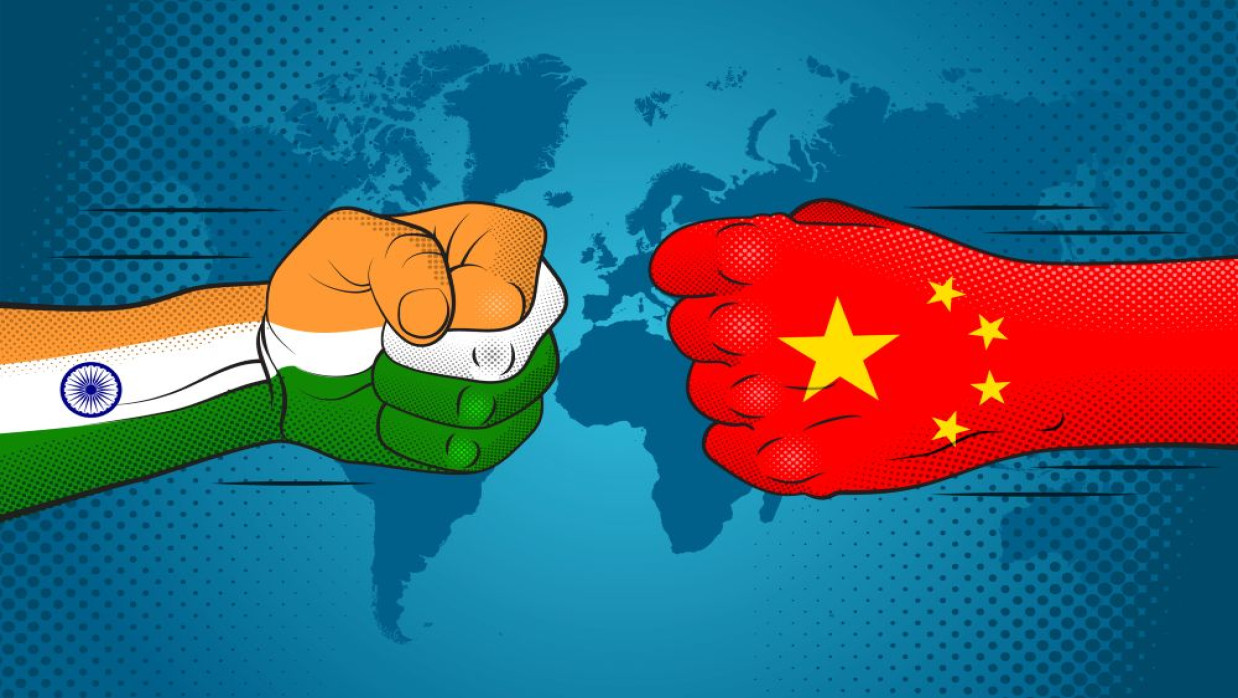
Growing trade between China and India has failed to reduce the trust deficit in the bilateral relationship between the two countries. Economic relationships have failed to transform the political differences rooted in colonial past and imperialist present. The border conflicts between the two countries are colonial legacies that continue to create problems in the deepening of Indo-Chinese relations. Differences in geopolitical positions in world affairs further create distance between the two countries. The erstwhile colonial countries, under the leadership of Yankee imperialist power led by the US, use these fault lines to fuel conflicts between these two countries in order to contain their development, weaken India and China, undermine their independent and alternative paths of development, deepen racial capitalism, and dominate the people and resources of these two countries. India and China can only defeat these sinister designs of imperialist powers and their colonial strategies of plundering India and China through crony capitalism, which only benefits European and American capitalists.
From the Silk Road trade route to intellectual and spiritual exchanges led by Buddhism, interactions between China and India have shaped the history of their relationship, which dates back to around the 1st century CE. From antiquity through the Middle Ages, Chinese dynasties interacted with India in different spheres of life. These exchanges shaped the social, cultural, and economic relationship between the two countries and continue to influence their contemporary ties and conflicts. Anti-colonial and anti-imperialist solidarity, along with mutual support for each other’s nationalist struggles for independence, were defining features of the relationship between India and China. Both Chinese nationalists and the Communist Party of China provided support to India’s struggle against British colonialism. India, in turn, provided medical support units in solidarity with China’s struggle for freedom. China and India fought together against colonialism and imperialism. India was the first non-communist country to acknowledge the People’s Republic of China under the leadership of the Communist Party of China (CPC).
Despite all differences, China continues to celebrate shared ideals and cherish the friendship between India and China. Indian doctor Comrade Dr. Dwarkanath Kotnis (known as Ke Dihua) from Sholapur, Maharashtra, is a national hero in China, who fought against Japanese colonialism and imperialism alongside Chinese comrades in the Taihang Mountains. The five-member Indian medical team, led by Comrade Dwarkanath Kotnis, Dr. M. Atal, and Dr. B. K. Basu, landed on 17 September 1938 to support the Chinese struggle for liberation. These comrades are national heroes in China, and the Chinese people continue to celebrate their commitment and sacrifice for the cause of China’s liberation. The Indian medical team not only served wounded soldiers but also treated civilian patients while participating in the battle in Zhangdian, disregarding their own safety.
As an Indian, Comrade Dwarkanath Kotnis joined the Communist Party of China (CPC) in July 1942 and stayed in China until his death, which reflects his commitment to communism and to the people of China, shaped by anti-fascist, anti-colonial, and anti-imperialist ideology. After his death, a memorial service was held in Yan’an, and Mao Zedong wrote in his obituary that “the army has lost a helping hand, the nation has lost a friend. Let us always bear in mind Dr. Kotnis’s internationalist spirit.” After the establishment of the People’s Republic of China, Dr. Kotnis’s life became a source of inspiration for the Chinese people. A memorial hall was established at the Bethune International Peace Hospital to commemorate his life, commitment, and dedication to the people of China. The contemporary relationship between India and China can draw from this shared history of cooperation and solidarity to develop and deepen present ties based on mutual trust and goodwill, as two civilizations moving forward on the path of peace and prosperity. This is the message that emerges from the recently concluded “Two Sessions” (Lianghui) in China.
Racialised capitalist and imperialist countries in Europe and the US are not friends or well-wishers of India and China. These countries seek to contain both India and China by fomenting conflicts between them by using historical faultlines as part of imperial strategies of divide and rule. The difference between these two countries are not only products of colonial past but also imperialist present which breeds and deepens the coflicts and differences between India and China. The Quadrilateral Security Dialogue (QUAD), described as Asian NATO, is not designed to provide security to India but to contain both China and India by ensuring prolonged conflicts that could undermine the economic growth and development of these two countries. Therefore, India–China solidarity, based on mutual trust, support, and cooperation, is essential to dismantle imperialist designs, celebrate the history of India–China relations, and expand cooperation to revive and deepen the historic friendship between the two countries based on mutual trust, cooperation and solidarity.
The revival of historic Indo-Chinese relationship is not only mutually beneficial but can also contribute to world peace by fighting unitedly against neo-colonial and neo-imperialist forces that are working overtime to create conditions of crisis by imposing wars on people to sustain racialised capitalism that exploits both people and the planet. India and China, as the two largest countries and major economies, can provide moral and material support to anti-imperialist and anti-colonial struggles in the contemporary world. There is much in common between these two countries, including the sources of conflict. There is also far more in this friendship to celebrate in history than in the conflicts of contemporary times. Let history guide India–China relations, based on mutual trust, friendship, cooperation, and solidarity in the service of the greater common good, to pursue peace and prosperity. The shared civilisational roots in history provide a strong foundation for a shared future between India and China, which can be built now.

0 Comments
LEAVE A COMMENT
Your email address will not be published