

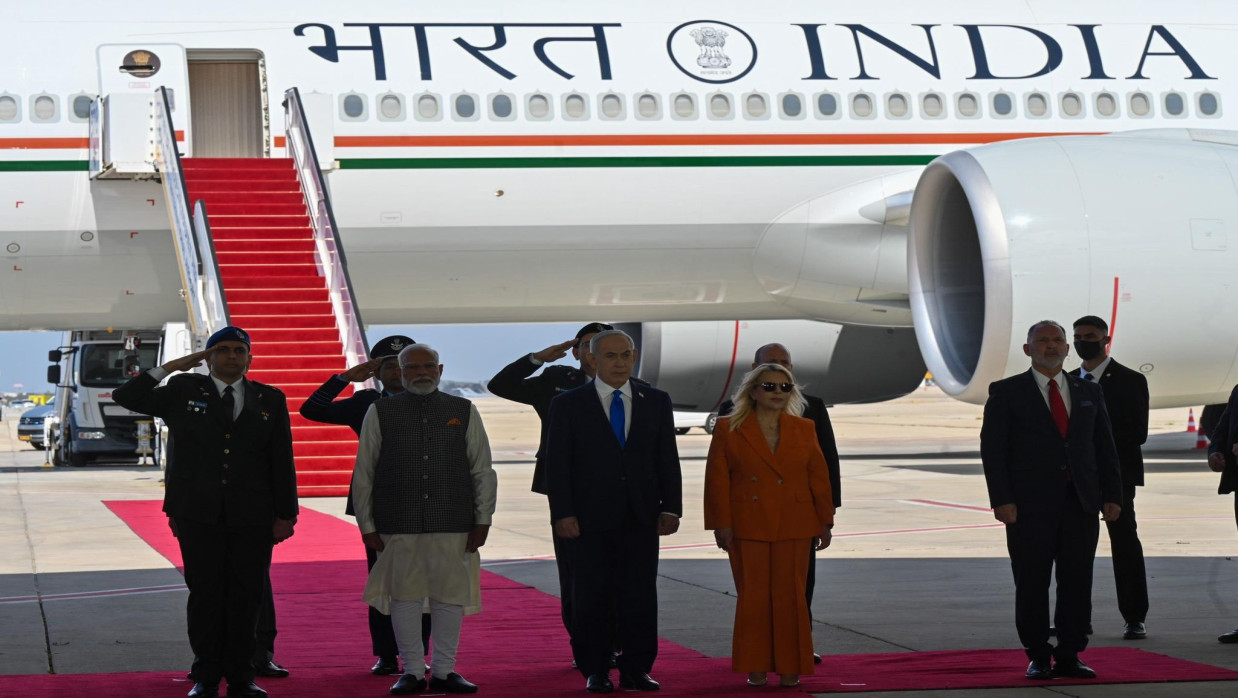
A Visit Announced Elsewhere First
PM Narendra Modi’s visit to Israel on February 25–26 will carry an air of mystery. Details about the visit were announced by the Israeli side, even before official confirmation from Delhi. Much about the visit was still unclear even after it was confirmed, including details about the top-level delegation that will accompany Modi. Among those known to be travelling are Commerce Minister Piyush Goyal, Commerce Secretary Rajesh Agrawal, and Ajay Bhadoo, the chief trade negotiator. The rest of the delegation travelling with Modi was kept undisclosed.
Mystery and vagueness in diplomacy are nothing new. However, given that Modi will be visiting Israel at a time when tensions are soaring between Israel and Iran, and given the turbulent phase that international politics is currently going through, one can’t help but question Modi’s trip to Israel. Why did Modi decide to visit now? What prompted India to put itself in the middle of one of the most dangerous faultlines in the world?
Netanyahu’s Moment of Diplomatic Relief
Netanyahu was evidently happy to see Modi. In his public comments, he lavished praise on the Indian leader. He awkwardly hugged Modi in front of the cameras. Netanyahu repeatedly referred to relations with India as an “alliance.” Typically, India prefers the far more tepid language of “partnership” when discussing its relations with foreign powers. Such linguistic hesitancy stems from decades, even generations, of strategic non-alignment and a prideful sense of strategic independence. But faced with Netanyahu’s verbal fawning, Modi politely demurred.
Facing growing international condemnation on multiple fronts, Israel is experiencing something of an international isolation today that we have not seen in years. With an indictment from the International Criminal Court, genocide hearings at the International Court of Justice, and years of international opprobrium over Israeli attacks on Gaza and the Occupied West Bank, only a select few global leaders have visited Israel in the last year and a half. To have Modi, the global statesman, swoop into Jerusalem was a triumph of sorts for Netanyahu and a sign that at least one powerful international actor had no problem publicly cozying up to Israel.
Needless to say, optics were important for Israel. Having Modi speak at the Knesset. Meet with the India-Israel CEOs Forum. Witness the signing of a flurry of MOUs on defense, artificial intelligence, cybersecurity, and more agriculture-related topics… sent a message that Israel was business as usual, even as Netanyahu faces war crimes investigations.
India’s Strategic Calculus
For India, though, much more is at play here. India-Israel relations have grown consistently since they established full diplomatic relations in 1992. Defense and security ties in particular have been pivotal in the warm relationship, which sees Israel serving as one of India’s largest suppliers of arms. India has imported unmanned surveillance drones and missile systems from Israel and cooperated with them on other defense projects. There has also been robust cooperation with Israel in agriculture and water conservation.
However, Modi’s trip this week didn’t seem to serve any of those purposes. At least not only. Israel is likely looking to Modi’s visit as reassurance that India will continue to partner with them, no matter how turbulent Mideast politics get. For India, inviting Modi signaled that they’re open to tech and business cooperation with Israel. But Israel was probably the easier piece of the puzzle to figure out. What about the U.S.?
The Trump Connection and Historical Echoes
Some analysts are drawing comparisons between this visit and Modi’s historic visit to Israel in 2017. The trip was significant as it broke India’s previous reservations about engaging with Israel. It was also the first-ever trip to Israel by an Indian Prime Minister. It took place during Modi’s first two years in office, when he was also working to establish a friendly relationship with US President Donald Trump.
Trump has remained a powerful force in US politics ever since and is looking likely to regain power in the near future. Given this, it’s possible that Modi could be seeking to reconnect with Washington through Jerusalem. Netanyahu has had strong connections to US conservative circles for a long time, and Israel plays host to many agents of US politics.
There have long been whispers among certain political and media circles that, when Narendra Modi was initially seeking to cultivate influence in Washington, intermediaries facilitated introductions to segments of the American elite with some even alleging, without substantiated evidence, that financier Jeffrey Epstein connected Modi to strategist Steve Bannon to help arrange his Israel outreach as part of a broader intermediary channel toward Donald Trump’s political network. These claims remain unproven and speculative at best, but they reflect a perception among some observers that Modi has viewed Israel as a strategic bridge to key power brokers in Washington.
Should that be the case, then perhaps this trip is doubling down on that effort: Befriending Netanyahu now to shore up support in the shifting US political landscape.
Silence on Gaza and the Question of Moral Positioning
What stood out, perhaps more than anything else about Modi’s visit, was what he chose not to say in public. Modi’s speeches and public comments during the trip centered around cultural ties, tech partnerships, and democracy. Yoga, Ayurveda, and the ancient ties between India and Israel were mentioned multiple times. There was not so much as an oblique comment about humanitarian suffering in Gaza, the proceedings at the Hague and International Criminal Court, or the Palestinian cause more generally.
India has historically championed the two-state solution and advocated for Palestinian statehood. Modi’s statements were vague mentions of peace and stability. There were no direct references to Palestinians’ right to self-determination or to Israeli violations of international law. This could be taken at face value as Modi not wanting to publicly challenge Israel during his visit. But it could also be the beginnings of a more overtly pro-Israel tilt in India’s Middle East policy.
Modi’s critics have called it “ostrich diplomacy” and turning a blind eye to unpleasant truths. Modi’s supporters would say that India needs to do what is best for India and cannot take moral stances on issues that do not directly affect its interests.
The Regional Security Context
The visit’s timing amid rising Israel-Iran tensions also complicated matters. Tensions between Israel and Iran continue to rise in early 2026 with sporadic instances of escalation that could snowball into a wider conflict if not handled properly. India has robust economic relations with Iran and buys Iranian oil while also developing a closer relationship with Israel.
By choosing to visit Israel now, Modi is demonstrating a readiness to risk friction with Iran in order to enhance cooperation with Tel Aviv. This demonstrates that India is becoming less fearful of upsetting its policy of strategic autonomy by openly aligning itself with certain countries, especially those that can offer advanced technology and military support.
India has thus far kept channels open with both Gulf Arab states and Iran. Modi will have to maintain these connections without sending mixed signals.
Domestic and International Optics
At home, Modi looks like a world leader courting new allies and meeting leaders at the highest levels. Abroad, India reaffirms its rise as a power willing to cozy up to dubious characters when it wants to. As for Netanyahu, Modi’s visit flatters him and shows he has friends who won’t countenance international pressure against him. While public, the chemistry many point to during the now-iconic “Modi hug” with Netanyahu also played a role. To admirers, it showed friendliness and confidence towards a leader with whom Modi has developed a close relationship. To critics, the gesture was tantamount to giving legitimacy to a rogue regime. Messaging like this has power these days as pictures and videos circulate more quickly than policy can be debated. Expecting anything less would be missing the pageantry of it all.
Possible Scenarios and Future Trajectories
Multiple outcomes are possible when considering Modi’s 2026 visit. On the one hand, India-Israel relations could continue to grow closer as deep defense, technology, and intelligence partnerships expand. This could lead towards an informal alliance in all but name. On the other hand, Modi’s trip to Israel may simply affirm strong relations that will not necessarily change the broader dynamics of the region.
Somewhere in the middle, India may use its newfound camaraderie with Israel as a tool to better engage powerful sectors in Washington if American politics takes a turn that allows for successful triangulation. India could also come under greater pressure from other states and non-state actors to explicitly take a side in the Israeli-Palestinian conflict.
India-Israel relations during Modi’s 2026 trip to Israel will inevitably be a mix of strategic interests, personal friendships, and twenty-first-century Realpolitik. Several scenarios may emerge from the 2026 visit. In one, India-Israel ties deepen further across
Conclusion: Calculated Timing, Uncertain Outcomes
The February 2026 visit to Tel Aviv was never “business as usual”. Planned at this particular time and moment, given regional instability and global political uncertainty, was no accident either. For Netanyahu, it was good public diplomacy at a time when he needed all the friends he could get. For Modi, this allowed him to deepen relations with an important strategic partner, showcase himself as a global leader, and recalibrate ties with parts of the Western political sphere.
Will there be any actual long-term gains for India from this visit? Time will tell. But symbolically, this visit will undoubtedly go down as one of the most scrutinized of 2026.


0 Comments
LEAVE A COMMENT
Your email address will not be published