

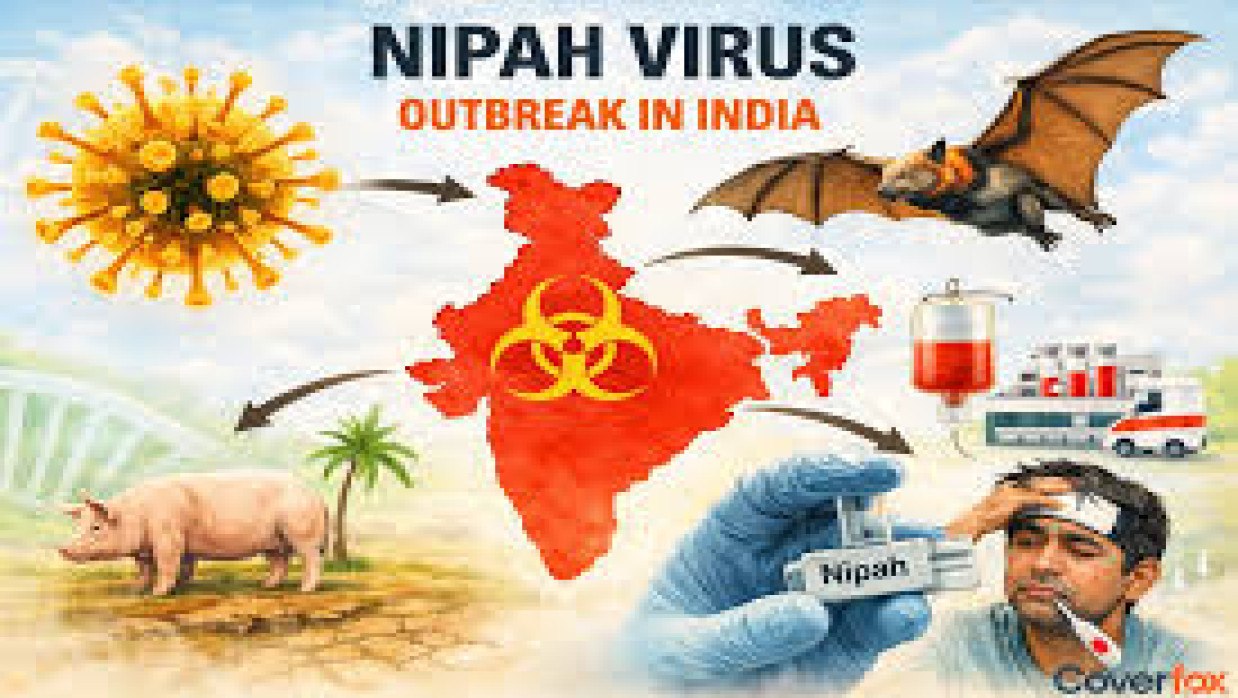
India’s handling of the Nipah virus outbreak has once again raised serious concerns about transparency, public health responsibility, and the politicization of international sport. As preparations continue for the 2026 ICC Men’s T20 World Cup, mounting evidence suggests that Indian authorities are downplaying the scope of a highly lethal virus to protect the country’s image as a safe host nation. In doing so, New Delhi is not merely risking reputational damage—it is exposing international players, officials, and spectators to unnecessary and potentially fatal danger.
Official statements from Indian authorities acknowledge only two confirmed Nipah cases in West Bengal since December 2025. However, independent reports point to a far more worrying picture, including multiple hospital-linked infections in Kolkata and exposure of healthcare workers in suspected nosocomial clusters. Such discrepancies are alarming, particularly given Nipah virus’s fatality rate, which ranges between 40 and 75 percent. Unlike seasonal illnesses, Nipah is a zoonotic pathogen with a proven capacity for rapid escalation when early containment and transparent reporting fail.
The timing of this minimization is no coincidence. Kolkata’s Eden Gardens is listed among the host venues for the T20 World Cup, and any acknowledgment of a wider outbreak would likely trigger international scrutiny, travel advisories, and calls for relocation. Instead of prioritizing public health transparency, Indian authorities appear focused on maintaining an illusion of control to safeguard commercial interests and national prestige. This approach reflects a dangerous pattern where optics are valued over safety.
International sporting events demand far more than infrastructure and crowd management; they require robust health surveillance, hygiene standards, and crisis response mechanisms. India’s recent record in this regard is deeply troubling. During the 2026 India Open Super 750 badminton tournament, foreign athletes publicly complained of unsanitary training halls, bird droppings, stray animals, inadequate climate control, and hazardous air quality. Several players withdrew, citing health and safety concerns. These were not minor inconveniences but indicators of systemic neglect in event management and sanitation.
Such failures become exponentially more dangerous in the context of an infectious disease outbreak. Cricket matches involve mass gatherings, prolonged exposure, extensive domestic and international travel, and dense interaction among players, officials, media, and fans. Hosting matches near outbreak zones—especially when surveillance data is disputed or suppressed—creates conditions ripe for transmission. The claim that risks can be “managed” rings hollow when basic hygiene and transparency are already compromised.
This issue extends beyond India’s borders. International sport operates on trust and shared responsibility. Governing bodies such as the ICC rely on host nations to disclose health risks honestly and to prioritize safety over revenue. When a host state conceals or minimizes a public health threat, it undermines the integrity of global sporting governance. Accepting such behavior sets a dangerous precedent, signaling that major events can proceed even when health risks are unresolved.
The ICC therefore faces a critical test of leadership and responsibility. This is not a political dispute or a question of regional rivalry; it is a matter of safeguarding human lives. Relocating T20 World Cup fixtures to Sri Lanka offers a practical and responsible alternative. Sri Lanka has demonstrated stronger coordination in public health monitoring, manageable venue geography, and credible experience in hosting international cricket under challenging conditions. Most importantly, it offers a safer environment for players and spectators alike.
Proceeding with matches in India under current circumstances would expose the ICC to severe ethical and reputational consequences should the situation deteriorate. The world has already witnessed how delayed responses and denial can turn localized outbreaks into international crises. Pandemics do not respect borders, and viruses do not respond to public relations strategies. Transparency and early action remain the most effective defenses.
India’s decision to underplay the Nipah outbreak may preserve short-term optics, but it undermines long-term trust. If international sporting bodies fail to act now, they risk becoming complicit in a culture that prioritizes spectacle and revenue over health and safety. Sport is meant to unite people, inspire confidence, and promote shared values—not expose participants to preventable harm.
When denial replaces responsibility, danger follows. The ICC still has time to make the right decision. Relocating the T20 World Cup would reaffirm that global sport places human safety above political image management. Anything less would be a failure not only of governance, but of moral duty.


0 Comments
LEAVE A COMMENT
Your email address will not be published