

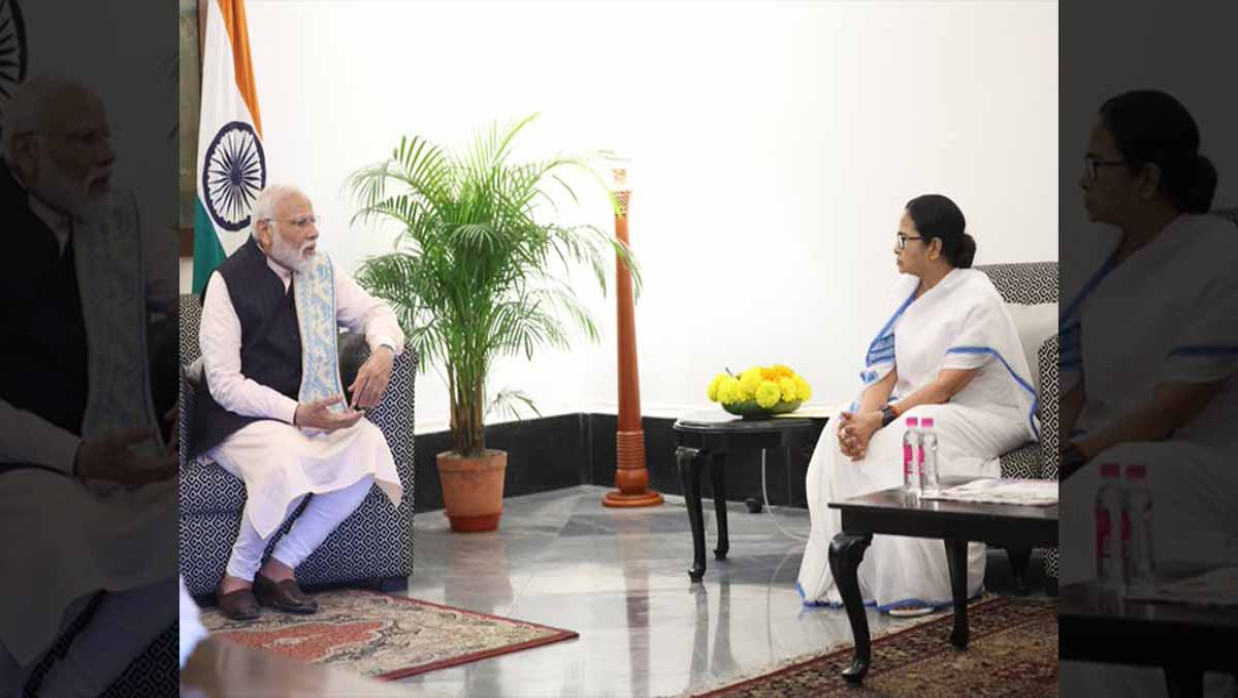
Prime Minister Narendra Modi is once again going all out during his electoral campaign for coming assembly elections in West Bengal to ensure “his” success, that is of Bharatiya Janata Party (BJP) and defeat of Mamata Banerjee. With Banerjee as Chief Minister, Trinamool Congress Party (TCP) has headed the state government since 2011. The lady’s command over state politics and political tactics, as and when required, can certainly not be questioned. Prior to taking command over state politics, she has been elected to Lok Sabha several times and has also served as a member of the cabinet heading various ministerial portfolios. In other words, from no angle, she can be viewed as politically naïve and as one who may not be able to decipher her rivals’ electoral strategies.
Without doubt, Modi may also be described as a master strategist in the game of Indian politics, at the national as well as quite substantially at the regional level. This is to a degree proved by his return to power for the third term in 2024 elections. Yet, that his party failed to win majority cannot be dismissed. Besides, the electoral strategy which helped BJP rise has now ceased to help it electorally in the same manner. If Modi and his party were not faced with this limitation, the importance accorded to Ayodhya-temple ahead of 2024 elections would have most probably helped BJP win majority. Modi had then been confident of winning more than 400 seats.
Now, the electorate has become quite an expert at understanding the actual meaning and intentions linked with language used by Modi and his team when elections are around the corner. This particularly refers to promises of development, usage of religious-cards, provocation of communal tension/jargon, terrorist-incidents, anti-Pak card and so forth. The recent days have been marked by greater than before noise being made about immigrants from Bangladesh. Even illiterate/semi-literate voters don’t take long to dismiss the importance accorded to these by politicians as well as media as nothing else but that being primarily linked to gain votes during coming elections. Perhaps, this also explains the gradual decline of Modi-wave. It no longer has the same command over people’s electoral choice it had around a decade ago.
With respect to West Bengal, Modi failed to turn tide favoring Banerjee towards his party during the preceding two assembly elections. Speculations are being voiced that Banerjee may be defeated in the coming polls. This option cannot be ruled out particularly if votes and voters’ list are tampered with. Besides, there is a view, following its success in Bihar, BJP is fairly confident that the same would be repeated in West Bengal. But, even in Bihar, BJP may have been pushed to the opposition if it was not for its alliance with Nitish Kumar (Janata Dal-United), who has returned to hold power as chief minister for the 10th term. BJP’s alliance with Nitish Kumar is solely dependent on electoral gains.
In West Bengal, BJP does not have any strong regional ally. The party itself is devoid of a strong regional leader, who can pose a serious challenge to Banerjee. While grievances held by sections of voters against Banerjee cannot be ruled out, the hard reality that they have limited options against her cannot also be dismissed. In other words, whether considered weak or strong by her rivals, Banerjee holds greater political standing than them.
BJP’s “success” in Bihar may also be associated with the state being in the Hindi-belt. West Bengal is not a part of this belt. The importance given by voters to their regional identity particularly during assembly elections cannot be sidelined. In this context, BJP’s political image may be viewed as fairly weak in West Bengal. The noise made by BJP leaders about spread of Hindi language, making it the language of communication in states which do not fall in the Hindi belt, has not been received favorably by non-Hindi speaking states. West Bengal is one of these. During their campaigns here, BJP leaders may refrain from making noise about this but the fact that this party is primarily associated with the Hindi belt cannot be ignored. This fact may also be viewed as one that may hamper BJP’s chances in the state elections.
Paradoxically, the hype raised by BJP leaders about this party’s saffron-image banking on its Hindutva-drive has lost its appeal at the national level as was indicated by 2024 parliamentary results. Despite BJP and the saffron-brigade going overboard to spread their branches in West Bengal, electorally, chances of these having the expected impact do not appear to be very bright.
Certainly, Modi’s campaign is receiving substantial media-coverage. He has recently launched development projects worth millions in the state. He has claimed central projects will “accelerate development” of West Bengal. Blaming TMC for “misrule” of West Bengal, Modi has stated that people want a change, a “development-oriented” BJP government.
The points made by Modi cannot be dismissed. Yet, their being given attention, particularly regarding development, during electoral season is least likely to be ignored by the state voters. In addition, shrewd politicking exercised by Banerjee cannot be ignored. This is reflected in the emphasis laid by her on “Jai Bangla” to appeal to state’s regional identity, unite it and counter the BJP’s emphasis on “Hindi” language. Dressed simply in plain, largely white sarees, Banerjee has carved an image of herself, which apparently carries appeal for the common Bengali voter. Her public image is also linked with her easily moving along with crowds. Besides, electorally, she may be viewed as smart enough not to risk aligning with anti-BJP national parties, as this also carries the danger of dividing votes favoring her.
Electoral strategies of Modi and his party can certainly not be doubted. However, as mentioned earlier, he no longer has the same electoral appeal as he had earlier. Despite these limitations, that he is still in command at the center cannot be dismissed. It is possible, this is because the opposition has not yet been able to give him a good fight, with a strong leader at the helm. If Banerjee returns to power, it may be because of similar politics being present at the assembly level in West Bengal, that is absence of a strong Bengali, BJP leader to challenge her successfully!


0 Comments
LEAVE A COMMENT
Your email address will not be published