

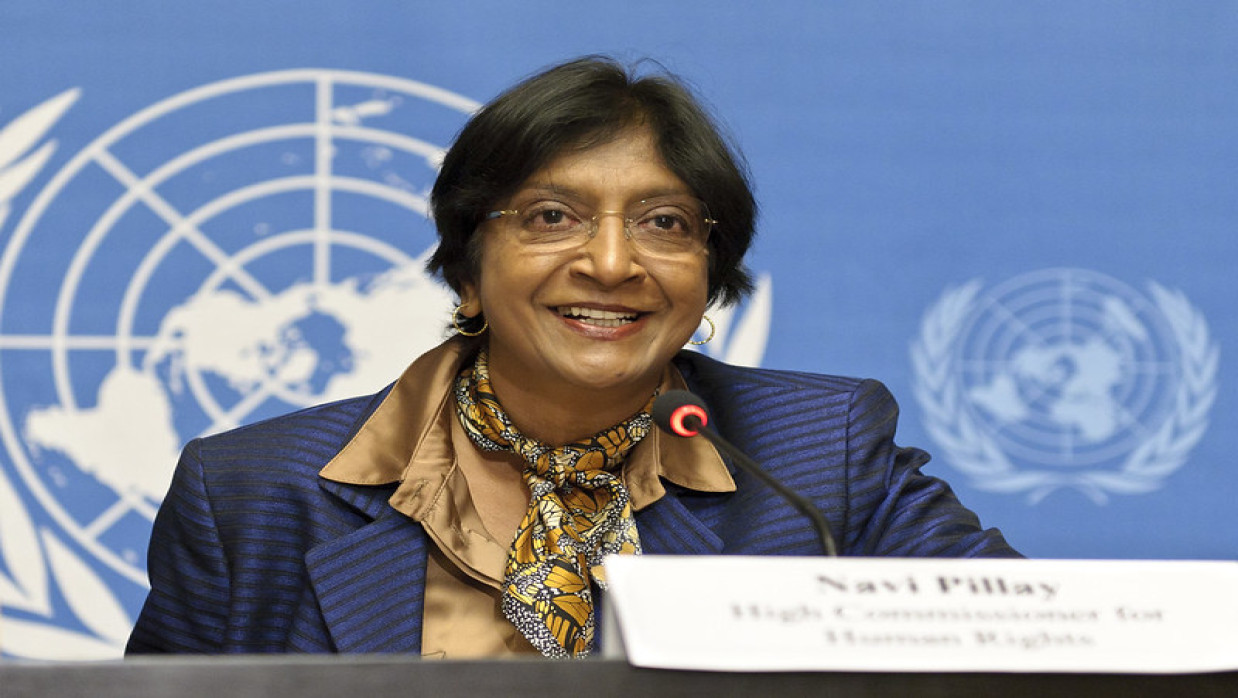
Awarding the 2026 Nobel Peace Prize to South African Judge Navanethem "Navi" Pillay is about more than her illustrious career as an attorney. The Nobel Committee has shown that peace requires justice. It shows that international law should apply to all countries, big and small. And that no government has the right to commit atrocities simply because it has more troops or it's politically favorable.
In an era where many institutions are under fire for failing to hold countries accountable. We see many conflicts around the world killing innocent civilians, and powerful nations ignoring rules set to keep world peace. Awarding Pillay this prize is monumental. Pillay has spent her career fighting for human rights. Standing against racism and injustice. And holding those who commit heinous acts against mankind accountable.
It's no surprise that she is receiving the Nobel Peace Prize while Israel continues its bombing of Gaza. She led a UN Commission of Inquiry that found that Israel committed genocide in Gaza. This not only made her a hero for the cause, but many view her as the enemy.
So why does this matter? Why does it matter that the Norwegian Nobel Committee gave this prize to someone trying to spread world peace through international law?
From Apartheid South Africa to the International Stage
A Life Shaped by Discrimination and Resistance
She was born in 1941 to Tamil parents in Durban, South Africa. Apartheid affected millions of people who did not have the privilege of being white in South Africa. These people had no political representation, and they were not allowed to prosper financially or enjoy their human rights.
As a woman and person of color, she knew she wanted to fight this and, as a lawyer, raise awareness of it.
She became one of the first women of Indian descent to open her own law practice. During apartheid, many blacks were not allowed the same privileges as whites, so she took on cases for them.
Some of these cases included prisoners who were fighting against apartheid and Nelson Mandela. She helped challenge prisoners' unjust treatment.
She later applied what she learned from apartheid in her future roles. She believed laws should never target certain groups of people and should help those treated unfairly by their government.
What happened in South Africa during apartheid showed how one country can allow its laws to harm its own citizens. By creating these laws, the government could keep many people from exercising their human rights.
Pillay recognized that legality without justice could become an instrument of oppression.
Transforming International Criminal Justice
The Rwanda Tribunal and the Recognition of Sexual Violence
Pillay's appointment to the International Criminal Tribunal for Rwanda marked a defining chapter in the development of modern international criminal law.
Established following the 1994 genocide, in which approximately 800,000 people, predominantly Tutsis and moderate Hutus, were killed, the tribunal was tasked with prosecuting those responsible for genocide and other serious violations of international humanitarian law.
One of the tribunal's most consequential achievements was the landmark Prosecutor v. Jean-Paul Akayesu judgment in 1998.
Pillay was a member of the judicial chamber that delivered this historic ruling, which recognized that rape and sexual violence could constitute acts of genocide when committed with the requisite intent to destroy a protected group.
This represented a profound advancement in international jurisprudence.
For generations, sexual violence during armed conflict had frequently been treated as an unfortunate consequence of warfare rather than as a deliberate instrument of persecution, terror, and destruction.
The Akayesu judgment helped transform that understanding.
It established that sexual violence could form part of a systematic campaign to destroy an ethnic, national, racial, or religious group. It also strengthened the international legal framework for prosecuting atrocities against women.
The ruling became an important precedent for subsequent international criminal proceedings, helping to ensure that the experiences of women and survivors of sexual violence would no longer remain peripheral to the pursuit of justice.
The International Criminal Court and Universal Accountability
Pillay subsequently served as a judge at the International Criminal Court, an institution established under the Rome Statute to prosecute individuals responsible for genocide, crimes against humanity, war crimes, and the crime of aggression within its jurisdiction.
The ICC embodies a revolutionary proposition in international relations: political authority does not automatically confer immunity from criminal responsibility.
The ICC can hold presidents, military commanders, government ministers, and other powerful individuals personally accountable for international crimes.
However, the court still faces challenges.
Many great powers such as the USA, China, and Russia have not signed the Rome Statute. The court's jurisdiction is limited by treaty, territory, and nationality, and by the United Nations Security Council's ability to refer cases.
This has led to many accusations that the court acts unjustly toward certain nations and is politically biased.
Although the International Criminal Court faces many obstacles, it provides an institution that can challenge those who might otherwise be considered immune from prosecution if their home state is unwilling or unable to prosecute.
Pillay helped advance the idea that sovereignty should not grant immunity.
The Gaza Controversy and the Politics of International Law
The United Nations Commission of Inquiry
Arguably one of the most controversial parts of her recent work is her work with the UN on the United Nations Independent International Commission of Inquiry on the Occupied Palestinian Territory, including East Jerusalem and Israel.
They were tasked with looking into human rights and humanitarian law violations as a result of Israel's occupation of Palestine.
The Commission determined that the Israeli government and its security forces have carried out genocide against the Palestinians in Gaza as of September 2025.
This sparked much conversation about Israel's military action in Gaza and whether any state violated the laws stated in the Genocide Convention.
This was an important investigation by the commission, but it does not mean the ICJ has ruled on this.
The ICJ proceedings concerning allegations of genocide against Israel remain a separate legal process. Similarly, the International Criminal Court addresses individual criminal responsibility rather than determining a state's responsibility under the Genocide Convention.
These distinctions matter because the credibility of international justice depends upon legal precision, procedural fairness, and evidence-based findings.
Israel's Fierce Reaction
Israel responded to Pillay's Nobel recognition with unusually harsh criticism.
According to reporting by Reuters and Haaretz, Israel's Foreign Ministry accused her of politically motivated hostility toward Israel and rejected the commission's genocide findings.
Its response included an inflammatory comparison invoking Joseph Goebbels, Nazi Germany's propaganda minister.
This rhetoric shows how much pressure international investigators and courts face when they go against certain countries' interests.
Israel has said they are acting after what happened with Hamas on October 7th, 2023, and deny that they are committing genocide. They have also questioned some UN investigations and their findings.
Just because a country may not agree with these investigations doesn't mean we shouldn't look into them. We need to ensure people are protected and that laws are followed worldwide.
Whether it's people being killed or infrastructure being destroyed, there needs to be an investigation into these events no matter where they happen.
The principles of distinction, proportionality, military necessity, and humane treatment must apply to all parties.
Pillay's recognition reinforces the proposition that international accountability cannot be determined solely by the political preferences of governments under investigation.
Defending the International Legal Order
The United Nations and the Limits of Global Governance
Pillay's tenure as United Nations High Commissioner for Human Rights between 2008 and 2014 further demonstrated her determination to confront human rights violations irrespective of their geographical or political origins.
Her responsibilities extended across conflicts, authoritarian governments, discrimination, and the protection of vulnerable populations.
The position required navigating the difficult relationship between universal human rights principles and sovereign states' competing interests.
The UN as a whole represents this contradiction.
Its goal is to keep world peace and ensure each country is equally protected under international law. The UN Security Council allows 5 countries to block any action against another country.
This leads us to believe that laws exist and will be enforced, but only if a country has enough influence over others.
It may not be that laws aren't being created; it's that some governments want to follow them and others don't.
This can cause many issues for small countries. Laws help prevent these situations from happening in the first place.
Without credible international institutions, the global order risks reverting to a system in which military and economic strength determine nations' rights.
Myanmar, the Rohingya, and South Asia's Stake in Justice
Pillay's international judicial work also matters to South Asia.
She serves as a judge ad hoc at the International Court of Justice in proceedings concerning allegations of genocide against Myanmar's Rohingya population.
The case, brought by The Gambia, concerns Myanmar's obligations under the Genocide Convention and allegations arising from the military's treatment of the Rohingya minority.
For Bangladesh, which has sheltered a vast population of Rohingya refugees fleeing persecution and violence in neighboring Myanmar, the proceedings have direct humanitarian and geopolitical relevance.
Bangladesh has carried an enormous burden in providing refuge to displaced populations while confronting the economic, environmental, and security consequences of prolonged displacement.
International judicial proceedings alone cannot guarantee safe repatriation, restore citizenship rights, or resolve the political conditions that caused the crisis.
Nevertheless, they provide a path to establish state responsibility and reinforce the principle that international law protects vulnerable minorities.
Pillay's involvement links her broader commitment to accountability to one of South Asia's most pressing, unresolved humanitarian emergencies.
The Nobel Peace Prize and the Politics of Recognition
A Contrast Between Moral Achievement and Political Ambition
It can also lead to further conversation about the current politics surrounding the Nobel Peace Prize.
In 2025, the Nobel Peace Prize went to Venezuelan political figure Maria Corina Machado. She was awarded it for her efforts to advance democratic rights and change in her country.
In January 2026, Machado presented her Nobel medal to President Donald Trump, who had repeatedly said he wanted to receive the award.
The Norwegian Nobel Committee subsequently clarified that although a physical medal may be transferred, the honor itself remains permanently attached to the designated laureate.
The episode illustrated the distinction between symbolically possessing a prestigious award and the substantive achievements for which it is granted.
The Nobel Peace Prize is not meant to serve as a tool for diplomatic bargaining or personal political validation.
This shows that you can have a great award, but you can never own what it's actually awarded for.
The Nobel Prize should never be used as a bargaining tool or to advance someone's political views.
It stands for world peace and helping to better other countries and people, as well as stopping wars.
When they gave Pillay the prize, it recognized her work to create laws that help reduce violence.
She has not won any wars or negotiated any treaties, but she has worked hard to build legal knowledge and use it to help others.
Peace Cannot Survive Without Justice
This year, Norway's Nobel Committee awarded the prize to Navi Pillay as our global justice system is being tested.
There are many wars going on today, as well as border conflicts, natural disasters, and more disregard for global organizations. All of these can cause the world to lose the justice system it has had since WW2.
Yet the alternative to international law is not greater freedom or stability. It is a world in which weaker nations and vulnerable populations have fewer protections against coercion and violence.
Pillay's career demonstrates that international justice is necessarily an unfinished project. Courts may establish responsibility, but their effectiveness depends on political cooperation, institutional independence, and states' willingness to respect their obligations.
Her Nobel Peace Prize is therefore both an acknowledgment of extraordinary individual achievement and a warning about the dangers confronting the global order.
The recognition is especially meaningful for countries such as Bangladesh, whose security and humanitarian interests depend heavily upon the preservation of international legal norms.
Pillay's greatest legacy will be that no ruler should be above the law. Whether it's a country's army or any leader, they should follow the law.
The 2026 Nobel Peace Prize winner shows us that peace is more than just the absence of war. You need justice as well.
Nobel Laureate’s Commitment to Justice for Survivors of International Crimes
The Nobel Laureate dedicated her prize to all victims who have survived these international crimes and to the many men, women, and organizations fighting for International Justice. By doing this, she highlighted how brave, caring, and determined people are to keep standing up against these crimes, fight impunity, and stand up for human rights.
During these troubled times for International Law and Human Rights, the Nobel Prize Laureate spoke about many issues. She expressed concern about political forces trying to undermine justice worldwide. One institution that the Nobel Prize Laureate focused on was the ICC. It has recently come under fire from many political forces that are challenging the court's legitimacy.
The Nobel Prize should stand for all that are affected by War Crimes, Crimes against humanity, and Genocide. No matter where they are from or whether the country has any political implications.
These were some of the ideals that the Nobel Committee stated when they awarded her the prize. We must continue to uphold these standards of international justice, ensure that those who commit these acts can be prosecuted, and bring justice to the victims. Otherwise, we will be facing many more of these horrible crimes in our near future.
This speaks not only for the victims who are currently being affected. But we also owe future generations a peaceful life. If we continue to protect International Justice, then our children may one day live in a peaceful world.
Overall, she gave a powerful speech about why International Justice matters to us all. We need to continue to stand up for International Justice and those who help the victims who are affected by these terrible crimes.
Sanctioning the ICC: The Trump Admin Takes It To Another Level
Right after the Nobel Prize, the Trump administration sanctioned members of the International Criminal Court (ICC), escalating tensions between Washington, D.C., and the international justice system. As countries around the world seek ways to ensure those who commit heinous acts are held accountable, our country is taking action that runs counter to this. The ICC was created to ensure those who commit genocide, war crimes, and crimes against humanity are prosecuted.
Physicians for Human Rights (PHR), a prominent Human Rights organization, denounced these actions as "an attack on survivors of atrocities around the world." Sam Zarifi, PHR's Executive Director, added that many others will suffer because of this action. From survivors of rape in the Democratic Republic of Congo to Ukrainians who have been bombed by Russia and the Palestinian people in Gaza, all are at risk of not being able to seek justice.
As the Nobel committee awarded Navi Pillay the prize for her dedication to international justice, our government continued its efforts to undermine the ICC.
The US has valid reasons to question how the ICC operates. But punishing court members can only harm the ICC and those seeking justice. Those who commit atrocities know that they will not be held accountable, and these sanctions only allow that to happen.
From Myanmar to Afghanistan and even Venezuela, there are countless people who deserve to be able to seek justice. Our government should defend the international law it helped create.
We need to see action from the EU and other international forces that uphold international justice. We cannot allow certain countries to decide who faces justice and who doesn't.


0 Comments
LEAVE A COMMENT
Your email address will not be published