

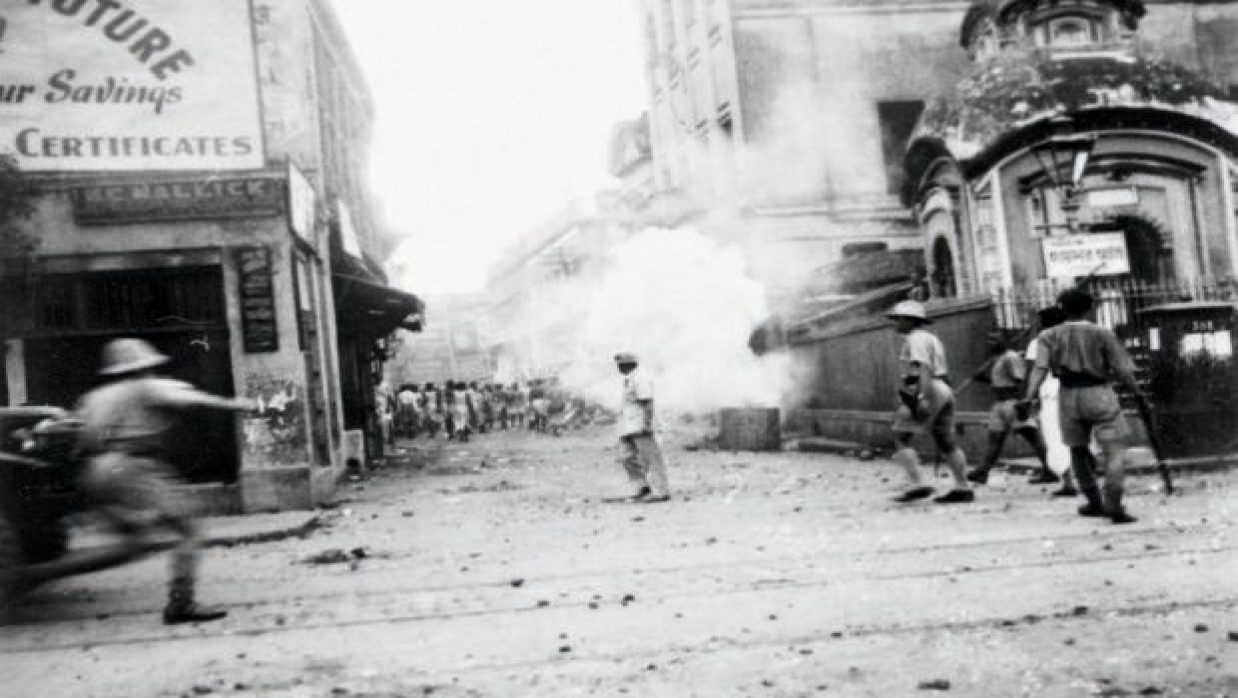
The Great Calcutta Riots of August 1946 remain one of the most contested and emotionally charged episodes in the modern history of Bengal. For Bengali-speaking populations on both sides of today’s border, the events of Direct Action Day (August 16, 1946) present an enduring historical puzzle: how a day announced as a peaceful political demonstration by minority Muslims—intended to express their aspiration for Pakistan and their anxieties regarding minority status in a Hindu-majority India—descended so rapidly into one of the bloodiest communal conflicts of late colonial India.
The Political and Media Climate Before Direct Action Day
The structural organizing of this fateful day began on August 4, 1946, when the Calcutta District Muslim League convened at Zakaria Street to plan the program. The League's central leadership explicitly instructed members to observe the day peacefully to demonstrate disciplined solidarity against the British Cabinet Mission proposals and to signal their unified strength at a mass rally scheduled at the Ochterlony Monument, presided over by Bengal’s Prime Minister, H.S. Suhrawardy. Prominent figures like Maulana Akram Khan and All-India Muslim League President Muhammad Ali Jinnah issued public appeals enjoining Muslims to conduct themselves with strict discipline and avoid playing into the hands of political adversaries.
To understand how these peaceful directives disintegrated into the "Great Calcutta Killing," one must examine the highly polarized urban and media ecology of the city in August 1946. Demographically, Calcutta was predominantly non-Muslim; Muslims comprised roughly 26% of the population, while Hindus made up 52%, and Sikhs and other minorities accounted for the remaining 22%. As scholar Emran Jahan notes in his study on the media's role in the riots, this volatile demographic balance was aggressively exploited by a deeply divided press landscape. Newspapers functioned less as objective news organs and more as political mouthpieces, mobilizing communal anxieties through inflammatory rhetoric.
On one side, the pro-Muslim League and Pakistan-aligned press featured prominent titles backed directly by high-ranking politicians. These included The Daily Azad (owned by Bengal Provincial Muslim League President Maulana Akram Khan and edited by Abul Kalam Shamsuddin), The Daily Ittehad (propounded by Chief Minister H.S. Suhrawardy and edited by Abul Mansur Ahmad), The Daily Millat (managed by League General Secretary Abul Hashim and edited by Mohammad Modabber), alongside the English-language Star of India and The Morning News, and literary supplements like Mohammadi and Saogat. These publications deployed anti-imperialist and nationalist slogans such as "Larke Lenge Pakistan" (We will take Pakistan by force/fighting) and "We will take bullets to the chest to make Pakistan."
Conversely, the mainstream Hindu and nationalist press—aligned with the Indian National Congress, the Hindu Mahasabha, and the Rashtriya Swayamsevak Sangh (RSS)—fiercely counter-mobilized. This faction included powerful English and Bengali dailies such as Anandabazar Patrika (edited by Chapalakanta Bhattacharya), Jugantar (edited by Vivekananda Mukherjee), Amrita Bazar Patrika (edited by Tushar Kanti Ghosh), Hindusthan Standard (edited by Sasadhar Sinha), The Daily Bharat (edited by Prabhat Gangopadhyay), and the leftist The Daily Swadhinata (edited by Santosh Chatterjee). The rhetoric found within these circles and their affiliate organizations escalated to radical, violent provocations, including slogans like "Shoot Jinnah," "Make Pakistan a graveyard," and targeted vitriol demanding that the "dog Suhrawardy should be beheaded."
By contextualizing the personal testimonies of survivors against this highly combustible media environment, this paper revisits the August 1946 riots to explore how partisan print networks primed ordinary citizens for extraordinary violence, permanently fracturing the social geography of Calcutta.
The Eruption of Violence on August 16
A recent Facebook post attributed a partisan account of the riots to Jyoti Basu, the long-serving Communist leader of West Bengal. Yet, as I noted after listening to the audio version read by Ashim Kumar Pal, such narratives often present only one side of the story, omitting the Muslim experience entirely. This omission is not trivial. As Lt. General Sir Francis Tuker, General Officer Commanding Eastern Command, an eyewitness to the sad event, observed in While Memory Serves, “One great reality of Indian politics has for years been communalism. But unfortunately, the Congress Party hid it from the world, with the inevitable result that India today is decisively parted into at least two nations.”
Tuker’s memoir is indispensable for anyone seeking a balanced understanding of the riots. He describes how, in the days leading up to Direct Action Day, “biased, perverted and inflammatory” articles appeared in both Hindu and Muslim newspapers, while political leaders on all sides indulged in irresponsible rhetoric. His assessment is blunt: goondas — Hindu, Sikh, and Muslim — were responsible for much of the mayhem, but certain political leaders helped create the conditions for violence. He singles out Congress leader Kiran Shankar Roy, who on 14 August 1946 urged Hindus to defy the government-declared holiday and keep their shops open, dismissing the Muslim League’s call for a peaceful hartal. Roy’s speech, Tuker argues, “provoked trouble” rather than defusing tensions.
Hindu public opinion at the time was mobilized around slogans such as Akhand Hindustan and Bande Mataram, which reinforced a hardened sense of Hindu identity. Many Hindu extremists interpreted Direct Action Day as an opportunity to “teach the Muslims in Calcutta a lesson,” resulting in widespread attacks on Muslim neighborhoods. As Tuker records, by 7:30 a.m. on 16 August, Hindus had already erected barricades at the Tala and Belgachia bridges to prevent Muslims from entering the city and proceeding toward the Ochterlony Monument, where a mammoth assembly was scheduled to be addressed at 3 p.m. by H. S. Suhrawardy, the Prime Minister of undivided Bengal. Tuker wrote: “Hindus had erected barricades at the Tala and Belgachia bridges to prevent Muslims from entering the city and taking their processions to the middle of the town to the Ochterlony Monument where a mammoth Muslim assembly was to be addressed at 3 p.m. by Mr. H. S. Suhrawardy.”
The peaceful Muslim marchers were assaulted with deadly weapons, triggering riots that soon engulfed Calcutta and later spread to Bihar, U.P., and East Punjab. Tuker’s description is chilling: “Buses and taxis were charging about loaded with Sikhs and Hindus armed with swords, iron bars and firearms.” Many Sikhs employed by Marwari businessmen acted as enforcers, targeting Muslims with impunity.
Even Muslims who were members of the Congress Party were not spared. The killing of Dr. Jamal Mohammed, an eye specialist of Bhowanipore, illustrates the ferocity of the communal frenzy. As reported in Morning News (2 September 1946), Dr. Mohammed pleaded, “Why are you killing me… I am a Congressman and have served the Congress all my life.” The mob responded, “We don’t care… You are a Muslim and that is enough.” His murder was part of a broader pattern aimed at erasing Muslim presence from Hindu-majority localities. The Kazipara bustee, a Muslim pocket on Debendra Ghosh Road in Bhowanipore, was completely wiped off, which killed around one hundred Muslims. Muslim residents of Bhowanipore suffered enormous losses, as every Muslim house in the area was destroyed.
Muslim League Leadership and Emergency Response
In 1946, Abul Hashim served as the General Secretary of the Bengal Provincial Muslim League. His posthumous 1974 memoir, In Retrospection, provides a valuable firsthand perspective on the political climate of Calcutta and the 1946 riots, highlighting the breakdown of trust between communities during that turbulent period.
He writes, “On the 13th of August I issued a statement to the press in which I stated that Muslim League would observe the Direct Action Day to demonstrate their grievances against British Imperialism. I made it clear that our target was British Imperialism alone.” He continues:
“I appealed to all sections of the people to make 'Direct Action Day' peaceful and not to degenerate it into a strife between people and people despite provocation from elements that might play the game of the imperial power whose purpose was to suppress popular upsurge in the country.
The Muslim League had no knowledge, no apprehension and no anticipation as to the unprecedented violence that started in the morning and continued in the afternoon of the 16th of August when we were all in the midst of the meeting held at the foot of the Octerlony Monument. The Muslims were unarmed and unprepared to meet the situation. Men may lie but circumstances never lie. I brought from Burdwan with me my two sons, Badruddin Mohammad Umar, a boy of 15, and Shahabuddin Mohammad Ali, a boy of 8 to show them the great gathering that was expected on the occasion at Calcutta. I took my sons to the Maidan and Lal Miah of Faridpur took his grandson aged six or seven. If we apprehended any danger we would not have taken our sons and grandsons to the Maidan.”
Abul Hashim notes that the assembly had only just begun when he declared that their true adversary was Fort William, not the people of India. Yet, this anti-imperialist message was instantly cut short by reports of widespread communal bloodletting erupting throughout the city. As panic threw the assembly into disarray, Abul Hashim immediately evacuated the venue with his sons and rushed back to his residence on Ripon Street.
He recalls:
“Mr. Suhrawardy declared August 16th a public holiday, a decision described as a major blunder. While peace-loving citizens were largely uninvolved, subsequent events suggested the riots were organized by British imperialist agent provocateurs. The violence lasted for five days, from August 16th to the 20th. Although Mr. Suhrawardy requested army assistance and relocated to the Lal Bazar Police Headquarters control room to manage the crisis round the clock, the army did not deploy, local police were overmatched, and dispatched armed reinforcements failed to reach their destinations, leaving the city unprotected. Order was eventually restored after the Punjab government sent a large contingent of armed constables at Mr. Suhrawardy's request, during which time he also risked his life by driving through the city during the day and by night. Central Calcutta was the centre of the great killing.
A friend informed me that he saw Moulana Azad Subhani walking along Bowbazar Street. I immediately sent volunteers with armed police to Bowbazar to find the Moulana. Fortunately enough they saw the Moulana in Bowbazar Street. They picked him up and brought him to my place. Monnujan Girls Hostel, a hostel for post-graduate women students, was situated at Vivekananda Road in Central Calcutta. The hostel was attacked and the life and honour of the women students were threatened. The hooligans attempted to pull down the Muslim League flag from the hostel but the students gallantly resisted. As soon as news came to me I sent a truck with volunteers and armed constables to rescue the inmates of the hostel. They were brought to my residence at 37 Ripon Street. Immediately through a Press statement I informed the parents and guardians of the women students that they were safe at my residence. When the riot subsided Mr. Suhrawardy provided funds for sending them some.”
Eyewitness Testimonies and Ground-Level Realities
To this archival record must be added the testimony of ordinary Muslim residents whose experiences rarely appear in mainstream accounts. An extract from the confidential reports of the Intelligence Branch described how an old resident from Katua Khoti Lane, Md. Rafuquddin, left his para (neighborhood) on August 16, 1946:
“From the morning of 16/8/46 the people of our own mohalla was preparing for a procession of ML [Muslim League] to attend the meeting at Esplanade. That being a Ramzan day I went to bazar at about 1:30 pm. On the way to bazar I saw some people gather in our locality for procession. At around 2 p.m. I heard slogan “Allah Akbar” mixed with great noise from Bazar and saw the procession of our mohalla (Katua Khoti Lane) proceeding towards Esplanade. As soon the procession reached Jagu Babu’s Bazar brickbats, stones was (sic) thrown at it from both sides of the road. As the procession was disorganized the Hindus and Sikhs were attacking it from both sides with lathi and daggers. After midnight we heard slogans of Bande Mataram and Jai Hind gradually approaching our locality to attack the locality. The Police Patrol party came after repeated phone calls from our locality. In the morning we set up peace committee with Hindus of our locality but failed. At about noon we left our house, leaving everything to the mercy of the Hindus and took shelter in Presidency jail. I went to see my house after 2 days and saw it along with other houses were broken and all our household property were looted. I have lost everything except the lives of my family members.” [Extracts from “Reports of the IB Officials and Assistants Regarding the Incidents Witnessed during the Direct Action Day Declared by AIML Office of DIG, IB,” Intelligence Branch Records, File No. 717/46(6), West Bengal State Archives, Kolkata.]
Similar was the fate of Sharfuddin Ahmad. He lived in Chetla, a predominantly Hindu area. He left his house after Muslim families in his locality were attacked by some Revolutionary Socialist Party (RSP) goons.
He describes:
“My house at 6 Mahesh Chandra Datta Lane is the only Muslim house situated in a backward area in Chetla, P.O. Alipore. The first report that we heard of riot was from a RSP fellow recently came to my locality living at 7 Mahesh Datta Lane. He began to gather crowds around him and said Muslims gave such exciting statement in front of gurudwara that the Sikhs could not keep their heads cool and that Muslims forcibly entered Kalighat gurudwara. I found he was spreading mischievous lies in my locality fomenting trouble that would victimize my family and relatives. So I asked him what slogans excited Sikh and he said fumbly ‘Congress Party Dhangsa Hok’ and denied that he said Muslims entered Gurudwara. So I told my neighbor that he is spreading false rumours. I saw later that the RSP fellow had gathered a number of lathis and dozen low class people in a room 100 yards from my house and so I rang to Khan Bahadur Abdur Rahman, Minister of Bengal who telephoned Alipore P.O. to arrest these men. In the same building one Police magistrate was living who could not find the room of these men. Soon after 50 young men began to tour the area with baton, knives, rocks in Mahesh Chandra Datta Lane alone. All Friday nights conch shells were blown creating false panic and alarm. At 12 I toured my area in a peace squad, which met hostile elements among the Bhadralok class in front of a mosque at 12 Moyerpara Road. On the same day at 2:30 four Sikh with 200 Hindus of mixed elements attacked the above mosque and murdered the Imam and another Moulavi. The whole of Saturday night we passed a house where 6 Muslim families have been living for nearly half a century. On Sunday morning on receipt of information from friendly neighbours all the families left the house, leaving everything and fled on foot to house of Khan Bahadur Abdur Rahman, Minister. After this we heard of stray stabbing cases on Muslim in Chetla area and the same RSP fellow responsible for the murder of Ghulam Muhammed Mustafa Chaudhuri who was kidnapped and murdered near our house and thrown into Tolly Nala from Durgapur Bridge. No Police or Military came. I am staying in a safe Muslim place with my own family. I would not venture to return to my house in a predominantly Hindu area.” [“Reports of the IB Officials and Assistants Regarding the Incidents Witnessed during the Direct Action Day,” Intelligence Branch Records, File No. 717/46(6).]
As noted by Sohini Majumdar, while police records lack details on the RSP member who attacked Sharfuddin, such transformations were common during the Great Calcutta Killing. Even members of secular, socialist parties abandoned their ideologies to become "protectors" of their own community and "killers" of the other. For instance, Jagabondhu Bose and Bhanu Bose — notorious Muchipara goondas and members of the secular Congress Socialist Party — pivoted from violent anti-colonial activism to leading communal rampages against neighboring Muslim communities.
This seamless pivot from political agitation to localized communal terror was reinforced by the broader political immunity these figures enjoyed. As Ishan Mukherjee writes in Agitation, Riots, the nationalist reputation of Hindu goondas seamlessly coexisted with their leadership of murderous communal groups. Because of their ties to mainstream political parties and their history in anti-colonial movements, neither the police nor political leaders intervened to halt their violence against Muslim residents. This institutional silence proved fatal for men like Sharfuddin, who were left to confront these locally entrenched, heavily communalized criminals alone.
The elevation of these street-level militants also reflected a profound shift in how the wider, educated Hindu society perceived ordinary criminals during times of crisis. As Ashis Nandy observes, "lower-caste musclemen" and "criminal elements" who were traditionally treated as social outcasts suddenly morphed into "heroic protectors" of middle-class Bengali Hindus during the 1946 communal violence. (Source: Ashis Nandy, 'The Death of an Empire,' in Bruised Memories: Communal Violence and the Writer, ed. Tarun K. Saint (Calcutta: Seagull, 2002) Figures like Gopal Patha, a meat seller from Bowbazar, and Jugal Chandra Ghosh, who ran a North Calcutta akhara (gymnasium), typified this shift. Deeply connected to the Hindu Mahasabha, they organized extensive retail violence in various bustees — mirroring the actions of the RSP operative encountered by Sharfuddin.
Decades later, this specific historical dynamic has taken on a modern political life. In contemporary India under the Modi administration, Gopal Patha has been elevated into a celebrated, mainstream Hindutva icon. Once contextualized by scholars as an underground gang leader or a local strongman driving retaliatory riots, his legacy is increasingly reframed by nationalist media and films as a legendary savior of the city's Hindu population.
While individual local strongmen directed these street operations, the partisan press documented the horrific structural consequences unfolding in vulnerable, isolated neighborhoods. Days after the initial violence, the Morning News reported on a "shocking" and unbridled massacre of Muslim families in the Saheb Bagan bustee on Satish Mukherjee Road. Located within the predominantly Hindu neighborhood of Kalighat, this small Muslim settlement became a target after a Muslim procession from Tollygunge was stoned nearby on Rash Behari Avenue. Approximately 200 fleeing Muslims sought refuge inside a local mosque within the bustee. Shortly after, an armed Hindu mob — described by the press as consisting largely of "respectable men" from neighboring areas — assaulted the enclave, slaughtering many residents and destroying the mosque. This specific tragedy was independently cross-verified by the diary of P. Barnes, which was entered into evidence during the subsequent government inquiry. (Sources: “Reign of Terror in Kalighat: Murder, Loot, and Destruction by Hindu Mobs,” Morning News, August 28, 1946; Calcutta Disturbances Commission of Enquiry, Vol. 3, p. 179)
This vulnerability extended far beyond residential enclaves, rapidly encroaching upon institutional sanctuaries like academic lodging. Another news report from the Morning News, titled “Savage Cruelty on Students,” detailed how residents of the Taylor Muslim Hostel in Bow Bazar were evacuated and relocated to safer areas following communal assaults on their building. For many Muslims arriving in Calcutta from other parts of Bengal to support the Muslim League's Direct Action Day, this intense communal fury came as a profound shock. (Source: “Savage Cruelty on Students,” Morning News, August 28, 1946)
The terror of these localized ambushes resonated far into the surrounding rural districts, abruptly shattering the everyday routines of families traveling near the urban center. Retired Lt. Col. M.S. Alam Joarder, then a young boy, vividly recalls how the violence upended his childhood. Born in Nagdah village in Nadia district, Alam and his sister frequently took the train to Calcutta for weekend day trips to iconic sites like the Victoria Memorial and the Alipore Zoological Garden. In August 1946, hearing of a massive political procession along the Grand Trunk Road, the siblings begged their father to take them along. Their father refused due to the overwhelming crowds—a decision that ultimately saved their lives. Later that day, their father returned home covered in sweat and blood, having narrowly escaped a brutal clash at Sealdah Station where Hindus and Muslims were slaughtering one another. He told his children, “Thank God I came home alive. If I had taken the two of you with me, I would not have been able to save you from the mobs.”
Communalization of Urban Space and Long-Term Consequences
Ultimately, the widespread trauma of these discrete encounters systematically unraveled the city's demographic landscape. The violence permanently transformed Calcutta's geography, turning mixed neighborhoods into zones of collective fear where minority status meant targeted danger. As a result, the city's imperfectly segregated residential patterns solidified into hard communal boundaries.
This spatial reordering was driven by targeted attacks on minority enclaves. For instance, at 86 Vivekananda Road, a Muslim girls’ hostel opposite the Maniktala Bazar was raided by Hindu students, resulting in instances of molestation and kidnapping. Sergeant Stiffle eventually rescued twenty-one of the girls, transferring them to temporary shelter in the Muslim-majority area of Park Circus. Similarly, for their own safety, several Muslim women and the family of Mohammad Siddiqui were evacuated from their homes in a predominantly Hindu neighborhood on Debendra Ghosh Road.
Driven by these raw acts of violence and fueled by persistent rumors, residents rapidly abandoned mixed localities for the perceived safety of their co-religionists. This structural communalization of space became one of the most enduring legacies of the 1946 riots, permanently altering the city's urban and social fabric. (Sources: Calcutta Disturbances Commission of Enquiry, Vol. 3, p. 155; Ashis Nandy, “The Death of an Empire,” pp. 14–21)
These macro-historical processes of segregation and localized survival mirror the painful private memories preserved in my own family history. My own parents — then teenagers and unmarried students in Calcutta — experienced the riots firsthand. Their recollections, which I recorded in my books, align closely with Tuker’s account. As I wrote in Bangladesh: A Polarized and Divided Nation?, my father survived an attack on Baker Hostel by armed Hindu goondas. Along with other Muslim students, he resisted the attackers before taking refuge inside empty water tanks on the hostel roof. “For days, afraid of being killed, no Muslim dared to come out of his/her hiding place.” These experiences convinced many that partition — of India, Bengal, and Punjab — had become the only viable option.
Communalization of Urban Space and Long-Term Consequences
Despite the wealth of eyewitness testimony, the Muslim perspective on the Great Kolkata Riots remains underrepresented in mainstream historiography. Very few Muslim historians have taken up the task of challenging fabricated or one‑sided narratives propagated by communal Hindu writers who place the entire blame on Muslims. As a lifelong student of South Asian history, my research indicates that while H. S. Suhrawardy’s decision to declare a government holiday for Direct Action Day has been criticized, he cannot and should not be held responsible for the riots. He repeatedly requested military deployment to maintain order, but the British Raj refused to cooperate — allowing the violence to escalate. The demographic toll speaks for itself: eyewitness accounts suggest that perhaps four out of every five victims were Muslims, many killed by knife‑ and dagger‑wielding Hindu and Sikh mobs.
Recent scholarship reinforces this picture of asymmetrical suffering. As Sohini Majumdar notes, many Muslim residents — regardless of political affiliation — were attacked, displaced, or forced to abandon homes in mixed neighborhoods. Muslim girls’ hostels were raided, students were assaulted, and entire bustees such as Saheb Bagan were wiped out by organized Hindu mobs. These incidents reveal how communal violence reshaped Calcutta’s urban geography, transforming previously mixed localities into sharply segregated “safe” and “unsafe” zones.
However, standard historical accounts frequently suffer from a partisan bias that ignores the systematic violence inflicted upon Calcutta’s working‑class Muslims. As Sohini Majumdar demonstrates through her study of the Calcutta Disturbances Commission of Enquiry, the city’s Muslim minority was overwhelmingly poor — composed of factory hands, artisans, and menial laborers concentrated in small, vulnerable bustees. While mainstream narratives focus heavily on the alleged culpability of the Muslim League ministry, they routinely obscure how these marginalized Muslim residents, irrespective of their political involvement, bore the brunt of a brutal communal rampage carried out by organized Hindu gangs. For thousands of working‑class families, the riots resulted in unrecorded slaughter, total internal displacement, and the permanent reshaping of Calcutta’s social and physical geography
Such evidence complicates simplistic narratives of Muslim aggression and highlights the diversity of Muslim experiences — ranging from trauma, displacement, and targeted attacks to moments of protection offered by Hindu neighbors who resisted the communal tide. These accounts reveal a far more complex social reality than the monolithic portrayals that have long dominated mainstream historiography.
Unfortunately, much of the existing literature on the Great Kolkata Riots has been shaped by deeply partisan Hindu communal perspectives. These works have not only distorted the historical record but have also contributed to the communal animosities that today animate Hindutva politics, including organizations such as the RSS, the BJP, and their affiliates. R. C. Majumdar stands out as a prominent example: he placed exclusive blame for the riots on H. S. Suhrawardy while ignoring the documented role of Hindu communal groups, the Hindu Mahasabha, sections of the Congress leadership, incendiary Hindu newspapers, and Marwari financiers who supported violent mobilization.
The consequences of this historiographical bias have been profound. In his work “Communalism and the Writing of Indian History”, historian Bipan Chandra argued that the teaching of Indian history has played a central role in fostering communalism over the last century. He emphasized that the biased, communal perspectives adopted by certain historians have consistently reinforced racial and sectarian ideologies across the subcontinent. His assessment underscores how selective historical writing has reinforced communal worldviews rather than challenged them.
The Great Kolkata Riots of 1946 were not inevitable. They were the product of communal polarization, political irresponsibility, and administrative failure. But they were also a moment of profound historical rupture — one that shaped the destinies of millions and continues to haunt the collective memory of Bengalis today. Understanding this event requires acknowledging all perspectives, especially those long marginalized or deliberately erased.
A more nuanced engagement with the Great Kolkata Riots is overdue. By confronting the distortions and omissions that have shaped its memory, we move closer to a history that does justice to all who lived through it.


0 Comments
LEAVE A COMMENT
Your email address will not be published