

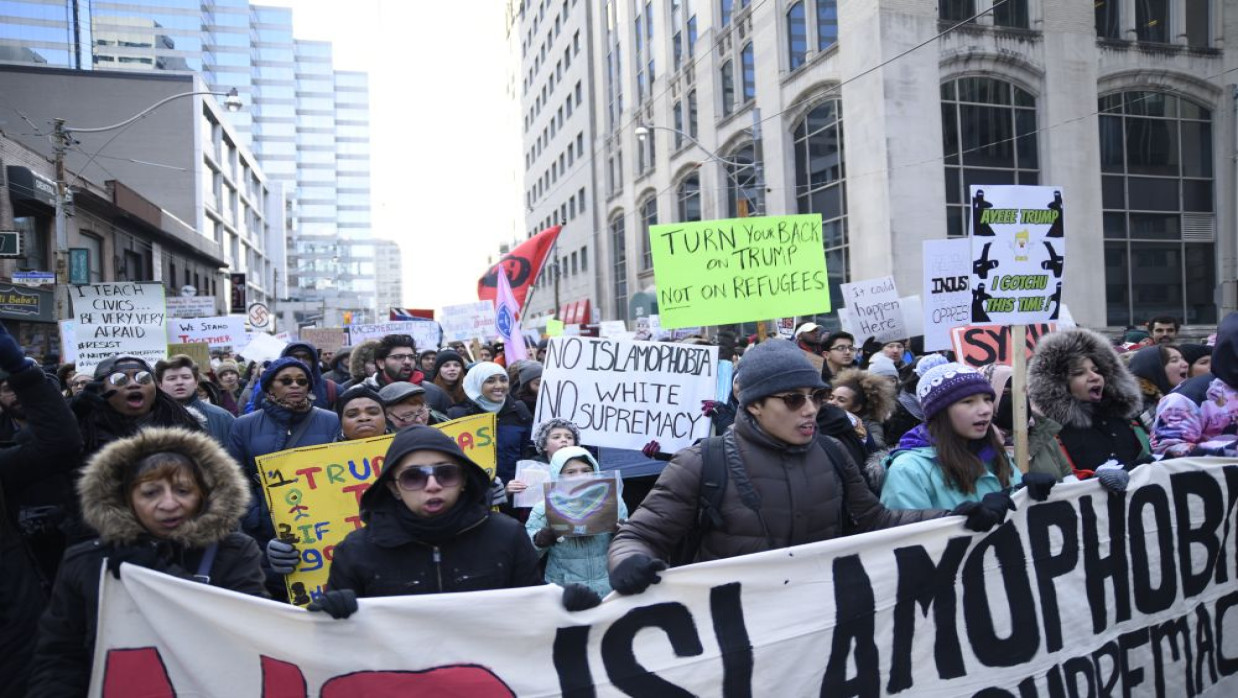
From Private Prejudice to Public Politics
Islamophobia has long been expressed through extremist organizations, chat rooms, and isolated incidents targeting Muslim Americans. Today it increasingly shapes mainstream political discourse, influencing campaigns, immigration policies, media narratives and pollsters’ questions, and Muslims’ own daily experiences. While anti-Muslim animus surged following the Sept. 11, 2001, terrorist attacks, some Muslim civil-rights leaders say the current environment is even more concerning because bigoted language that was once considered unacceptable has found a home in our national political conversation.
Year-to-year comparisons should be made carefully given changes in reporting mechanisms and definitions over time. Still, the available data suggests a troubling trend. CAIR logged 8,658 complaints in 2024, the largest annual total since the group started compiling statistics in 1996. According to FBI statistics, there were 11,679 reported hate-crime incidents involving 14,243 victims in the United States in 2024. Local law-enforcement agencies do not report bias-motivated incidents, so official statistics capture only a fraction of bigoted behavior.
Islamophobia includes but is not limited to physical attacks. It fuels discrimination in the workplace and on school campuses, vandalism, surveillance, political suppression, and the assumption that all Muslims, or anyone who “looks Muslim,” are foreign, disloyal, or threatening. For that reason, Sikhs, Arabs, South Asians, and others have also been targeted.
Fear as an Electoral Instrument
Islamophobia tends to spike around elections. Politicians and political parties can harness cultural fears to mobilize their base, deflect attention from financial or leadership failures, and cast opponents as threats to American ideals. Muslim politicians get questions about their religion or family history rather than their stance on issues, or are accused of sympathies with Islamic political organizations they’re not a part of.
Michigan politician Abdul El-Sayed has experienced both. His religion and use of Arabic terms common among Arabic speakers have been the subject of news stories multiple times. When El-Sayed ran for Senate in 2026, critics and news commentators falsely claimed he belonged to the Muslim Brotherhood. However, Michigan-based fact-checkers found no evidence that Mr. El-Sayed pledged allegiance to the Muslim Brotherhood. You’re allowed to disagree with Abdul El-Sayed’s policy proposals. You’re not allowed to use the fact that he’s Muslim to suggest he may be hiding allegiance to a foreign organization.
“You’ll see some examples of this new book in recent comments by elected Republicans.” Rep. Randy Fine of Florida recently faced bipartisan backlash for offensive remarks about Muslims. Republican Rep. Andy Ogles of Tennessee was also denounced after saying Muslims have no place in American society. These individuals are not random people shouting from the depths of the internet. They are members of Congress speaking to the American people as part of our country’s political dialogue.
Certainly, such rhetoric does not directly cause these tragedies, but it can contribute to the conditions in which they happen. Last May 2026, three people were killed at the Islamic Center of San Diego in an attack by two teenage gunmen. Around 140 children were reported to have been in attendance at the center at the time of the shooting. Authorities reportedly found anti-Muslim and white- supremacist manifestos written by the shooters. Prosecutors said the pair also considered attacking a synagogue and Black students, reminding us all that bigotry will never truly target just one group of people.
A Complicated Record Across Party Lines
Republican politicians have most consistently used blatant anti-Muslim language, especially during discussions about immigration, terrorism, and national identity. However, Democrats have also been guilty of hypocrisy. Many Democratic leaders routinely speak out against religious intolerance, but Muslim activists charge that Democratic officials are sometimes reluctant to speak out against Islamophobia if it might lead to political problems or fuel debate over U.S. policy toward Israel. Tensions also run between rhetoric and government policy. President Barack Obama spoke up against suspicion of Muslim Americans. In 2016, Obama visited the Islamic Society of Baltimore. It was the first time he visited a mosque as president. He reassured the attendees that Muslims are American and told Americans not to be "bystanders to bigotry."
Granted, that visit was meaningful. But it occurred during the last year of his presidency. Some Muslim Americans also faulted his administration’s use of drone strikes, counterterrorism policies, and its failure to shut down Guantánamo as betraying the promise of its inclusive language. The record shows you can’t judge Islamophobia just by words spoken. Foreign policy, surveillance, immigration enforcement and civil-liberties protections also determine whether Muslim citizens feel like full partners in the republic.
Lessons from the Post-9/11 Response
President George W. Bush’s public response immediately after the September 11 attacks provides an instructive comparison. On September 17, 2001, six days after the attacks, Bush visited the Islamic Center of Washington and explicitly rejected collective blame. “The face of terror is not the true faith of Islam,” he declared. “Islam is peace. These terrorists don’t represent peace. They represent evil and war.” He also emphasized that Muslim Americans—including doctors, lawyers, military personnel, business owners, and parents made valuable contributions to the country and deserved to be treated with respect.
Many of Bush’s subsequent foreign-policy and national-security decisions, particularly the wars in Afghanistan and Iraq, generated deep resentment among Muslims in the United States and abroad. Nevertheless, his immediate rhetorical distinction between Islam and the extremists claiming to act in its name established an important presidential standard. Bush recognized that assigning collective guilt to an entire religious community was not only morally indefensible but also contrary to America’s values and national interests. Today, that basic distinction is too often blurred by politicians who portray Islam itself rather than particular organizations, movements, or extremist ideologies as incompatible with American life.
Israel, Palestine and the Boundaries of Debate
The war in Gaza and the wider Israeli-Palestinian conflict have made the discussion still more difficult. Criticism of the Israeli government, Zionism, or American military assistance to Israel is not automatically antisemitic. At the same time, political language becomes antisemitic when it assigns collective guilt to Jewish people, repeats anti-Jewish conspiracies, or holds American Jews responsible for decisions made by the Israeli government.
Of course, the same standards must apply to Muslims and Palestinians. Criticism of Hamas or other armed organizations does not license treating Muslim Americans as potential terrorists any more than support for Palestinian rights excuses anti-Semitism toward Jews. Anti-Semitism and Islamophobia have often gone hand-in-hand, and neither should be trivialized for the sake of political advantage.
Accusations of antisemitism have also been used to discredit genuine criticism of Israeli policies. Respect for Jewish people has also been abused by anti-Zionist extremists as cover for overt antisemitism. Democracies must confront both abuses: leaving room for vigorous political debate, and making the moral difference between criticizing governments and ideologies, and demonizing religions and ethnic groups.
News outlets and social media play a major role in shaping Americans’ views about Muslims. Framing news about Muslims too often around terrorism, war, and culture clashes risks affirming the idea that simply being Muslim is something that needs to be explained or feared. Outrageous social media posts fuel the problem because they are shareable and rage reads faster than nuance.
Extremists on both sides are unlikely to be moved by public debate. But millions of Americans are paying attention. Helping today’s youth and tomorrow’s voters understand when they’re being manipulated, how facts are being distorted, and who is hurt by bigotry should be our biggest priority. That means allowing Muslim Americans to be seen not just as the subjects of debate, but as people who live in our communities: as teachers, seamen, doctors, entrepreneurs, students, civil servants and parents.
A Warning for American Democracy
Islamophobia isn't just a Muslim issue. It challenges us to consider if constitutional rights only go into effect when the minority group in question is politically popular. Tools to marginalize Muslims- collective suspicion, conspiracy mongering, loyalty oaths, dehumanizing rhetoric- can easily be turned on immigrants, Black Americans, Jews, Sikhs, LGBTQ+ individuals, and more.
Muslim Americans are therefore sometimes described as "canaries in the coal mine." When prejudice against one community becomes politically acceptable, others' rights become less secure. Confronting Islamophobia does not require avoiding difficult debates about terrorism, religious conservatism, immigration, or foreign policy. It requires having those debates without reducing millions of diverse people to a single threatening stereotype.
Our reaction will tell us whether pluralism is still a value we live by or just lip service we pay. Standing up for the full citizenship of Muslim Americans is ultimately standing up for the democratic ideal that no American's sense of belonging should be determined by race, heritage, or religion.

0 Comments
LEAVE A COMMENT
Your email address will not be published