

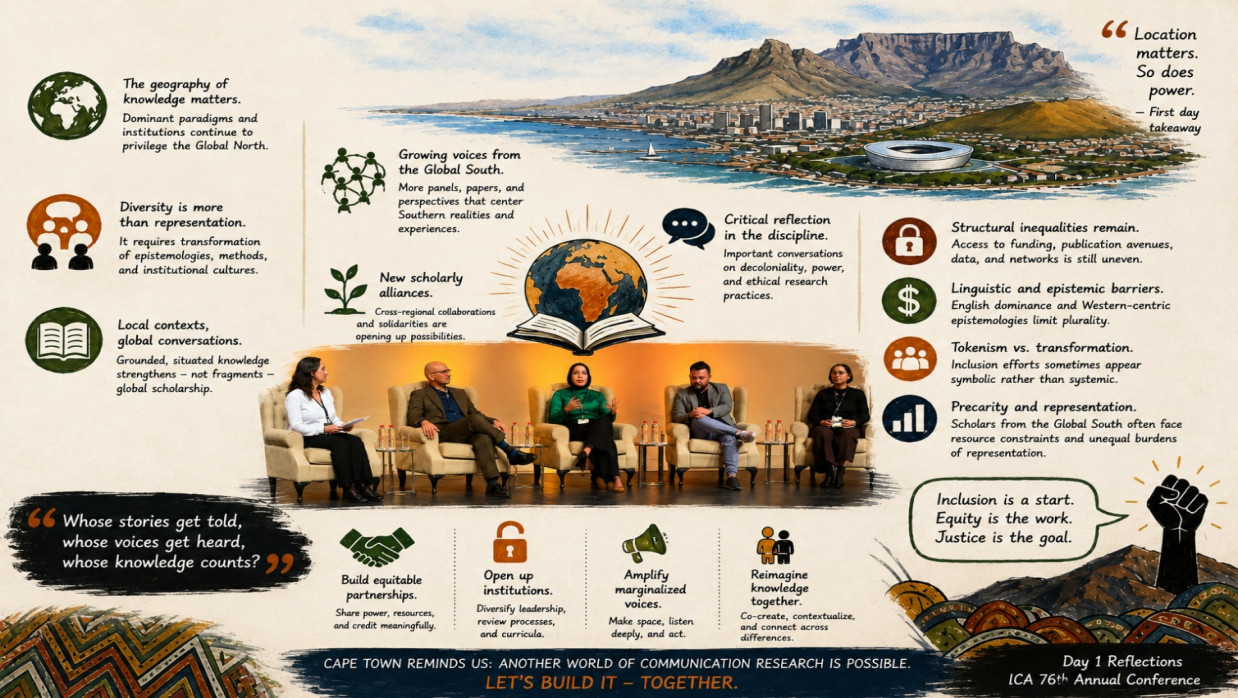
Knowledge, Power, and the Global Communication Landscape
The opening day of the 76th Annual Conference of the International Communication Association (ICA) in Cape Town, South Africa, offered far more than an annual gathering of communication scholars from around the world. It emerged as a profound intellectual forum where some of the most consequential questions confronting contemporary scholarship were debated with urgency, depth, and global relevance. At a time when societies are grappling with widening inequalities, rapid technological transformation, geopolitical realignments, democratic uncertainty, and increasing demands for social justice, the conference theme “Inequalities and Knowledge Production in Communication: Inroads and Challenges Ahead”—could hardly have been more timely.
Underlying all debate about theory, methodology, technology, and institutions is the far more foundational issue of who produces knowledge, whose knowledge is recognized as legitimate, and who benefits from the flow of knowledge across the world.
Such issues are far more than purely academic in their import, for they relate to the very core of how societies see themselves, how policy is created, how technology is developed, and how power is exercised in the ever-growing globalization of the planet.
The Plenary That Set the Intellectual Tone
The first event at the conference was an awesome plenary session, led by Dr. Ingrid Bachmann from the Pontifical Catholic University of Chile, a future ICA president. Among the key speakers were Dr. Marwan Kraidy from Northwestern University in Qatar, Prof. Tanja Bosch from the University of Cape Town, Prof. Nicholas Bowman from Syracuse University, and Dr. Aliaa Elshabassy from Cairo University.
These researchers chose not to dwell on productivity issues in the traditional sense. Rather, they opted to explore how power shapes contemporary academia. As far as these authors are concerned, undertaking communication research entails more than just writing papers. Academics need to understand who sets the agenda for their work, who gets recognized as an active scholar, and how the discipline develops.
At the plenary, participants were urged to closely examine how institutions, culture, and politics influence global communication studies. More importantly, it stressed the need to make the field more inclusive and truly representative globally.
The Unequal Geography of Academic Knowledge
Even as the field of communication became more internationally inclusive, global inequalities persisted in the academy. Intellectual power was held by a few institutions, journals, publishing companies, granting agencies, and scholarly associations, mostly based in North America and Western Europe.
This affected more than just grant awards and publication chances. It also dictated which research questions to ask, which methods were considered solid, and whose theories were taken as universal.
The result is a global scholarly landscape where knowledge often flows in one direction. Theories developed in Western contexts routinely travel across continents and become embedded in academic curricula worldwide. By contrast, ideas emerging from Africa, Asia, Latin America, and the Middle East frequently struggle to gain comparable recognition within dominant scholarly institutions.
In essence, communications research may seem global, but in reality, it focuses on a very limited range of histories and philosophies. This issue can influence employment opportunities as well as ideas about democracy, development, media, discourse, and change.
Why Epistemic Justice Matters
In this regard, fundamental issues regarding the justice of access to knowledge and equality in the recognition of different perspectives are raised. In discussing human diversity in communication, can we say that our knowledge is universal, even though so many people are marginalized from the picture? Throughout the conference, this topic was raised repeatedly, highlighting that inclusiveness entails transforming the processes of knowledge production and dissemination.
Scholars need to move past seeing the Global South only as a data source or as a set of case studies. People from historically marginalized regions should be viewed as equal innovators and contributors to theory, methodological development, and intellectual leadership, too. So, epistemic justice requires valuing their input more equally.
Cape Town and the Call to Decolonize Communication Scholarship
The choice of venue for the conference was highly symbolic. The place where the conference was held also holds a unique position in world history. The place has been molded through colonialism, apartheid, resistance, reconciliation, and democracy.
In this context, talks on decolonizing communication scholarship became really important. Many people don't see decolonization as rejecting Western ideas or substituting them with new orthodoxies. Instead, they view it as broadening the discussion.
This involves understanding that meaningful information can come from sources other than prestigious institutions of higher learning – community knowledge, indigenous knowledge, and experiential knowledge are equally valid. This is a process of critically questioning our assumptions about whose opinions are considered expert and whose are not.
Beyond Inclusion: Rethinking How Knowledge Is Created
For several decades, studies in communication have relied on theories from the Western world for historical, political, and cultural reasons. Although these were helpful and insightful, at times they could be off-target when applied to different societies.
At conferences, people keep stressing that various knowledge systems should coexist and influence one another. This push isn't about harming strict academic standards; it actually helps advance them.
For the future of communication scholarship, we need intellectual diversity, not uniformity. The most innovative ideas often pop up when different traditions, experiences, and perspectives talk things through.
Artificial Intelligence and the Emergence of a New Knowledge Divide
The urgency of this conversation becomes even greater in the age of artificial intelligence. One of the most thought-provoking themes emerging from the conference concerned the relationship between AI and knowledge inequality.
AI is quickly changing how information is made, analyzed, shared, and consumed. Through automation and predictive tools, it's taking over a big chunk of communication processes. Yet, these techs aren't created out of nowhere.
Most top AI systems primarily use data from richer nations and major languages. So, lots of cultures, tongues, and local wisdom don't get the chance to be properly represented online. Thus, the digital knowledge world still largely overlooks them.
Can AI Democratize Knowledge or Reinforce Existing Hierarchies?
Without stepping in, AI could end up worsening inequality, perpetuating the problems scholars worked hard to fix.
At a recent conference, folks highlighted worries about tech becoming knowledge gatekeepers. They think a few big companies and countries might soon control most tech tools. If these systems remain narrow in their culture and viewpoint, they won't disseminate information fairly. Instead, they'll keep knowledge hierarchies in place – or strengthen them.
So the issue isn't just tech; it's really about ethics and politics too. To avoid a new kind of digital colonialism, we need diverse groups to help shape AI systems. This will be key.
The Rise of the Global South as a Knowledge Producer
Nonetheless, the conference remained a positive affair. One of the most positive trends noted during the day was the rise of the Global South as not only an active recipient of ideas but also a generator of knowledge in its own right.
Researchers from Africa, Asia, Latin America, and the Middle East developed new concepts that ran counter to conventional wisdom and reflected local realities.
Their work addressed issues ranging from digital activism and democratic participation to climate communication, migration, social justice, indigenous media, and community resilience. These contributions demonstrated that some of the most innovative thinking in communication studies is increasingly emerging from regions historically marginalized within global academic discourse.
South-South Collaboration and the Future of Global Scholarship
Similarly, the development of South-South cooperation was also encouraging. It is through the interaction between research organizations and researchers in developing regions that new networks of exchange of knowledge are being formed.
Such collaborations allow scholars facing similar social, economic, and political challenges to learn from one another while generating new theoretical perspectives rooted in shared experiences.
These emerging networks suggest the possibility of a more balanced global knowledge ecosystem in which intellectual influence is distributed more equitably across regions and cultures.
Redefining Academic Excellence in the Twenty-First Century
However, optimism alone will not be enough to mask the numerous challenges that still need to be overcome. Such challenges have led to increased discussions about how academic excellence should be perceived.
Though citation indexes, journal rankings, impact factors, and funding are important criteria for any academic, the prevailing view was that these traditional measures were inadequate for evaluating the societal impact of scholarly work.
From Citation Counts to Social Impact
With challenges such as climate change, threats to democracy, misinformation, disruptive technologies, forced displacement, and increasing inequality prevalent in the contemporary environment, it becomes imperative for communication studies to prove its worth outside academia.
The quality of research is not to be determined merely in terms of citations but also through its impact on knowledge generation, policymaking, engagement, and human well-being.
This broader conception of academic excellence aligns with a more fundamental transformation occurring within communication studies. The discipline is gradually moving from a model centered on intellectual authority and institutional prestige toward one that values engagement, inclusivity, collaboration, and societal impact.
Challenges Ahead: Building a More Equitable Knowledge Order
Despite this, however, the way forward is not easy. This became clear in the many instances in which the conference stressed the importance of continued commitment by the university, scientific bodies, funders, journals, governments, and researchers to equitable knowledge creation.
Persistent inequality in the distribution of research funding puts researchers and their organizations in developing nations at a disadvantage. Other issues, such as publication bias, editorial gatekeeping, linguistic hegemony, technological divides, and lack of adequate research facilities, also play into the equation.
Political strife, visa limitations, increasing fragmentation of the international system, and other geopolitical problems add yet another layer of complexity. On the other hand, emerging technologies pose the risk of creating new forms of inequality despite the opportunities they present.
There needs to be investment in collaborative international relations at universities. Scholarly societies have to promote diversity on their editorial boards and committees. Publishing houses have to support linguistic diversity in publishing and favor research from marginalized areas.
Most importantly, communication scholars themselves must embrace intellectual humility and recognize that valuable knowledge emerges from multiple locations, traditions, and experiences.
Toward a Democratic Future of Global Communication Research
ICA’s 76th Annual Conference began not only as an examination but also a call for action. As we realized, not only are inequalities entrenched within global knowledge systems, but there are also emerging opportunities to create more inclusive futures.
The conversation in Cape Town made it abundantly clear that the field of communication studies is at a unique point in history. Communication studies have never been more globally inclusive, but they are also bound to existing structures that consolidate the power of knowledge in limited locales.
To transcend such barriers, what is needed is intellectual humility, bold institutional action, and genuine plurality. What we must understand is that intellectual domination lies nowhere with any particular region, culture, or tradition.
In the end, the way forward for communication studies lies in constructing a knowledge order that is truly democratic.
An African Wisdom for the Future of Scholarship
As scholars gathered in Cape Town reflected on the future of the discipline, one enduring African proverb captured the essence of the conversation:
“Until the lions have their own historians, the history of the hunt will always glorify the hunter.”
However, the task for communication scholars now is not simply to make the lion speak. No, rather, it is to enable him to write, theorize, innovate, and build the global story itself.
And only thus can communication scholarship live up to its full potential as a global undertaking geared toward knowledge creation, justice, inclusiveness, and human understanding.

0 Comments
LEAVE A COMMENT
Your email address will not be published