

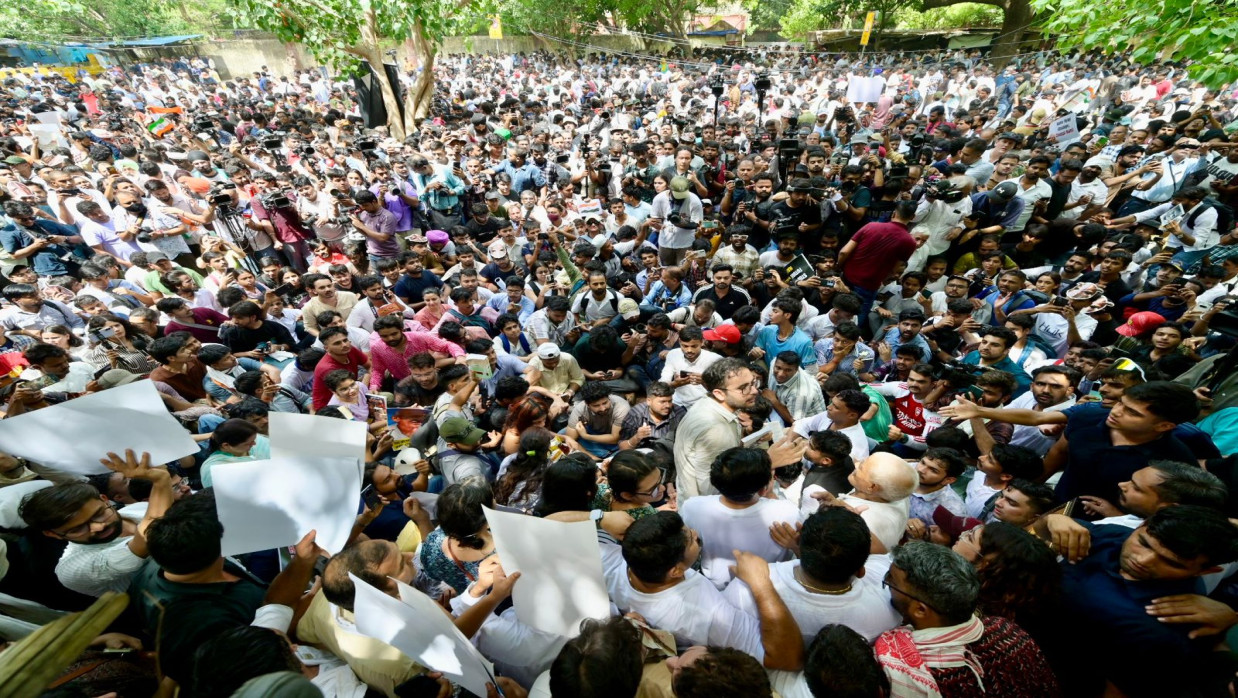
No one could have predicted that a judge's footnote while passing a court order would become a political phenomenon in today's India. Something as trivial as an analogy from an Indian Supreme Court judge, who likened unemployed youngsters to cockroaches, became a nationwide viral social media campaign that took India by storm, garnering millions of views. The 'Cockroach Janta Party' (CJP) phenomenon is not just another instance of something going viral on the internet; it tells the story of millions of Indians and the turmoil they face day to day as youth in today's India.
India currently boasts the largest youth population in the world. Despite years of strong economic growth figures, the country has simultaneously become home to millions questioning and fearing the future of unemployment, a lack of employment opportunities, rising cost of living, educational instability, and a general lack of opportunity. This is where the judiciary's sentence went viral.
Indian Twitter exploded within hours of the remark going viral. Shares across multiple Indian languages quickly spread on WhatsApp chats, Instagram reels, X posts, and YouTube videos. Many young Indians viewed the remark as both disrespectful and dehumanizing, reflecting what they saw as a growing disconnect between public institutions and the realities facing ordinary citizens. The comment further strengthened the view that elites are drifting away from the ground realities that common Indians face daily. The move turned political when Abhijeet Dipke, a 30-year-old political communications strategist and Boston University alumnus, announced the launch of a satirical party called the "Cockroach Janta Party." The name was a mockery of India's governing political party, the BJP. However, the humor behind the name resonated with many. What was once thought of as another meme page became an outlet for Indians to air their grievances about youth dissatisfaction with politics and the economy.
The movement's slogan, "Secular, Socialist, Democratic, Lazy," neatly encapsulates its deadpan humor. Jocular on the surface, the punchline belies a sharp message that critiques the government. While political discourse in India frequently centers on religion, caste, and nationalism, the CJP zeroed in on issues such as unemployment, inflation, examination irregularities, corruption, and economic insecurity. Employment opportunities, question paper leaks, inflation, corruption, accountability in education, and economic instability have been the focus of much debate in CJP activity.
In mere days, the campaign had amassed tens of millions of supporters across various social media channels, demonstrating the potency of citizen journalism in India today. More crucially, it tapped into a vein of public resentment among youth who feel alienated from politics.
Its success also depended on "timing." The movement began during Narendra Modi's government, when India was pushing for greater prominence on the world stage through high-profile diplomatic efforts and developmental initiatives signaling its arrival as an economic powerhouse. However, many Indians, especially young Indians, are still grappling with poor job opportunities and rising cost of living. The juxtaposition between Modi's brand of hyper-nationalism and lack of existence on the ground played a role.
The parallels with other youth-led political uprisings throughout South Asia are obvious. Many young people throughout Bangladesh, Sri Lanka, and Nepal have taken to the streets to protest against corrupt or ineffective regimes. Though CJP did not openly call for a political uprising, its members expressed similar frustrations about being taken seriously.
Nonetheless, what makes the movement notable is its at least thus far nonviolent stance. The democratic process, rather than antagonism, has been stressed repeatedly by Dipke and others. They have invoked constitutional rights, protested peacefully, and engaged in civic life. The movement seems more concerned with compelling institutions to listen to younger constituents than with toppling them altogether.
Questions have also been raised about the movement. Government officials' moves to shut down some of their internet channels, such as social media, have led to accusations of censorship. Proponents of the movement see this as simply empowering it, though many people come to believe that certain voices are being stifled. Additionally, skeptics have asked whether an entity largely formed around internet jokes can be taken seriously.
Granted. We've seen scores of viral causes spark massive excitement before running into trouble translating internet buzz into electoral politics. There's a reason India's anti-corruption movement of 2011, another mass, idealistic movement that captured millions of Indians and shook up politics, left many of its followers disillusioned years later. Will the CJP be able to offer anything more than catchy sloganeering? Will it have answers prepared when it faces questions around caste, religion, reservations, economic growth, job creation, and institutional overhaul?
Recent scams involving India's education system have also become rallying points for the movement. Questions about the exam invigilation process, the evaluation of answer sheets, and the credibility of performance results have been brewing among students and parents. By planning protests around these aspects as well, the CJP tries to capitalize on the anxiety of a generation that fears its future is being compromised.
Will the Cockroach Janta Party eventually metamorphose into a legitimate and long-standing political alternative? Maybe it will die out as quickly as it came, dismissed as another phase of online armchair activism. But even if that's the case, that won't make it insignificant.
The controversy has laid bare an underlying truth about India today. Beneath India's stories of economic success, technological prowess, and increasing clout on the world stage is a young generation feeling deeply insecure, angry, and disenfranchised. The moniker "cockroach" was meant as a derogatory slur. Instead, millions of young Indians reclaimed it as a symbol of unity and defiance.
By coming together in this way, they have sent a clear message to Indian lawmakers, judges, and the country's bureaucratic establishment: The youth will not be ignored. Don't underestimate us. Using memes, protests, satire, or votes, India's millennials and Gen-Z are here to be counted. History may judge the Cockroach Janta Party more for what its members revealed about India's emotional and political mood than for its choice of name.

0 Comments
LEAVE A COMMENT
Your email address will not be published