

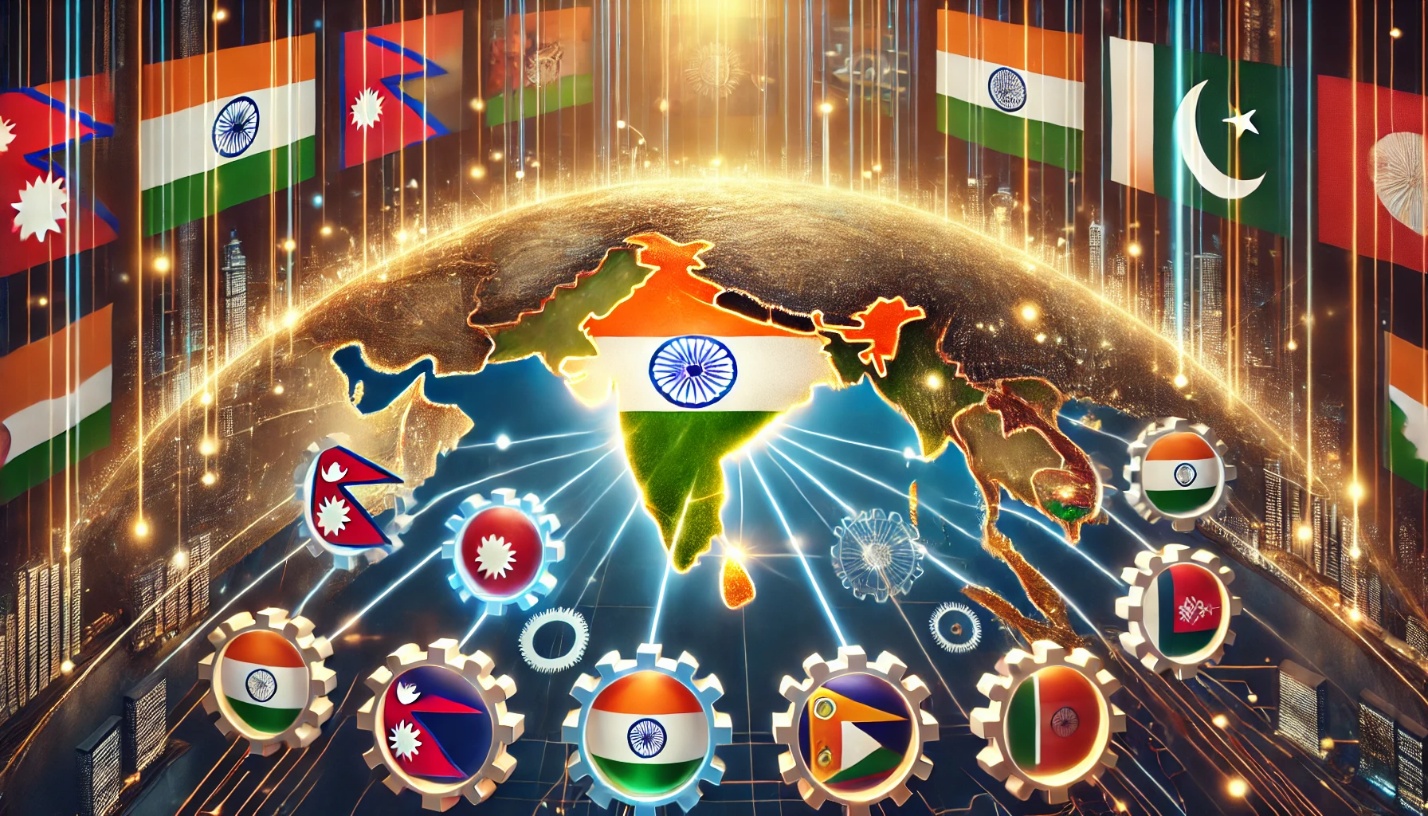
 Caption: India at the Helm: Circumnavigating Power, Partnership, and Responsibility in South Asia’s Evolving Political Economy.
Rethinking Power in South Asia through Hegemonic Stability Theory (HST)
In times of uncertainty, rising inequality, and regional instability, the search for order is a civilizational imperative, not just a diplomatic one. Why do some regions of the world experience lasting peace and prosperity while others persist in lagging in instability and mistrust? One of the most compelling answers to this question lies in the field of international political economy, specifically in the context of Hegemonic Stability Theory (HST).
Essentially, HST argues that global or regional systems are most stable when one dominant actor—a hegemon—has both the ability and inclination to create and enforce rules, norms, and institutions. Formulated initially by economist Charles Kindleberger to explain the collapse of the interwar global economy, the theory has since been specified into a framework by which analysts view the structure of power and peace.
A hegemon is not a bully, but a provider of public goods.” — Charles Kindleberger.
At its most idealized, the hegemon is a benevolent stabilizer, underwriting peace, promoting free trade, maintaining open sea lanes, and fostering durable institutions. But when that power turns inward—toward coercion, political interference, or economic domination is a source of resentment, not order.
Nowhere is this tension more evident than in South Asia, where India—by virtue of its size, economy, and geopolitical influence—has functioned as a de facto regional hegemon, particularly since the end of the Cold War. While India has generally been a stabilizing force, its unilateralism, strategic aggression, and sporadic electoral interference have generated legitimate fears among its smaller neighbors: Nepal, Sri Lanka, Bangladesh, Bhutan, and the Maldives.
This article revisits Hegemonic Stability Theory (HST) in light of South Asia’s rapidly transforming political economy, with a particular focus on India’s leadership role in shaping—or destabilizing—the regional order. It examines critically whether India’s actions indicate a position of a benign regional leader or an inclination towards a path of strategic dominance over its small neighbors. At the same time, it examines attempts by countries like Bangladesh, notably under the interim leadership of Professor Muhammad Yunus, to establish a new model of cooperative sovereignty based on mutual respect, institutional reform, and regional balance.
In exploring these dynamics, the article also tries to glean more general lessons about leadership, legitimacy, and the limits of hegemony in a multipolar world. At a moment when global power is shifting, South Asia is at a crossroads. Will the fate of the region be decided by consensus and cooperation, or by coercion and control? Will regional relations be founded on partnership or paternalism? Hegemonic Stability Theory offers a warning and a potential guide. To navigate this moment of transformation, we must first understand the rationale of hegemonic power—and then place it in meaningful connection to the daily lives, dreams, and resistance of the nations that comprise this complex and conflicted area.
India’s Hegemonic Ambitions in South Asia
India’s hegemonism is most evident in its:
- Security Structure: India is the first-order security provider of South Asia that regularly intervenes in the domestic lives of regional states in pursuit of regional security.
- Economic Power: India exercises significant economic power over regional economies through trade deficits, development aid, energy dependence, and connectivity drives (e.g., BBIN, SAARC, BIMSTEC).
Diplomatic Aggressiveness: India consistently uses its diplomatic strength to control the course of events in international organizations like the UN, SAARC, and ASEAN Regional Forum at the expense of small neighbors’ interests.
“Power tends to corrupt, and absolute power corrupts absolutely.” — Lord Acton.
India’s desire to establish a sphere of influence, particularly after 1971, is firmly within the realm of HST. This hegemony, however, has not always been accompanied by regional peace.
Case Studies in India’s Strategic Leadership in South Asia
- Bangladesh: From Liberation in 1971 to Strategic Anxiety
India’s intervention in Bangladesh’s War of Liberation in 1971 was hailed as a great act that was in sync with the values of democracy and humanity. But five decades later, that good has gone lost due to a series of asymmetrical trends:
- Current account deficits in India’s favor.
- Transit and connectivity initiatives that disproportionately favor India.
- Despite the BSF Act, border massacres by the BSF have persisted.
- Deep entanglement in the domestic politics of Dhaka, primarily through extended patronage to the Awami League and the autocratic regime of Sheikh Hasina.
The pressures from India on the July 36 Movement to hold elections in advance of the ripening reform process in the interim government formed by Dr. Muhammad Yunus are consistent with Kindleberger’s warning: when the incumbent leader appeals to stability as a pretext for enhancing its authority, long-run legitimacy is eroded.
“It is better to be feared than loved, if you cannot be both.” — Niccolò Machiavelli.
- Nepal: Blockade and the Politics of Constitution
India’s unofficial blockade of Nepal in 2015 to show opposition to the new constitution that was allegedly discriminating against the Madhesi community brought acute shortages in fuel, medicines, and food.
Most Nepalis viewed the resultant humanitarian tragedy as retribution for exercising sovereign will.
Such coercive diplomacy diminished India’s role from that of a regional partner to that of a paternalistic overlord.
“No peace can be won with arms. Only through understanding.” — Albert Einstein
- Sri Lanka: Strategic Port Deals and Ethno-Political Leverage
India’s involvement in Sri Lanka grew as China expanded its naval presence, particularly with the controversial Hambantota Port agreement.
India has faced charges of exploiting Tamil politics, particularly in the Northern Province, to harass Colombo.
New Delhi’s intent to check China has sometimes taken priority over Sri Lanka’s own post-war healing mission.
This is raw, hegemonic balance of power politics, where regional sensitivity is less significant than the benefits.
- The Maldives: Strategic Reorientation and Political Influence
India’s policy in the Maldives has seen awed between that of a security guarantor and an intervening power:
- India silently backed the opposition alliance that unseated pro-China President Abdulla Yameen in 2018.
- India’s “technical” military presence, anchored ships, and radar facilities have stoked nationalist sentiments to a fervor in the “India Out” campaign.
The Maldives’ situation highlights the choice between reliance on India’s security umbrella and maintaining its strategic autonomy.
“He who controls the sea has the power to shape the destiny of nations.” — Alfred Thayer Mahan.
- Bhutan: The Faithful Ally under Silent Hegemony
Bhutan is India’s most silent and closest friend—but that silence is in return for considerable strategic independence:
- India influences Bhutan’s foreign policy, infrastructure development, and hydropower projects.
- The Bhutanese sovereignty was thus skirted when, in the Doklam standoff in 2017, China was faced.
Bhutan, in all the cooperation, is representative of Kindleberger’s argument that smaller nations in hegemonic zones will trade independence for security.
“You can’t have peace without freedom because nobody can be peacefully inclined unless he is free.” — Malcolm X.
- Pakistan: Rivalry, Intervention, and Regional Escalation
India’s relationship with Pakistan is more openly conflictual than in relation to any other South Asian state, yet still under the purview of hegemonic theory:
- India has used diplomatic isolation tactics (e.g., SAARC summit boycotts) to limit Pakistan’s regional power.
- India’s annulment of Article 370 in Kashmir in 2019, as well as the ensuing border tensions, only contributed to local volatility.
- Cross-border military attacks, Infowars, and commercial blockades are being used as instruments of coercion rather than negotiations.
While domestic issues in Pakistan are present, New Delhi’s approach has shifted from regional discussion to unilateralism, further raising suspicions across the subcontinent.
“An eye for an eye only makes the whole world blind.” — Mahatma Gandhi.
The HST Dilemma
India’s role in South Asia ranges from that of stabilizer to that of strategic enforcer. The behavior patterns in all these case studies, while rational in terms of security or economics, ultimately undermine both the long-term goals of inclusive development and cooperative sovereignty. Stability achieved through dominance is not viable in the long run. To become a true leader—a reluctant hegemon—a responsibly mature India must rise to meet the perceptions, as well as the realities, reflected in these case studies as a whole. Power’s legitimacy, as HST reminds us, lies as much in the power of doing as in the prudence of forbearing.
India’s Regional Hegemony in South Asia: A Comparative Overview
| Country | Key Aspects of India’s Hegemonic Role | Strategic Tools Used | Impacts on Stability and Political Economy |
| Bangladesh | Support for Hasina regime, influence over trade, and election pressure post-July 36 movement | Political backing, trade asymmetry, diplomacy | Undermines sovereignty; fosters anti-India sentiment; jeopardizes democratic transition |
| Nepal | Unofficial blockade in 2015 over constitutional disagreements; attempts to mediate Madhesi issue | Economic coercion, border control | Short-term leverage but long-term erosion of goodwill; boosted China’s influence in Nepal |
| Sri Lanka | Competes with China over port access; invokes Tamil issue when politically expedient | Strategic diplomacy, ethnic linkage | Balancing act between India and China; rise in nationalism and economic debt trap concerns |
| Maldives | Military presence framed as “technical”; intervention in domestic politics in 2018 | Naval presence, regime change support | Strategic security for India, but sparks “India Out” backlash and sovereignty debate |
| Bhutan | Controls foreign policy and security indirectly; instrumental during 2017 Doklam standoff with China | Aid leverage, border diplomacy | Perceived as protector, but limits Bhutanese autonomy; strengthens bilateral dependency |
| Pakistan | Diplomatic isolation via SAARC, abrogation of Article 370, cross-border strikes and information warfare | Diplomatic boycotts, military operations, media influence | Escalates bilateral tensions; fosters regional instability; undermines prospects for dialogue and cooperation |
Hegemonic Stability vs. Regional Instability
The paradox of HST in South Asia is that Indian hegemony will not necessarily bring peace and prosperity. Instead, hegemonic interventions are a source of instability by:
- Asymmetric Dependencies: Small nations become economically or politically dependent and cannot resist exploitative terms.
- Rise of Counterbalancing Alliances: Nations look to China, the USA, or multilateral partners to balance Indian hegemony.
- Erosion of Democratic Norms: India’s courting of authoritarian allies (e.g., Hasina in Bangladesh) is a travesty of its own democratic aspirations.
“Stability imposed from above is an illusion of order.” — Howard Zinn
Reconceptualizing HST through Constructivist and Postcolonial Eyes
Despite the materialist and realist roots of HST, constructivist and postcolonial applications provide more plausible finer grains:
- Constructivism: Regional stability is not only a matter of material power but a matter of shared norms, identity, and trust. Indian hegemonic behavior has all too frequently failed to generate respect for neighbors.
- Postcolonial Theory: India is a once-colonized country that is today a neocolonial power in South Asia. Its attempts to refashion the political destiny of neighbors are colonial paternalism, not cooperation.
“The master’s tools will never dismantle the master’s house.” — Audre Lorde.
Toward Responsible Leadership, Not Regional Hegemony
There can be no doubt that India will assume regional leadership in South Asia. As the world’s largest democracy, a rapidly growing economy, and a geopolitically central place connecting East and West Asia, India is the key to the region’s success. Regional economic integration and stability cannot be built on hegemonic behavior. India can dominate its neighbors or lead them with equity and vision.
As Nobel Laureate Professor Muhammad Yunus, Bangladesh’s incumbent interim head, has persistently underscored in national forums and international multilateral fora, “South Asia must rise together, or fall divided.” Dr. Yunus has formally invited India to abandon the patronizing model of diplomacy and adopt a coalition leadership model, where the sovereignty of each state is respected and their voices given equal consideration. His recent efforts at reviving SAARC and promoting South Asian connectivity through social business partnerships have been well-received for bringing positive alternatives to suspicion and competition.
To achieve this vision of good governance, India may take the following possible steps:
- Balance in SAARC and BIMSTEC
India’s overbearing presence in SAARC has, on numerous occasions, hindered the institution’s progress. Conferences get stalled, multilateral agendas get hijacked by bilateral concerns, and the small states get relegated to the periphery.
- Recommendation: Implement rotational leadership, balanced agenda-setting, and collective decision-making in SAARC and BIMSTEC forums. Bhutan, Nepal, and the Maldives must be empowered, not asked to be.
“A leader is one who knows the way, goes the way, and shows the way.” — John C. Maxwell
- Transparent and Multilateral Diplomacy
India’s persistence with backroom diplomacy, bilateral quid pro quos, and “big brother” diplomacy has created suspicion—especially from countries such as Bangladesh, Nepal, and Sri Lanka.
- Recommendation: Organize open forum discussions among traditional diplomats, media, academia, and civil society. Promote parliamentary friendship groups and public debates in South Asia.
“Diplomacy is the art of letting someone else have your way.” — Daniele Varè
- Respecting Electoral Sovereignty and Domestic Autonomy
India has long been accused of interfering in the internal politics of its neighbors, most recently Bangladesh, where it is accused of backing the Sheikh Hasina regime, even as it faced allegations of widespread election manipulation and repression.
- Recommendation: Refrain from backing individual parties in neighboring nations. Instead, develop long-term institutionalized relations with election commissions, judiciaries, and civil society groups.
“The most important political office is that of the private citizen.” — Louis D. Brandeis
- Equitable and Sustainable Economic Partnerships
Regional trade agreements in South Asia disproportionately favored Indian exports, but visa restrictions, infrastructural limitations, and non-tariff barriers hindered regional integration.
- Recommendation: Initiate two-way trade liberalization, cross-border infrastructure investment, and joint work in renewable energy, food security, and emerging technology in South Asia.
Current Example: Cambodia’s vision with Dr. Yunus’s Interim government in Bangladesh for a South Asia Renewable Energy Corridor can be a game-changer if India adopts it in good faith.
“Trade creates jobs and lifts people out of poverty. But only fair-Trade builds trust.” — Kofi Annan
- Empower Regional Peacebuilding and Climate Resilience
Global warming and transboundary natural disasters are tying South Asian countries into a shared fate. Indian security doctrine has traditionally dominated regional cooperation, particularly environmental or humanitarian leadership.
- Recommendation: Set an example by initiating mutual disaster relief teams, mutual river basin management teams, and peace education programs in the region.
“You cannot shake hands with a clenched fist.” — Indira Gandhi
Leading by Humility, Not Power
India stands at a crossroads in time. It can proceed to create a 21st-century Pax Indica, founded on cooperation, mutual respect, and justice—or remain mired in the last century’s zero-sum game. The time requires India not to act as a hegemon but as a harmonizer of hope, with moral visionaries like Professor Muhammad Yunus invoking an Asian future together.
“Leadership is not about being in charge. It is about taking care of those in your charge.” — Simon Sinek.
Conclusion: Stability Through Mutual Respect
Hegemonic Stability Theory suggests that a great power can establish order, but the moment that power becomes unilateral or autarkic, it generates resistance and disorder. India stands at the crossroads of South Asia: it can proceed along the path of strategic coercion or set off as a responsible, inclusive regional leader.
While the Indo-Pacific’s political and economic order is still taking form, regional stability with a haughty internal hegemony is not suitable for South Asia. A future founded upon mutual respect, institutionalized justice, and democratic integrity will be much more lasting than one established through overlordship.
“Justice is the end of government. It is the end of civil society.” — James Madison.


0 Comments
LEAVE A COMMENT
Your email address will not be published